
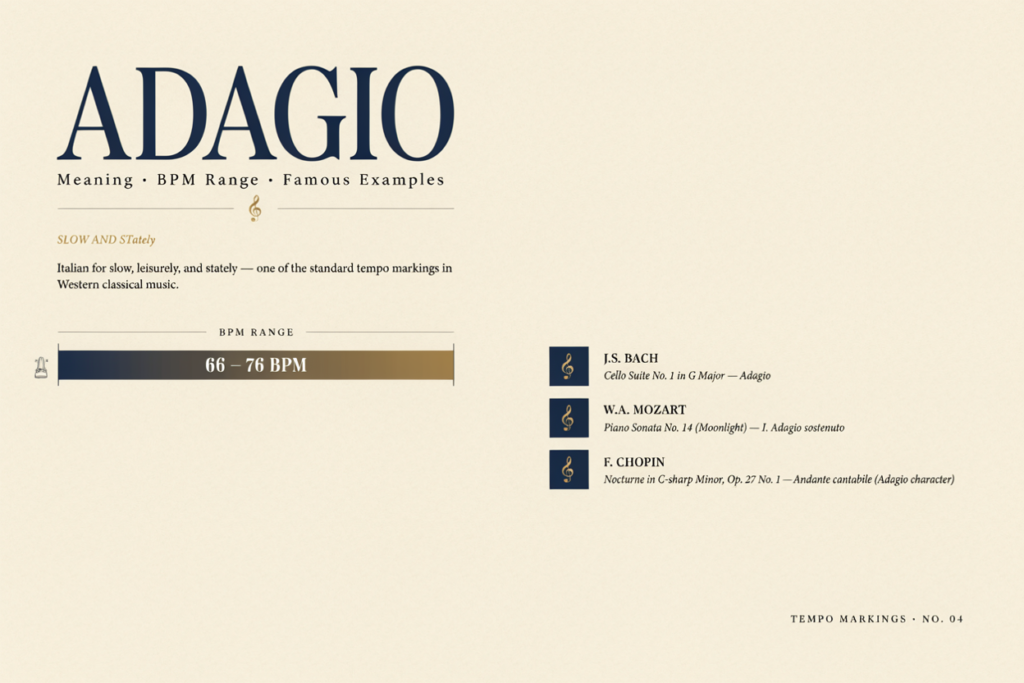
Adagio is an Italian tempo marking meaning “slowly,” often with a calm and expressive character. It is commonly associated with roughly 44–66 BPM, but the correct tempo depends on the beat unit, meter, style, and phrasing of the piece.
What Does Adagio Mean in Music?
Adagio tells musicians to perform at a slow, controlled pace. It often suggests spacious phrasing, sustained tone, and expressive weight rather than simply reducing speed.
The word belongs to the traditional system of Italian tempo markings used in written music. These markings can guide both pace and character.
What Is the Literal Meaning of Adagio?
Adagio is usually translated as “slowly” or “at ease.”
In performance, the marking suggests an unhurried tempo that leaves room for long phrases, careful articulation, and expressive shaping.
Is Adagio Only a Speed Marking?
Adagio primarily indicates tempo, but it often carries a character as well.
A slow pace can create calmness, breadth, tenderness, solemnity, or tension. Adagio does not automatically mean sad, quiet, or lifeless.
What BPM Is Adagio?
Adagio is commonly associated with approximately 44–66 BPM. This range is a reference, not a universal rule.
| Adagio Setting | General Impression |
|---|---|
| 44 BPM | Very broad and spacious |
| 50 BPM | Slow and controlled |
| 56 BPM | Flowing but unhurried |
| 60 BPM | One beat per second |
| 66 BPM | Upper edge approaching Adagietto or Andante |
The guide to reading tempo markings explains why verbal directions and metronome numbers must be interpreted together.
Why Adagio BPM Ranges Differ
Tempo-word ranges vary across composers, editors, performers, and historical periods. Meter, note density, articulation, and performance tradition also affect perceived speed.
What Note Value Receives the Beat?
A metronome number is incomplete unless the score identifies the beat unit.
For example:
- Quarter note = 56 BPM
- Half note = 56 BPM
- Dotted quarter = 56 BPM
Each marking produces a different subdivision speed and sense of motion.
The broader relationship between pulse and musical pace is covered in the guide to tempo in music.
How Should You Play Adagio?
Maintain a slow, stable pulse while shaping long phrases and preserving forward motion. The music should feel spacious without becoming disconnected.
Identify the Meter and Beat Unit
Check the time signature before choosing a tempo.
In 4/4, the quarter note may receive the beat. In 6/8, the dotted quarter often acts as the main pulse. The same BPM number can therefore produce very different results.
Think in Longer Phrases
Slow music can become fragmented if you focus on one note at a time.
Listen for the direction of the entire phrase. Identify where it begins, where it grows, and where it resolves.
Preserve Forward Motion
Adagio should move toward cadences, climaxes, and phrase endings.
Long notes still need support and direction.
Use Rubato Carefully
Rubato is expressive flexibility around an underlying pulse.
A performer may stretch or compress time slightly, but rubato should shape the phrase rather than erase the beat.
How Is Adagio Different From Other Slow Tempo Markings?
Slow Italian tempo terms overlap, and their exact meaning depends on context.
| Tempo Marking | Approximate Meaning | Common Reference BPM |
| Largo | Slow and broad | About 40–66 |
| Lento | Slow | About 40–60 |
| Adagio | Slowly, often expressively | About 44–66 |
| Adagietto | Slightly faster than Adagio | About 46–80 |
| Andante | At a walking pace | About 56–108 |
Adagio Versus Largo
Largo usually emphasizes breadth and expansiveness. Adagio often suggests slow, expressive motion.
Their ranges overlap, so character and phrasing often matter more than the numbers. See the guide to Largo tempo.
Adagio Versus Lento
Lento directly emphasizes slowness.
Adagio may carry a stronger implication of ease, expressiveness, or sustained phrasing, although interpretation still depends on the score.
Adagio Versus Adagietto
Adagietto generally means slightly faster or lighter than Adagio, though usage varies.
Adagio Versus Andante
Andante usually has a clearer walking motion and more forward movement.
Adagio is generally slower and broader. For comparison, see the guide to Andante tempo.
What Do Combined Adagio Markings Mean?
Adagio can appear with additional Italian words that refine its character.
Adagio Cantabile
Adagio cantabile means slowly and in a singing style.
The performer should aim for connected phrasing, smooth tone, and a vocal sense of line.
Adagio Sostenuto
Adagio sostenuto means slowly and sustained.
Notes and phrases should remain supported, connected, and controlled without losing the underlying pulse.
Adagio Molto
Adagio molto means very slowly.
The final tempo still depends on the composition.
Adagio Ma Non Troppo
Adagio ma non troppo means slowly, but not excessively so.
The phrase warns the performer not to make the tempo so broad that the music becomes heavy or disconnected.
How Do You Set a Metronome for Adagio?
When no exact marking is supplied, start near 52–56 BPM and adjust after playing a complete phrase.
A general introduction to the device is available in the guide to what a metronome is.
Check the Note Value
Identify whether the BPM applies to a quarter note, eighth note, half note, or dotted quarter.
This is especially important in 6/8 time, where the dotted quarter commonly receives the main beat.
Practise Subdivisions
Slow clicks can leave large spaces between beats.
Count or play eighth-note and sixteenth-note subdivisions to prevent dragging. The subdivisions should support the pulse without making the performance rigid.
Test a Full Phrase
Use an online metronome and play more than one measure.
A tempo that feels comfortable at first may become too broad across a full phrase.
Adjust in Small Steps
Change the setting by 2–4 BPM.
Choose the tempo that allows clear tone, controlled breathing, accurate rhythm, and natural phrase direction.
How Does Time Signature Affect Adagio?
The same Adagio BPM can feel different in different meters.
Adagio in 4/4
In 4/4, the music may contain four slow quarter-note beats per measure.
Performers may think in larger half-measure or full-measure phrases to keep the line moving.
Adagio in 3/4
In 3/4, the music has three beats per measure.
Avoid giving every beat equal weight. The first beat usually carries the strongest accent, while beats two and three continue the phrase.
Adagio in 6/8
In 6/8, the dotted quarter often receives the beat.
This creates two broad compound pulses, each divided into three eighth notes. Counting all six subdivisions can help at very slow tempos.
Why Is Slow Music Difficult to Play?
Adagio exposes timing, tone, intonation, breath control, balance, and phrase shape more clearly than faster music.
Maintaining a Stable Pulse
Performers may drag during long notes or rush through ornaments and difficult transitions.
Subdividing mentally helps maintain continuity between slow beats.
Supporting Long Notes
Singers and wind players need controlled breath. String players need balanced bow speed and pressure. Pianists need careful tone, voicing, and pedal control.
The challenge is to sustain the sound without losing direction.
Connecting the Phrase
Slow music should sound like a continuous line rather than separate events.
Listen beyond each note and aim toward the next harmonic or melodic goal.
Common Mistakes When Interpreting Adagio
Common mistakes include treating 44–66 BPM as an absolute rule, ignoring the beat unit, and playing so slowly that the phrase falls apart.
Other errors include confusing slow with quiet, giving every beat equal weight, using rubato without an underlying pulse, and assuming Adagio must always sound sad.
A convincing interpretation balances slowness, clarity, tone, structure, and expression.
Frequently Asked Questions
What does Adagio mean in music?
Adagio means “slowly” or “at ease.” It usually indicates a slow tempo with an expressive, spacious character.
What BPM is Adagio?
Adagio is commonly placed around 44–66 BPM. The correct setting depends on the beat unit, meter, style, and phrasing.
Is Adagio slower than Andante?
Usually, yes. Adagio is generally slower and broader, while Andante has a more walking-like motion.
Is Adagio slower than Largo?
Not always. Their ranges overlap, and Largo often emphasizes breadth while Adagio emphasizes slow expressive motion.
What does Adagio cantabile mean?
It means slowly and in a singing style. The performer should use connected phrasing and a lyrical tone.
How should I set a metronome for Adagio?
Start near 52–56 BPM when no exact marking is given. Check the beat unit, play a complete phrase, and adjust by 2–4 BPM until the music feels clear and connected.

Olivia Carter is a music technology writer and rhythm analysis specialist at Tempo Finder. She focuses on tempo detection, BPM analysis, beat matching, rhythm tools, and music production workflows for DJs, producers, musicians, and beginners. Olivia creates practical, easy-to-understand content around tempo finding, beat synchronization, metronomes, DJ transitions, and audio timing to help creators improve workflow, accuracy, and musical performance.