
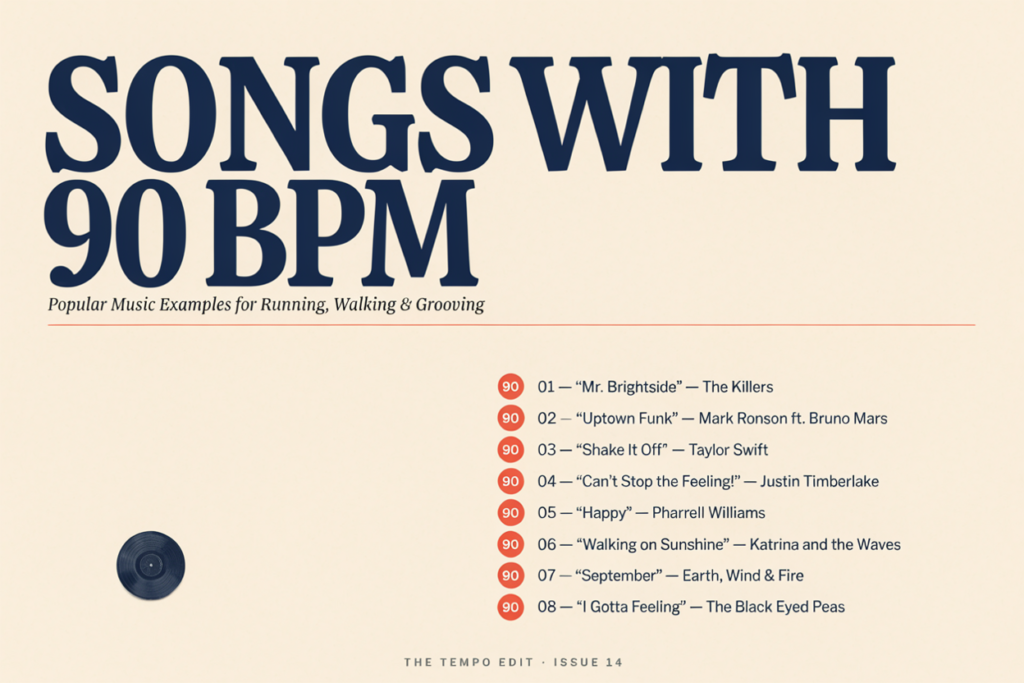
Songs with 90 BPM offer a relaxed yet steady groove that works across hip-hop, pop, rock, R&B, and electronic music. This tempo is popular because it’s comfortable to listen to, easy to walk to, and ideal for practicing with a metronome. While some databases list slightly different BPM values for the same song, many well-known tracks fall at or very close to 90 BPM.
If you want to verify a song’s tempo yourself, you can use a BPM finder instead of relying on a single online database.
Popular Songs With 90 BPM
The following songs are commonly reported as being at or very close to 90 BPM. Small differences may exist between BPM databases due to different analysis methods, tempo rounding, or whether the song is interpreted in half-time or double-time.
| Song | Artist | BPM* | Genre |
|---|---|---|---|
| Still D.R.E. | Dr. Dre ft. Snoop Dogg | 90 | Hip-Hop |
| Stereo Hearts | Gym Class Heroes ft. Adam Levine | 90 | Pop Rap |
| Demons | Imagine Dragons | 90 | Alternative Rock |
| Nights | Frank Ocean | 90 | R&B |
| Roar | Katy Perry | 90 | Pop |
| Headlines | Drake | 90 | Hip-Hop |
| God’s Plan | Drake | 90 | Hip-Hop |
| Money Trees | Kendrick Lamar | 90 | Hip-Hop |
| XO Tour Llif3 | Lil Uzi Vert | 90 | Hip-Hop |
| No Role Modelz | J. Cole | 90 | Hip-Hop |
*Reported BPM may vary slightly depending on the analysis source.
Songs Close to 90 BPM
Many tracks fall within a few beats of 90 BPM while maintaining a similar musical feel.
| BPM | Feel |
|---|---|
| 88 BPM | Slightly slower and more laid back |
| 89 BPM | Relaxed groove |
| 90 BPM | Balanced and steady |
| 91 BPM | Slightly more energetic |
| 92 BPM | Noticeably more driving |
Because tempo differences of one or two BPM are subtle, many DJs and musicians treat songs between 88–92 BPM as compatible.
If you’re looking for slower or faster alternatives, you can also explore our guides to songs around 80 BPM or songs around 100 BPM.
What Does 90 BPM Feel Like?
At 90 beats per minute, each beat lasts approximately 0.667 seconds.
Here are some useful note values:
| Note Value | Duration |
|---|---|
| Quarter Note | 667 ms |
| Half Note | 1,333 ms |
| Eighth Note | 333 ms |
| Sixteenth Note | 167 ms |
This moderate pace creates a rhythm that’s easy to follow without feeling rushed. It’s one reason why producers frequently choose 90 BPM for groove-oriented music.
To better understand how beats per minute work, read our guide explaining what BPM means.
Why Is 90 BPM So Popular?
Several musical styles naturally sit around this tempo.
Hip-Hop
Classic boom-bap, trap, and modern rap often use tempos between 85 and 95 BPM because they leave room for lyrical delivery while maintaining a strong rhythmic pocket.
Pop
Many pop songs use 90 BPM when they want a relaxed groove instead of a dance-focused energy.
R&B
Smooth vocal phrasing often benefits from moderate tempos where melodies have room to breathe.
Alternative Rock
Rock bands sometimes use 90 BPM for emotional ballads and mid-tempo anthems that emphasize atmosphere over speed.
Great Uses for a 90 BPM Playlist
A playlist around 90 BPM works well in many situations.
Walking
Many people naturally walk at a cadence close to this tempo, making these songs feel comfortable without encouraging a sprint.
Music Practice
Practicing scales, chords, or rudiments at 90 BPM helps develop timing while remaining manageable for beginners.
An online metronome makes it easy to lock into this pulse during practice sessions.
Music Production
Producers often begin songwriting around 90 BPM because it’s flexible enough for hip-hop, pop, indie, and R&B productions.
DJ Mixing
Since many songs fall near this tempo, DJs can create smooth transitions without large tempo adjustments.
Why Different Websites Show Different BPM Values
You may notice that one website lists a song at 90 BPM while another reports 180 BPM or 89 BPM.
This usually happens for three reasons.
Half-Time vs. Double-Time
Some rhythms can be counted in two equally valid ways.
For example:
- 90 BPM
- 180 BPM
Both may describe the exact same recording depending on which beat is counted.
Tempo Detection Algorithms
Different BPM analyzers use different detection methods, producing slight variations.
Human Performance
Live drummers rarely maintain mathematically perfect timing throughout an entire recording. Small fluctuations can influence automated tempo detection.
If you’d like to verify a track yourself, our guide on how to find the BPM of a song explains several reliable methods.
90 BPM Compared With Other Common Tempos
| Tempo | Typical Feel |
|---|---|
| 80 BPM | Slow and relaxed |
| 90 BPM | Steady and groovy |
| 100 BPM | More energetic |
| 110 BPM | Upbeat pop |
| 120 BPM | Dance-friendly |
If you’re unsure whether BPM and tempo mean the same thing, our comparison of BPM vs. tempo explains the differences.
Tips for Practicing at 90 BPM
If you’re learning an instrument or improving your timing, try these ideas:
- Play scales using quarter notes.
- Practice eighth-note subdivisions.
- Alternate between quarter notes and syncopated rhythms.
- Record yourself while playing with a metronome.
- Gradually increase the tempo after achieving consistent accuracy.
Starting at 90 BPM provides enough space to focus on precision while still developing rhythmic consistency.
Frequently Asked Questions
Are songs with exactly 90 BPM common?
Yes. Many hip-hop, pop, and R&B songs are produced at or very close to 90 BPM because it provides a balanced, comfortable groove. Exact values may differ slightly between BPM databases.
Is 90 BPM considered slow?
Not really. It falls into a moderate tempo range that feels relaxed without becoming sluggish. Many listeners perceive it as a natural walking pace.
Why do some websites say a song is 180 BPM instead of 90 BPM?
Many songs can be counted in either half-time or double-time. A track reported as 180 BPM may have the exact same rhythmic feel as one listed at 90 BPM.
Can I practice guitar or piano at 90 BPM?
Absolutely. Many teachers recommend starting around 90 BPM because it’s fast enough to build rhythm while remaining slow enough to maintain accuracy.
How can I check a song’s BPM myself?
You can tap along using a Tap Tempo tool or analyze the recording with a BPM detector. Using multiple methods is often the best way to confirm the tempo.
Is 90 BPM good for workouts?
Yes. It works particularly well for walking, mobility sessions, light cardio, warm-ups, and strength training where controlled movement is more important than maximum intensity.

Olivia Carter is a music technology writer and rhythm analysis specialist at Tempo Finder. She focuses on tempo detection, BPM analysis, beat matching, rhythm tools, and music production workflows for DJs, producers, musicians, and beginners. Olivia creates practical, easy-to-understand content around tempo finding, beat synchronization, metronomes, DJ transitions, and audio timing to help creators improve workflow, accuracy, and musical performance.