
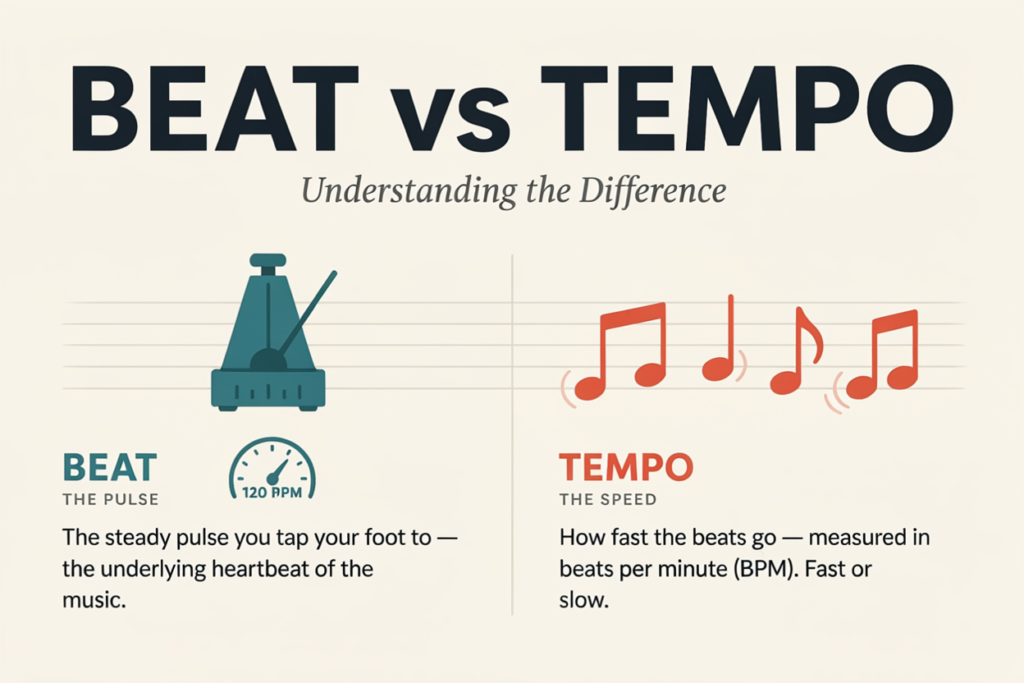
A beat is the steady pulse you count or tap along with in music, while tempo is the speed at which that pulse moves. Tempo is usually measured in beats per minute, or BPM, so a track at 120 BPM has 120 counted beats every minute.
Think of a clock: each tick acts like a beat, and the rate of ticking is the tempo. The beat gives music a regular reference point, while tempo tells you whether that reference point is moving slowly or quickly.
For a broader explanation of musical speed, see this guide to tempo in music.
Beat Is the Pulse You Follow
The beat is the repeating pulse underneath the music. It is what you follow when you nod your head, clap, or count “1, 2, 3, 4.”
A beat does not have to be played by one instrument on every pulse. Drums, bass, and melody may all help imply it.
Tempo Is the Speed of That Pulse
Tempo describes how quickly or slowly the beats occur. At 60 BPM, one beat occurs every second. At 120 BPM, two beats occur every second.
The count may still be “1, 2, 3, 4,” but the space between each number becomes shorter as the tempo increases. Tempo may be shown as a BPM value or with a traditional marking such as Largo, Andante, Allegro, or Presto. The guide to what BPM means explains the numerical side in more detail.
Beat vs Tempo at a Glance
| Feature | Beat | Tempo |
|---|---|---|
| Meaning | The steady musical pulse | The speed of the pulse |
| What you experience | The points you tap or count | How quickly you tap or count |
| Measurement | Counted as recurring pulses | Measured in BPM |
| Example | “1, 2, 3, 4” | 60 BPM or 120 BPM |
| Related concepts | Meter, downbeat, subdivision | BPM, tempo markings, accelerando |
A Simple 4/4 Example
Imagine counting four evenly spaced beats:
1, 2, 3, 4
Those four counts are the beats. Count them slowly and you have a slow tempo. Count the same numbers twice as quickly and the beat structure remains the same while the tempo becomes faster.
The time signature tells you how beats are grouped. In 4/4 time, there are four quarter-note beats in each measure. It does not tell you how quickly those beats should be played. That distinction is covered further in the guide to musical time signatures.
What Changes When BPM Changes?
| Tempo | Approximate spacing | General feel |
| 60 BPM | 1 second per beat | Slow and spacious |
| 90 BPM | 0.67 seconds per beat | Moderate |
| 120 BPM | 0.5 seconds per beat | Energetic |
The beat count remains unchanged, but the spacing between beats changes.
How Do Beat, Rhythm, and Tempo Work Together?
Beat provides the steady pulse, rhythm organizes sounds and silences around that pulse, and tempo controls how quickly the full pattern unfolds.
Beat vs Rhythm
The beat is regular and repeating. Rhythm is the changing pattern created by note lengths, rests, accents, and subdivisions.
You might tap a steady beat with your foot while clapping a more complex rhythm with your hands. Notes may fall on, between, or across beats.
For a focused comparison, see how rhythm differs from tempo.
Tempo vs Rhythm
Tempo changes the speed of a rhythm without necessarily changing its structure. A drummer can play the same kick-and-snare pattern at 80, 100, or 120 BPM.
The note placement stays the same, but the pattern takes less time to complete at a faster tempo.
Where Meter Fits
Meter organizes beats into recurring groups. In 3/4 time, beats are commonly grouped in threes. In 4/4 time, they are grouped in fours. In 6/8 time, musicians often feel two main pulses, each divided into three eighth notes.
Meter explains how beats are grouped, tempo explains how quickly the groups pass, and the beat is the pulse being grouped.
Why Is the Word “Beat” Sometimes Confusing?
The word “beat” can refer to the underlying pulse, a drum pattern, a produced instrumental, or a particular level of counting.
Beat as an Underlying Pulse
In music theory, beat usually means the regular pulse used to measure musical time. It is the reference point used for counting rhythms and following a conductor or metronome.
Beat as a Drum Pattern
In production, “beat” may mean a drum groove or an entire instrumental backing track. This broader use refers to the arrangement rather than one recurring pulse.
Half-Time and Double-Time Counting
One person may hear a track at 70 BPM while another counts it at 140 BPM. Both values can describe the same timing relationship when one is exactly double the other.
The music does not physically change speed; only the chosen counting level changes. The distinction between numerical BPM and the broader idea of tempo is explained in BPM vs tempo.
Can Two Songs Have the Same Beat but Different Tempos?
Two songs can use similar rhythmic patterns or drum placements at different tempos. The pattern may remain recognizable, but one version unfolds more quickly.
Same Pattern, Different Speed
Consider a basic pattern with a kick on beats 1 and 3 and a snare on beats 2 and 4:
Kick, snare, kick, snare
At 70 BPM, the pattern feels slow and open. At 140 BPM, the same placement moves twice as quickly. The relationship between the drum hits stays the same even though the tempo changes.
Same BPM, Different Feel
Two tracks at the same BPM can still feel different because subdivision, accents, swing, instrumentation, and note density affect perceived speed. A sparse 100 BPM ballad may feel slower than a busy 100 BPM funk groove.
How Can You Identify the Beat and Tempo of a Song?
Find a pulse you can follow consistently, count how many pulses occur during a fixed period, and convert that count into BPM.
Find the Steady Pulse
Listen for a repeating point that feels comfortable to tap. A reliable pulse should still make sense when the drum pattern or melody changes.
Count Beats for 15 Seconds
Count the beats for 15 seconds and multiply the result by four. If you count 25 beats:
25 × 4 = 100 BPM
Counting for 30 seconds and multiplying by two can improve accuracy. The full method is explained in how to find a song’s BPM.
Confirm the Result
A tap tempo counter estimates BPM from repeated taps. You can also use an online metronome and adjust it until the clicks stay aligned for several measures.
Common Beat and Tempo Mistakes
More Notes Do Not Always Mean Faster Tempo
A musician can play many short notes between two beats. These smaller divisions are called subdivisions.
At the same tempo, one part might play quarter notes while another plays sixteenth notes. The second part sounds busier, but the BPM has not changed.
A Drum Hit Is Not Automatically a Beat
Drums often emphasize the pulse, but syncopated grooves deliberately place sounds between beats. The beat is the timing framework beneath the pattern, not every individual sound.
BPM May Be Counted Two Ways
A song listed at 70 BPM may also be analyzed at 140 BPM. To choose the more useful interpretation, listen to the snare placement, harmonic changes, and natural body movement. The best value is usually the one that makes the meter easiest to count.
Frequently Asked Questions
Is beat the same as BPM?
No. A beat is one pulse in the music, while BPM measures how many pulses occur in one minute. BPM is a tempo measurement, not the beat itself.
Does every song have a steady beat?
Most popular music has a clear or implied steady beat, but some music uses free timing, flexible phrasing, or changing meter. In those cases, the pulse may be difficult to identify or may not remain constant.
Can tempo change during a song?
Yes. Music can gradually speed up with an accelerando, gradually slow down with a ritardando, or switch suddenly to a new tempo.
Does a busier rhythm mean a faster tempo?
No. A rhythm can contain many subdivisions at a slow tempo. Note density affects how busy the music feels, while BPM describes the speed of the underlying pulse.
What is the difference between beat, tempo, and meter?
Beat is the recurring pulse, tempo is the speed of that pulse, and meter is the way beats are grouped into measures.

Olivia Carter is a music technology writer and rhythm analysis specialist at Tempo Finder. She focuses on tempo detection, BPM analysis, beat matching, rhythm tools, and music production workflows for DJs, producers, musicians, and beginners. Olivia creates practical, easy-to-understand content around tempo finding, beat synchronization, metronomes, DJ transitions, and audio timing to help creators improve workflow, accuracy, and musical performance.