
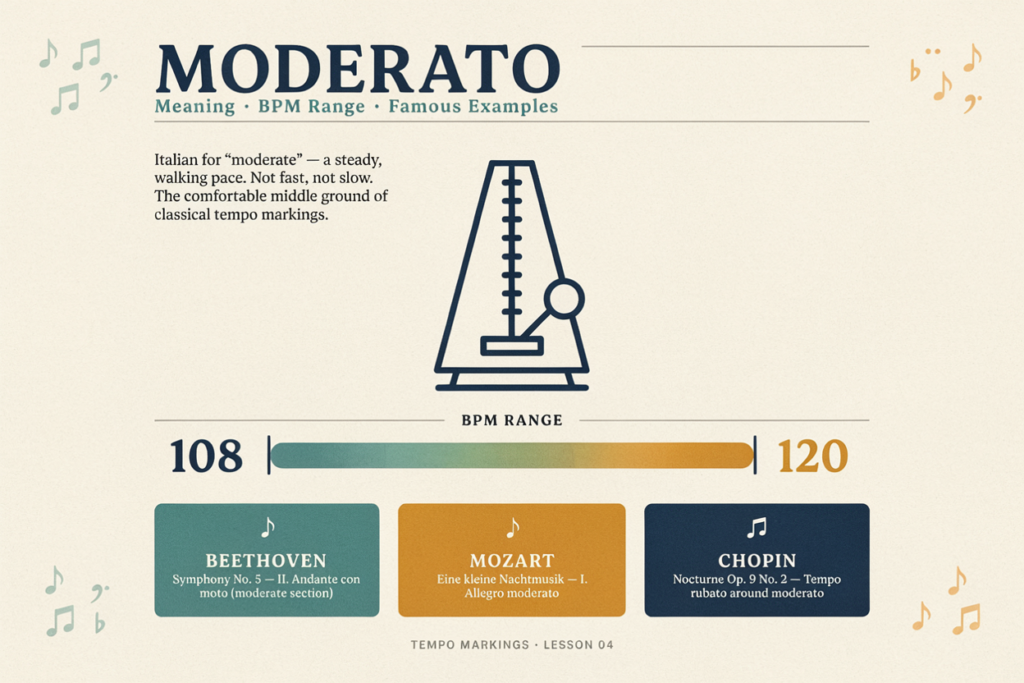
Moderato is an Italian tempo marking meaning “at a moderate speed.” It is commonly associated with roughly 108–120 BPM, although the correct performance tempo depends on the beat unit, meter, musical style, and character of the piece.
What Does Moderato Mean in Music?
Moderato tells musicians to play at a balanced, moderate pace. It is neither especially slow nor especially fast, and it usually suggests controlled forward motion.
The word belongs to the traditional system of Italian tempo markings used in written music. These terms guide speed, but they can also imply character and style.
What Is the Literal Meaning of Moderato?
Moderato means “moderately.”
In practice, it asks the performer to avoid both sluggishness and excessive speed. The music should move steadily while leaving enough room for clear phrasing, articulation, and expression.
Is Moderato a Speed or a Character?
Moderato primarily indicates tempo, but it can also suggest restraint and balance.
A piece marked Moderato should not sound mechanical or emotionally neutral. Dynamics, tone, articulation, and phrase shape still determine its character.
What BPM Is Moderato?
Moderato is commonly placed around 108–120 BPM. This range is a practical reference rather than a strict law.
Different tempo charts sometimes give slightly different values because Italian terms developed before modern metronome numbers became standard. Context matters more than a rigid boundary.
| Moderato Setting | General Impression |
|---|---|
| 108 BPM | Calm, measured forward motion |
| 112 BPM | Balanced moderate pace |
| 116 BPM | Lively but controlled |
| 120 BPM | Upper edge approaching Allegretto or Allegro |
The guide to reading tempo markings explains how verbal directions and metronome numbers work together.
Why BPM Ranges Differ
Tempo words have been interpreted differently across periods, composers, editors, and performance traditions.
A Moderato movement in a Classical-era work may not feel the same as a Moderato section in a modern film score. Note density, articulation, meter, and phrasing can also make the same BPM feel faster or slower.
What Note Value Receives the Beat?
A BPM number is incomplete unless you know which note value receives the beat.
For example:
- Quarter note = 112 BPM
- Half note = 112 BPM
- Dotted quarter = 112 BPM
These produce very different subdivision speeds.
The relationship between beat rate and musical pace is explained further in the guide to tempo in music.
How Do You Play a Piece Marked Moderato?
Establish a steady moderate pulse, then preserve the phrasing, dynamics, articulation, and musical character of the piece.
Identify the Time Signature
Check whether the music is in 4/4, 3/4, 6/8, or another meter.
A marking of 112 BPM in 4/4 may refer to quarter-note beats. In 6/8, the dotted quarter may receive the beat, producing two larger pulses per measure.
Start Near the Middle of the Range
When no exact metronome marking is given, try approximately 112–116 BPM as a starting point.
Play a complete phrase, not just one measure. Then decide whether the music feels rushed, heavy, unclear, or naturally balanced.
Adjust for Musical Character
A lyrical melody may need more space than a march-like passage. Dense technical writing may need a slightly slower setting, while light articulation may work closer to the upper end of the range.
The goal is not to force every Moderato piece into the same speed.
Avoid Mechanical Playing
Moderato does not require every beat to receive equal weight.
Natural phrase direction, breathing, rubato, articulation, and dynamic shaping may still be appropriate depending on the style.
How Is Moderato Different From Other Tempo Markings?
Moderato sits between slower walking tempos and faster lively tempos, but the ranges overlap.
| Tempo Marking | Approximate Meaning | Common Reference BPM |
| Andante | At a walking pace | About 76–108 |
| Andantino | Slightly faster than Andante in many contexts | About 80–108 |
| Moderato | Moderately | About 108–120 |
| Allegretto | Moderately fast | About 112–120 |
| Allegro | Fast and lively | About 120–156 |
These numbers are approximate and should not be treated as exact borders.
Moderato Versus Andante
Andante usually feels calmer and more walking-like. Moderato generally has stronger forward motion.
The guide to Andante tempo explains the slower marking in more detail.
Moderato Versus Allegretto
Moderato and Allegretto may overlap in BPM.
Allegretto often suggests a lighter or more animated character, while Moderato emphasizes balance and control.
Moderato Versus Allegro
Allegro is usually faster and more energetic.
A piece marked Moderato should generally feel more contained than one marked Allegro. For comparison, see the guide to Allegro tempo.
What Do Combined Moderato Markings Mean?
Moderato can modify another tempo term, refining its speed or character.
Allegro Moderato
Allegro moderato means moderately fast.
It suggests an Allegro that is held back from its fullest speed. The music should remain lively without becoming hurried.
Andante Moderato
Andante moderato suggests a moderate walking pace.
It is usually more active than a relaxed Andante but still calmer than a typical standalone Moderato or Allegro.
Marcia Moderato
Marcia moderato means a moderately paced march.
The pulse should remain clear and organized, but the tempo should not feel rushed.
Molto Moderato and Poco Moderato
Molto means “very,” while poco means “a little.”
Their exact effect depends on context. These modifiers should be interpreted with the surrounding score rather than translated into one fixed BPM.
How Do You Set a Metronome for Moderato?
Start around 112 BPM when no exact metronome mark is supplied, then adjust in small steps.
A general explanation of the device is available in the guide to what a metronome is.
Check the Beat Unit
Before setting the tempo, identify whether the score assigns the BPM to a quarter note, half note, dotted quarter, or another value.
This is especially important in compound meter. In 6/8 time, the dotted quarter often receives the main beat.
Test a Full Phrase
Use an online metronome and play a complete musical phrase.
A tempo that feels acceptable for one measure may make a longer phrase breathless, heavy, or technically unclear.
Adjust in Small Steps
Change the setting by 2–4 BPM.
Continue until the articulation remains clear, the phrasing feels natural, and the music has enough forward motion without sounding rushed.
How Does Time Signature Affect Moderato?
The same BPM can feel different depending on the meter and beat unit.
Moderato in 4/4
In 4/4, Moderato often means four steady quarter-note beats per measure.
At the upper end of the range, performers may feel the measure in two larger pulses while still respecting the four-beat structure.
Moderato in 3/4
In 3/4, the music has three quarter-note beats per measure.
The first beat usually carries the strongest accent, producing a flowing three-beat motion.
Moderato in 6/8
In 6/8, the dotted quarter often receives the beat.
That creates two main compound beats per measure, each divided into three eighth notes. The same displayed BPM may therefore feel very different from quarter-note Moderato in 4/4.
Common Mistakes When Interpreting Moderato
Common mistakes include treating 108–120 BPM as an absolute rule, ignoring the note value beside the metronome mark, and assuming moderate means emotionless.
Other errors include choosing the tempo from one difficult measure, playing every beat with equal weight, confusing Moderato with Allegretto, and ignoring the musical period or style.
A good interpretation balances speed, clarity, expression, and character.
Frequently Asked Questions
What does Moderato mean in music?
Moderato means “at a moderate speed.” It indicates a balanced tempo that is neither especially slow nor especially fast.
What BPM is considered Moderato?
Moderato is commonly associated with about 108–120 BPM. The correct setting still depends on the beat unit, meter, and musical context.
Is Moderato faster than Andante?
Usually, yes. Moderato generally has more forward motion than Andante, although their reference ranges can overlap.
Is Moderato slower than Allegro?
Usually, yes. Allegro is generally faster, brighter, and more energetic.
What does Allegro moderato mean?
Allegro moderato means moderately fast. It suggests an Allegro tempo performed with some restraint.
How should I set a metronome for Moderato?
Start near 112 BPM when no exact marking is provided. Check the beat unit, play a full phrase, and adjust by 2–4 BPM until the music feels balanced and clear.

Olivia Carter is a music technology writer and rhythm analysis specialist at Tempo Finder. She focuses on tempo detection, BPM analysis, beat matching, rhythm tools, and music production workflows for DJs, producers, musicians, and beginners. Olivia creates practical, easy-to-understand content around tempo finding, beat synchronization, metronomes, DJ transitions, and audio timing to help creators improve workflow, accuracy, and musical performance.