
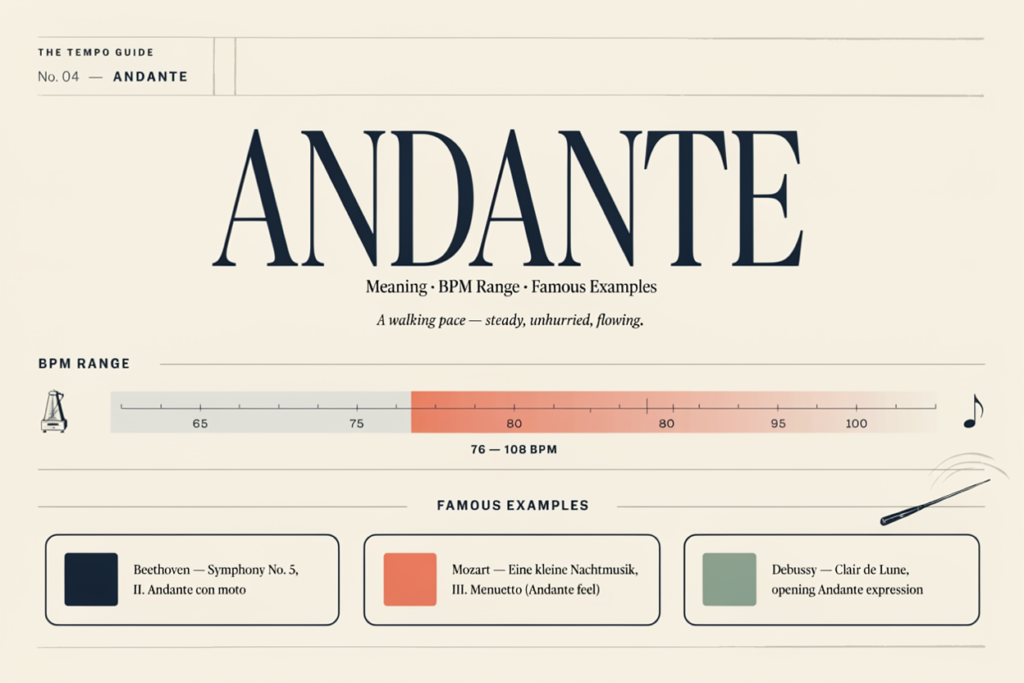
Andante is an Italian tempo marking meaning “at a walking pace.” It usually suggests a moderate, flowing speed rather than something very slow or very fast. Modern tempo charts often place Andante around 76–108 BPM, though context matters.
Think of a natural walking pace: steady, relaxed, and always moving forward.
What Does Andante Mean in Music?
Andante tells the performer to play at a moderate walking pace. It is one of the most common Italian tempo markings found in classical and modern notation.
The marking may appear alone or beside a metronome value. When both are present, the BPM gives a measurable speed while the word Andante shapes the character.
What Is the Literal Meaning of Andante?
The word comes from the Italian verb andare, meaning “to go” or “to walk.” In musical use, Andante suggests natural forward motion.
That does not mean every Andante passage should imitate literal footsteps. The idea is a comfortable, even pace that moves without dragging or rushing.
Is Andante a Tempo or a Character?
It functions as both. Andante identifies a moderate speed range, but it also suggests an easy, flowing character.
Two performers may choose different BPM values while preserving the same character.
Can Andante Be the Title of a Movement?
Yes. Composers often label a movement “Andante” when that tempo and character define the section.
The guide to reading tempo markings explains how words such as Andante work with note symbols, modifiers, and metronome numbers.
What BPM Is Andante?
Andante is commonly associated with approximately 76–108 BPM. Published ranges vary, so the number should be treated as a guide rather than a strict rule.
A marking such as:
Andante, ♩ = 84
means that the quarter note receives 84 beats per minute and the music should feel natural, flowing, and moderately paced.
Why Does the BPM Range Vary?
Italian tempo words developed before modern electronic metronomes. Their interpretation depends on context, including:
- Composer and historical period
- Time signature
- Note value receiving the beat
- Instrument or ensemble
- Phrase length
- Performance tradition
- Musical character
Does the Note Symbol Matter?
Yes. ♩ = 84 and 𝅗𝅥 = 84 do not create the same pulse.
At ♩ = 84, the quarter note receives the beat. At 𝅗𝅥 = 84, the half note receives the beat, so the smaller note values move more quickly relative to each click.
How Should Andante Feel?
Andante should feel steady, relaxed, and continuously moving forward.
Walking Pace, Not Dragging
The biggest mistake is treating Andante as very slow. It is usually more mobile than Adagio and should not sound heavy or hesitant unless the music specifically asks for that character.
Imagine a comfortable walk rather than a slow procession.
Smooth Musical Phrasing
Andante often supports long, lyrical phrases. Notes should connect across beats and bar lines so the listener hears complete musical sentences.
Breaths, bow changes, articulation, and pedal should support the phrase rather than interrupt it.
Natural Expression
Because Andante sits between slow and fast extremes, it gives performers room to shape dynamics, articulation, and rubato without losing pulse.
The broader guide to what tempo means explains why tempo includes both measurable speed and musical motion.
Emotional Character
Andante can sound calm, warm, reflective, graceful, pastoral, or gently expressive. The marking does not prescribe one emotion.
Harmony, register, orchestration, articulation, and dynamics determine the final mood.
How Is Andante Different From Other Tempo Markings?
Andante sits among the moderate tempo terms, between slower markings such as Adagio and faster ones such as Moderato or Allegretto.
| Marking | General Meaning | Relative Character |
|---|---|---|
| Largo | Very slow and broad | Spacious |
| Adagio | Slow and expressive | Calm and lyrical |
| Andante | Walking pace | Flowing and natural |
| Moderato | Moderate | Balanced and controlled |
| Allegretto | Moderately fast | Light and lively |
| Allegro | Fast | Energetic |
Andante vs Adagio
Adagio is generally slower and more relaxed than Andante. Adagio often emphasizes ease and lyricism, while Andante has a stronger sense of forward motion.
Andante vs Moderato
Moderato usually feels more neutral and controlled. Andante has the specific image of walking pace, while Moderato simply indicates a moderate speed.
Andante vs Largo
Largo is much slower and broader. Andante moves more naturally and usually has less spacious weight.
Andante vs Allegretto
Allegretto is lighter and quicker than Andante. It often feels playful or gently lively rather than calm and walking.
What Do Common Andante Variants Mean?
Modifiers refine the basic marking and change the way the tempo should feel.
Andante con moto
Andante con moto means walking pace with motion.
The phrase should remain moderate, but it needs more forward drive than plain Andante. The performer should avoid making it overly relaxed.
Andantino
Andantino is historically ambiguous. In some traditions it means slightly faster than Andante; in others, slightly slower.
The surrounding style, metronome marking, and composer’s usage are more reliable than the word alone.
Andante maestoso
Andante maestoso means a walking pace with a majestic character.
The tempo remains moderate, but articulation, weight, and phrasing should sound noble and dignified.
Andante sostenuto
Andante sostenuto suggests a sustained, supported walking pace. Long tones and phrases should remain connected and controlled.
How Does Time Signature Affect Andante?
Time signature changes how the pulse is grouped and perceived, even when the tempo word remains the same.
Andante in 4/4
In 4/4, Andante often feels like four comfortable quarter-note beats per measure. At a broader tempo, performers may feel two half-note pulses instead.
Andante in 3/4
In 3/4, the music has three beats per measure and may feel graceful, swaying, or gently dance-like.
The first beat usually has the strongest accent, but the phrase should continue through beats two and three.
Andante in 6/8
In 6/8, Andante may be felt as two dotted-quarter beats rather than six individual eighth notes.
This larger pulse often creates a flowing, rocking quality. The written note symbol determines which beat unit the metronome should follow.
How Do You Practise Andante?
Start by establishing a steady pulse, then focus on phrase shape and natural movement.
Use a Metronome
Set an online metronome to the written BPM or a comfortable practice tempo.
Listen for one or two measures before playing. Count aloud so you know where the main beats fall.
Avoid Starting Too Slowly
If the passage feels disconnected, the practice tempo may be too slow. Use subdivisions to keep the line moving rather than stretching every note.
Shape the Phrase
Mark cadences, breaths, harmonic changes, and dynamic peaks. Decide where the phrase is going instead of treating each beat separately.
Reduce Dependence on the Click
Once the pulse is stable, use fewer clicks or alternate between playing with and without the metronome.
The guide to using a metronome explains how to build an independent internal pulse.
Famous Examples of Andante
Many classical works contain movements or sections marked Andante. Mozart, Beethoven, Haydn, Schubert, and other composers frequently used the term for moderate movements with lyrical or reflective character.
Different performances of the same Andante movement may use noticeably different speeds. This does not automatically mean one is wrong.
The successful interpretation is the one that preserves the written structure, style, phrase direction, and natural walking motion.
Common Mistakes When Playing Andante
Common mistakes include playing too slowly, confusing Andante with Adagio, following a BPM number without shaping the phrase, and allowing the pulse to lose forward motion.
Other problems include excessive rubato, equal emphasis on every beat, and ignoring the note value in the metronome marking.
A successful Andante performance combines steady timing, natural flow, and expressive phrasing.
Frequently Asked Questions
What does Andante mean in music?
Andante means “at a walking pace.” It indicates a moderate, flowing tempo with steady forward movement.
What BPM is Andante?
Andante is commonly associated with about 76–108 BPM. The exact speed depends on the composer, meter, note value, style, and character.
Is Andante faster than Adagio?
Yes. Andante is generally faster and more mobile than Adagio.
What is the difference between Andante and Moderato?
Andante suggests a natural walking pace, while Moderato indicates a balanced moderate speed without the same walking image.
What does Andante con moto mean?
It means walking pace with motion. The music should remain moderate but have extra forward energy.
How do you pronounce Andante?
In English musical usage, it is commonly pronounced “ahn-DAHN-tay.”

Olivia Carter is a music technology writer and rhythm analysis specialist at Tempo Finder. She focuses on tempo detection, BPM analysis, beat matching, rhythm tools, and music production workflows for DJs, producers, musicians, and beginners. Olivia creates practical, easy-to-understand content around tempo finding, beat synchronization, metronomes, DJ transitions, and audio timing to help creators improve workflow, accuracy, and musical performance.