
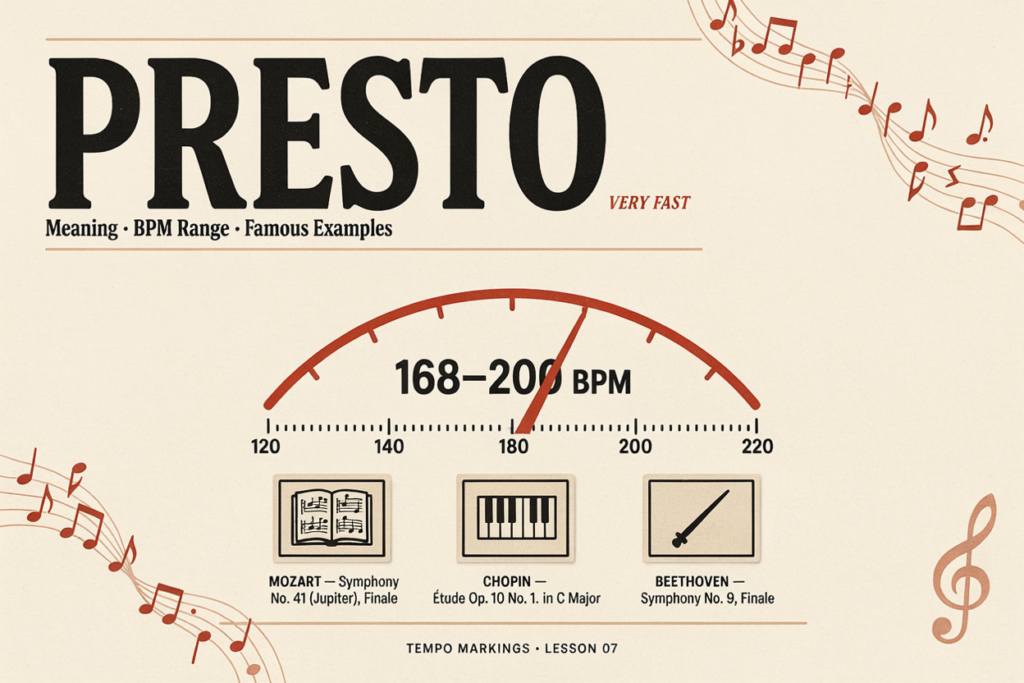
Presto is an Italian musical direction meaning very fast or quickly. It is commonly associated with about 168–200 BPM, although the exact speed depends on beat unit, meter, style, and context.
A convincing Presto performance should sound controlled, rhythmically clear, and musically shaped rather than rushed.
For a wider overview of these terms, see the guide to common tempo markings.
What Does Presto Mean in Music?
Presto means very fast in Italian. In a musical score, it tells the performer to use a rapid tempo while preserving clarity, phrasing, and control.
The word usually appears at the beginning of a movement or section, though it can also signal a sudden increase in speed.
Understanding what tempo means in music helps explain why Presto is not just a number. Traditional tempo words communicate both speed and character, while a metronome marking gives a more exact pulse.
What Is the Literal Meaning of Presto?
The literal Italian meaning of Presto is quickly, promptly, or very fast. In music, the word normally points to a rapid, urgent, or highly animated pace.
The exact character depends on the composition: a Presto finale may sound joyful, while a storm scene may sound dramatic.
Does Presto Describe Mood or Only Speed?
Presto primarily describes speed, but musical context still shapes the mood. Articulation, dynamics, orchestration, harmony, and rhythm determine whether the result feels playful, aggressive, elegant, or intense.
A light Presto may use crisp staccato notes, while a dramatic one may use strong accents and dense rhythmic motion.
What BPM Is Presto?
Presto is commonly placed around 168–200 BPM. This range is a practical modern reference rather than an official universal standard.
Some charts use a narrower range, while others allow Presto to extend slightly lower or higher. The correct performance tempo should come from the score, musical style, conductor, and intended character.
Why Do Presto BPM Ranges Differ?
Tempo charts differ because Italian markings were never designed as exact mathematical categories. They developed as expressive instructions long before composers regularly added precise metronome numbers.
Different publishers divide the tempo spectrum differently. One chart may begin Presto at 168 BPM, while another may reserve it for a slightly faster range. Performers should therefore use BPM ranges as guides rather than strict boundaries.
How Does the Beat Unit Affect Presto?
The beat unit determines which note value receives the BPM number. Quarter note = 180 means 180 quarter-note beats occur each minute. Dotted quarter note = 180 creates a different rhythmic structure because each beat contains three eighth notes.
Meter also affects how the music is felt. In a fast 6/8 passage, musicians may count two large beats per measure instead of six separate eighth notes.
Before choosing a speed, identify the main pulse and learn how to read tempo markings together with the time signature.
Presto vs Allegro vs Vivace vs Prestissimo
Presto is generally faster than Allegro and Vivace, while Prestissimo is faster than Presto. Their estimated BPM ranges can overlap because the terms also describe musical character.
| Tempo marking | Common reference range | General meaning |
|---|---|---|
| Allegro | 120–156 BPM | Fast and bright |
| Vivace | 156–176 BPM | Lively and spirited |
| Presto | 168–200 BPM | Very fast |
| Prestissimo | 200 BPM and above | Extremely fast |
These figures are approximate. A composer’s own metronome marking, when provided, should take priority over a general chart.
Is Presto Faster Than Vivace?
Presto is usually faster than Vivace. Vivace emphasizes a lively, animated character, while Presto gives a stronger instruction for very rapid speed.
Their ranges may overlap near 168–176 BPM. A movement marked Vivace at 172 BPM and another marked Presto at the same number can still require different articulation and phrasing.
The full Vivace tempo explanation shows how its lively character differs from the more speed-focused Presto marking.
Is Presto Faster Than Allegro?
Yes. Allegro normally means fast and bright, but Presto indicates a more extreme level of speed.
Allegro covers a wide range and appears frequently in symphonies, sonatas, concertos, and popular teaching pieces. Presto is more likely to be reserved for finales, rapid transitions, virtuosic sections, or moments of heightened excitement.
For a direct comparison, see the guide to Allegro in music.
What Is Faster Than Presto?
Prestissimo is the traditional marking above Presto. It means extremely fast or as fast as possible within musical and technical control.
Prestissimo is often placed at 200 BPM or above in modern charts, though the actual result still depends on the beat unit and musical context.
How Is Presto Used in Musical Scores?
Presto can appear as a main tempo marking, a movement title, or part of a longer instruction. The surrounding words refine how the speed should feel.
Presto as a Movement Title
Classical movements are often identified by their opening tempo directions, so a finale may simply be called “Presto.”
Vivaldi’s “Summer” from The Four Seasons ends with a famous Presto movement that depicts a violent storm through rapid scales, repeated notes, and forceful rhythmic motion. The marking supports both the speed and the dramatic effect.
Presto With Modifying Words
Composers often combine Presto with additional Italian terms:
- Presto agitato means very fast and agitated.
- Presto con fuoco means very fast with fire or intensity.
- Presto ma non troppo means very fast, but not excessively so.
- Presto possibile suggests as fast as practically possible.
Each modifier changes the expressive target, so BPM alone is not enough.
How Should You Practice a Presto Passage?
Practice a Presto passage slowly enough to maintain accuracy, then increase the speed in small steps. Efficient movement, clear beat grouping, and physical relaxation matter more than forcing the final tempo immediately.
Begin Below Performance Tempo
Start at a speed where every note, rest, fingering, and articulation is dependable. This may be 50–70% of the target tempo.
Work in short sections and raise the metronome by two to five BPM after accurate repetitions. If tension returns, reduce the tempo.
A reliable online metronome makes these small increases easier to manage.
Group Notes Around the Main Beat
Fast passages become more manageable when notes are grouped around beats, phrases, or harmonic changes. Thinking about each individual note can overload attention and make the performance sound rigid.
Practice with a slight accent on the beginning of each group. Remove the artificial accent later while keeping the internal organization.
Reduce Unnecessary Movement and Tension
Excess movement wastes time at fast tempos. Instrumentalists should look for oversized finger, hand, or arm motions, while singers should avoid tightening the jaw, tongue, neck, or breath.
Stop when tension appears. Repeating a tense motion at higher speed usually makes it less reliable rather than more secure.
Understanding how a metronome works can also help you separate steady tempo practice from uncontrolled acceleration.
Why Should Presto Not Sound Rushed?
Presto should sound fast, but it should not sound unstable. A rushed performance loses pulse, articulation, phrase direction, or coordination because the player is moving faster than the music can be controlled.
Keep Rhythm and Articulation Clear
Short notes must remain distinct, and longer notes must receive their full rhythmic value. Performers should listen for clipped endings, uneven subdivisions, and unintended tempo changes.
The fastest acceptable tempo is the speed at which the details still communicate clearly.
Preserve Musical Phrasing
Fast notes still belong to larger phrases. Dynamics, harmonic direction, accents, and cadences should remain audible even when the surface rhythm is dense.
A strong Presto performance gives the listener both excitement and structure. Speed creates energy, while phrasing makes that energy meaningful.
Frequently Asked Questions
What BPM is Presto?
Presto is commonly associated with approximately 168–200 BPM. The exact tempo depends on the beat unit, meter, style, and any metronome marking supplied by the composer.
What does Presto mean in music?
Presto is an Italian tempo marking meaning very fast or quickly. It asks for rapid movement while preserving rhythm, articulation, and musical control.
Is Presto faster than Vivace?
Presto is generally faster than Vivace. Their BPM ranges can overlap, but Vivace emphasizes liveliness while Presto gives a stronger instruction for very fast speed.
What is faster than Presto?
Prestissimo is faster than Presto. It means extremely fast and is often placed at 200 BPM or above in modern reference charts.
Is 180 BPM considered Presto?
Yes. A tempo of 180 BPM falls within the commonly cited Presto range, though the beat unit and musical context still determine how fast the passage actually feels.
Can a modern song be described as Presto?
Yes. Although Presto is most common in classical notation, it can describe any modern track or section with a very fast musical pulse. Modern producers usually communicate that speed with an exact BPM value.

Olivia Carter is a music technology writer and rhythm analysis specialist at Tempo Finder. She focuses on tempo detection, BPM analysis, beat matching, rhythm tools, and music production workflows for DJs, producers, musicians, and beginners. Olivia creates practical, easy-to-understand content around tempo finding, beat synchronization, metronomes, DJ transitions, and audio timing to help creators improve workflow, accuracy, and musical performance.