
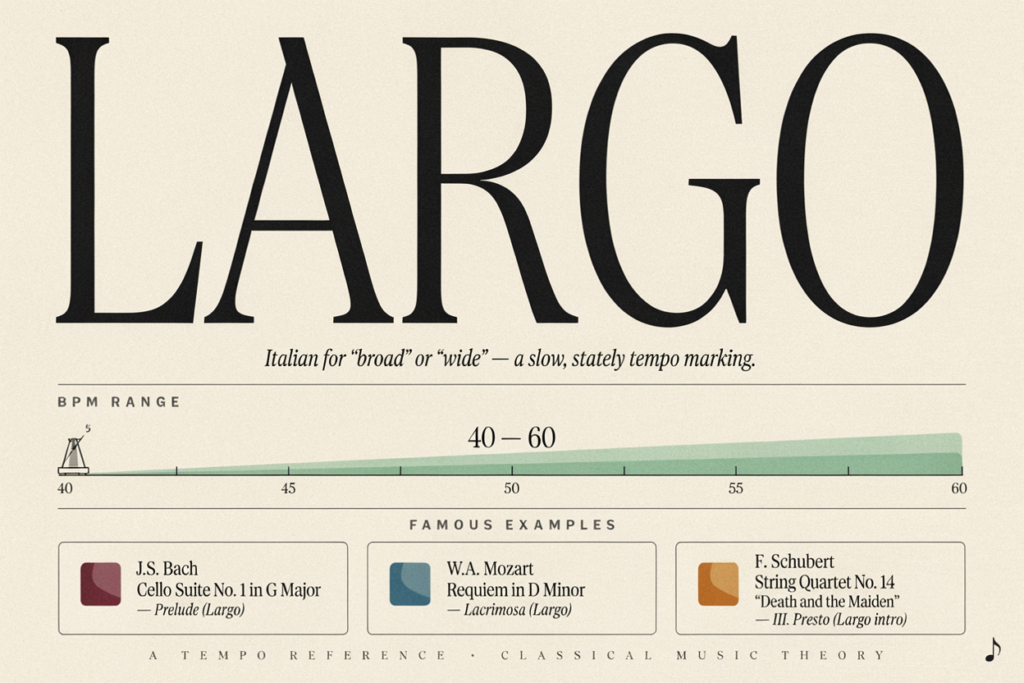
Largo is an Italian tempo marking meaning broadly and very slowly. It is commonly associated with roughly 40–66 BPM, but the exact speed depends on the meter, note value, composer, historical period, and musical character.
Largo also suggests spacious phrasing, sustained tone, and an unhurried sense of breadth.
What Does Largo Mean in Music?
Largo tells the performer to play very slowly and broadly. It is one of the best-known Italian tempo markings used in Western music notation.
It may appear alone or beside a metronome value, which gives the measurable pulse.
What Is the Literal Meaning of Largo?
In Italian, largo can suggest broad, wide, or spacious. In music, that idea becomes long phrasing, generous resonance, and room between musical gestures.
Largo should not mean “as slowly as possible”; the music still needs direction.
Is Largo a Tempo or a Musical Character?
It functions as both. Largo indicates a very slow general tempo, but it also asks for breadth.
Two performers may choose different BPM values while preserving the same broad character.
Can Largo Be the Name of a Movement?
Yes. Largo may appear as the title or tempo label of a movement.
The guide to reading tempo markings explains how words such as Largo combine with note symbols, BPM values, and modifiers.
What BPM Is Largo?
Largo is often placed around 40–66 BPM on modern tempo charts. Published ranges vary, so treat the number as a guide.
A marking such as:
Largo, ♩ = 48
means that the quarter note receives 48 beats per minute and the music should be played with a broad, spacious character.
Why Do Largo BPM Ranges Differ?
Tempo ranges vary because Italian markings developed before standardized electronic metronomes. Their meaning depends on context.
Factors that influence a Largo interpretation include:
- Historical period
- Composer and style
- Time signature
- Note value receiving the beat
- Instrument or ensemble
- Acoustics
- Phrase length
- Performance tradition
Does the Note Symbol Matter?
Yes. ♩ = 48 and 𝅗𝅥 = 48 do not create the same pulse.
At ♩ = 48, the quarter note receives the beat. At 𝅗𝅥 = 48, the half note receives the beat, so the smaller notes move twice as quickly relative to each click.
How Should Largo Feel?
Largo should feel spacious, controlled, and unhurried while maintaining a clear underlying pulse.
Broad Phrasing
Long phrases should move toward harmonic and melodic destinations rather than sounding isolated.
Sustained Tone
Slow music exposes tone quality. Singers need stable breath support, string players need controlled bow speed, pianists must manage decay and pedal, and wind players need carefully planned air.
Space Without Stagnation
A Largo performance can be spacious without becoming lifeless. The smaller subdivisions should remain internally active even when the listener hears a broad beat.
This is part of what tempo means in music: tempo is more than a speed setting.
Emotional Character
Largo is often associated with solemn, peaceful, noble, mournful, or expansive moods.
Harmony, articulation, register, instrumentation, and dynamics determine the final character.
How Is Largo Different From Other Slow Tempo Markings?
Largo belongs to a group of slow Italian markings, but each word carries a slightly different emphasis.
| Marking | General Meaning | Relative Character |
|---|---|---|
| Larghissimo | Extremely slow | Exceptionally broad |
| Largo | Very slow and broad | Spacious and expansive |
| Lento | Slowly | Direct emphasis on slowness |
| Adagio | Slow and at ease | Lyrical and expressive |
| Andante | At a walking pace | Flowing and mobile |
Largo vs Adagio
Largo emphasizes breadth and spaciousness. Adagio often suggests slowness with ease, lyricism, or expressive calm.
Their BPM ranges can overlap, so context matters.
Largo vs Lento
Lento means slowly. Largo also means very slowly, but its stronger expressive implication is broadness.
Largo vs Larghissimo
Larghissimo intensifies Largo. It is generally treated as extremely slow and exceptionally broad.
Largo vs Andante
Andante means at a walking pace and is usually more mobile than Largo. Largo feels broader and slower, while Andante typically has a clearer sense of forward movement.
Moderato is faster and suggests a controlled middle tempo.
How Does Time Signature Affect Largo?
Time signature changes how a Largo pulse is grouped and perceived. The same BPM can feel different in 4/4, 3/4, or 6/8.
Largo in 4/4
In 4/4, the performer may feel four quarter-note beats or two broader half-note beats per measure.
Largo in 3/4
In 3/4, three slow beats may create a stately, swaying, or solemn character.
Largo in 6/8
In 6/8, the music may be felt as two dotted-quarter beats rather than six separate eighth notes. This larger pulse can keep a slow passage flowing.
Why Slow Music May Use Larger Beats
Experienced performers often feel Largo in larger units, such as one pulse per half note or one pulse per measure.
Smaller subdivisions must remain active internally.
How Do You Practise a Largo Passage?
Begin by establishing the subdivision, then develop the broad phrase.
Establish the Smaller Pulse
Count eighth notes or another smaller unit before trying to feel only the large beat. This keeps entrances, rests, and sustained notes rhythmically connected.
Use an online metronome at the written beat value. If the tempo is extremely slow, temporarily set the click to a subdivision.
Plan the Phrase
Mark harmonic changes, breaths, and dynamic peaks before adding expressive freedom.
Reduce the Click Gradually
Once the rhythm is stable, use fewer metronome clicks.
The guide to using a metronome explains how to reduce dependence while strengthening internal pulse.
Keep Sustained Notes Alive
A long note should have direction. Shape its tone, balance, vibrato, resonance, or dynamic intensity instead of letting it become static.
Add Rubato Carefully
Rubato can stretch or compress time expressively, but it should not destroy the larger pulse or ensemble coordination.
Famous Examples of Largo in Music
Handel’s aria “Ombra mai fu” from Serse became widely known through arrangements often called “Handel’s Largo.”
The Largo movement from Dvořák’s Symphony No. 9, From the New World, is another famous example.
Performances of these works vary in duration and BPM. This shows why Largo cannot be reduced to one number.
Common Mistakes When Playing Largo
Common mistakes include playing so slowly that the pulse disappears, isolating every note, ignoring the written beat unit, and treating a BPM chart as an absolute command.
Other problems include confusing quiet with slow, excessive rubato, and weak subdivision.
A successful Largo combines steady timing with breadth and phrase shape.
Frequently Asked Questions
What does Largo mean in music?
Largo means very slowly and broadly. It describes both an approximate tempo and an expansive style of performance.
What BPM is Largo?
Largo is commonly associated with approximately 40–66 BPM. The actual speed depends on the note value, meter, composer, period, and musical context.
Is Largo slower than Adagio?
Largo is generally treated as slower and broader than Adagio, although their practical BPM ranges can overlap.
What is the difference between Largo and Lento?
Lento primarily means slowly. Largo also indicates slowness but more strongly suggests breadth and spaciousness.
How do you pronounce Largo?
In English musical usage, it is commonly pronounced “LAR-go.”
Can Largo be used as the title of a movement?
Yes. Largo may label a movement or be used as a noun for a piece or section performed in a Largo style.

Olivia Carter is a music technology writer and rhythm analysis specialist at Tempo Finder. She focuses on tempo detection, BPM analysis, beat matching, rhythm tools, and music production workflows for DJs, producers, musicians, and beginners. Olivia creates practical, easy-to-understand content around tempo finding, beat synchronization, metronomes, DJ transitions, and audio timing to help creators improve workflow, accuracy, and musical performance.