
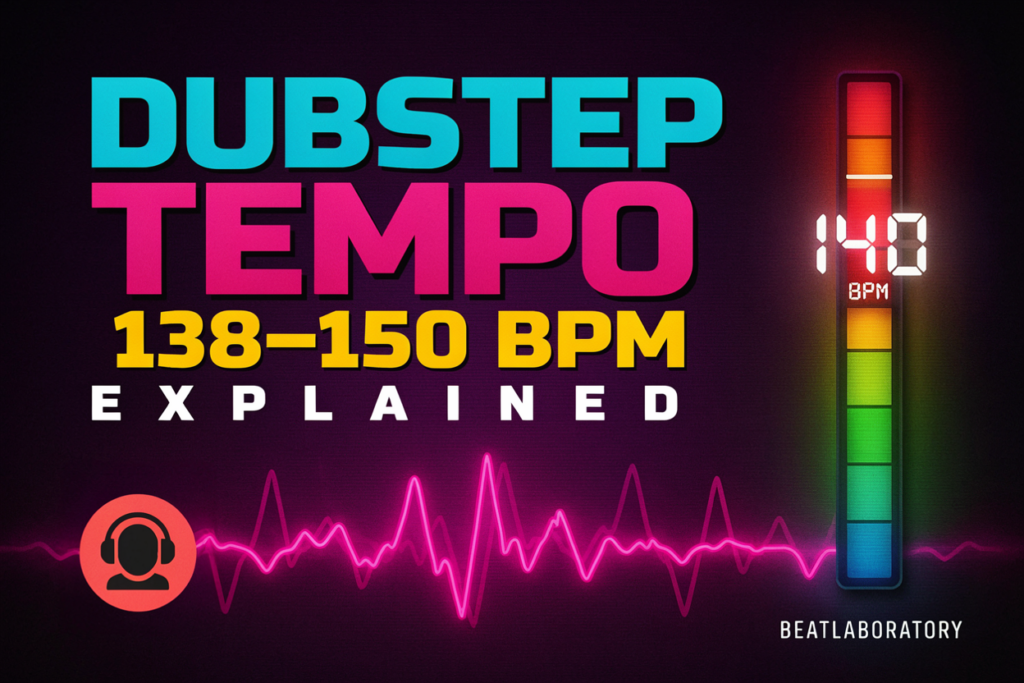
Dubstep is usually produced between 138 and 150 BPM, with 140 BPM serving as the genre’s most common reference point. That tempo supports the heavy half-time drum groove, spacious arrangement, and deep bass movement associated with classic and modern dubstep.
The genre may sound slower because producers often emphasize a half-time pulse closer to 70 BPM while the project remains at 140 BPM.
For a wider comparison of electronic styles, see this guide to typical BPM ranges by genre.
Why Is 140 BPM So Common?
Early UK dubstep developed around 140 BPM because the speed supported detailed percussion while leaving room for long sub-bass notes, delays, and dramatic gaps. That balance remains useful for producers and DJs today.
Can Dubstep Be Faster or Slower?
Yes. Tempo is a strong genre signal, but it is not a strict boundary. A track at 138 BPM may sound deep and spacious, while one at 150 BPM may feel sharper and more urgent.
The rhythmic structure, bass design, drum placement, and arrangement matter more than whether the project is set to one exact number.
Dubstep BPM Range at a Glance
| Tempo range | Typical feel | Common use |
|---|---|---|
| 138–140 BPM | Deep, spacious, traditional | UK dubstep, minimal and sub-heavy tracks |
| 141–145 BPM | Balanced and energetic | Modern dubstep, brostep, melodic styles |
| 146–150 BPM | Fast and aggressive | High-energy drops, riddim-influenced production |
| Above 150 BPM | Experimental or hybrid | Genre blends and unusually intense arrangements |
These categories overlap because subdivisions, accents, bass rhythms, and sound design can make tracks at the same BPM feel very different.
Why Does Dubstep Feel Slower Than 140 BPM?
Dubstep feels slower because its main drum accents are commonly arranged in half time. At 140 BPM, a half-time groove creates a perceived pulse of about 70 BPM while preserving the faster project grid for percussion, effects, and editing.
Understanding the difference between the underlying pulse and the measured speed is easier after reviewing how beat and tempo differ.
How Half-Time Drum Programming Works
Dubstep often leaves more space between major hits and places a strong snare on beat three. This broad spacing makes the rhythm feel heavy and slow even at 140 BPM.
Why Fast Details Still Fit the Groove
Sixteenth-note hats, percussion fills, bass modulation, and vocal chops add movement without changing the half-time feel. Large accents feel slow while smaller subdivisions sound fast.
Why Is Dubstep Sometimes Detected at 70 BPM?
A dubstep track at 140 BPM may be detected as 70 BPM because 70 is exactly half of 140. Automatic analyzers sometimes follow the slower perceived pulse instead of the faster production grid.
The relationship is:
70 × 2 = 140 BPM
Both readings are related, but 140 BPM is usually more practical for production, beat grids, effects, and mixing.
If an analyzer returns a suspiciously low number, compare it with the rhythm manually or use a BPM finder to check the audio again. You can also follow a manual process for finding a song’s BPM.
How Do Dubstep Subgenres Use Tempo?
Most dubstep subgenres share a similar BPM range and are distinguished more by sound design, drum texture, harmony, arrangement, and bass rhythm.
UK Dubstep
Traditional UK dubstep often stays near 140 BPM, using sparse drums, deep sub-bass, atmospheric textures, and negative space to create a slower, heavier feel.
Brostep
Brostep commonly sits around 140–145 BPM and uses aggressive midrange bass, dramatic builds, and dense drops that can feel faster than minimal UK dubstep.
Melodic Dubstep
Melodic dubstep often stays between roughly 140 and 150 BPM. Long chords, emotional vocals, and sustained melodies can soften the perceived speed, while the drums still provide a powerful half-time foundation.
Riddim
Riddim is frequently produced around 140 BPM and relies on repetitive bass patterns, strong downbeats, and carefully placed syncopation. Some producers use slightly faster settings, but the groove and sound design remain the main identifying features.
What Tempo Should You Use to Produce Dubstep?
A beginner can start at 140 BPM, then test nearby values. Try 138–140 BPM for a deeper feel, 142–145 BPM for more motion, and 146–150 BPM for a more aggressive result. The best setting is the one that makes the kick, snare, and bass groove feel natural.
Build the Core Drum Pattern First
Program the kick and snare before adding bass sounds and effects. Once the half-time groove works, add hats, ghost notes, percussion, and fills.
Test Several Nearby Tempos
Play the same loop at 138, 140, 142, and 145 BPM. Small changes can alter bass phrasing, vocal timing, swing, and the space between hits.
How Does Tempo Affect Dubstep Production?
Tempo affects note length, sample timing, bass envelopes, delay values, automation speed, and the amount of space between major drum accents.
At higher BPM values, each beat is shorter. Samples may need tighter editing, bass movements may need faster automation, and rhythmic effects may require different timing.
A BPM-to-milliseconds calculator can help you calculate quarter-note, eighth-note, and sixteenth-note delay values for a chosen project tempo.
Bass Design and Drop Energy
A heavy drop does not require constant bass notes. Strategic gaps can make each hit sound larger, while faster internal modulation adds motion inside the spacious half-time groove.
Arrangement and Contrast
Dubstep arrangements create energy by contrasting quiet breakdowns with dense drops. A sparse 145 BPM section may feel calmer than a densely programmed 140 BPM drop.
How Do DJs Mix Dubstep Tempos?
DJs usually mix dubstep by aligning nearby tempos, confirming the beat grid, and matching musical phrases. Tracks between 138 and 145 BPM can often be blended with small pitch or tempo adjustments.
A track analyzed at 70 BPM may need its grid doubled to 140 BPM before looping or synchronization behaves as expected.
Mixing With Other Bass Genres
Dubstep can mix naturally with trap, halftime, grime, and other bass styles because many tracks share compatible half-time relationships. It can also transition into faster music when the double-time relationship is managed carefully.
For example, moving between dubstep and drum and bass tempo ranges often requires more than simple beatmatching, but half-time phrasing can help create a musically convincing transition.
Common Dubstep Tempo Mistakes
One common mistake is assuming every dubstep track must be exactly 140 BPM. That number is a useful reference, not a rule.
Another mistake is treating a 70 BPM analysis as completely wrong. It may reflect the same track’s half-time pulse, although 140 BPM is usually more useful for editing and mixing.
Producers may also choose a BPM before building the groove. The tempo should support the rhythm, not replace it.
Finally, increasing the tempo does not automatically increase energy. Rhythmic density, sound design, arrangement, and dynamics often have a greater effect on perceived intensity.
Frequently Asked Questions
What BPM is dubstep?
Dubstep is generally produced between 138 and 150 BPM. The most common reference tempo is 140 BPM.
Why is dubstep usually 140 BPM?
A tempo near 140 BPM supports fast percussion and detailed editing while allowing the main kick, snare, and bass groove to feel spacious in half time.
Why does dubstep feel like 70 BPM?
Dubstep often uses half-time drum programming. A 140 BPM project can therefore create a perceived pulse of 70 BPM.
Can dubstep be 150 BPM?
Yes. Some melodic, aggressive, and hybrid dubstep tracks reach 150 BPM or higher. Their genre identity depends on the full rhythmic and sonic structure, not BPM alone.
What BPM should a beginner use for dubstep?
Start at 140 BPM, build a clear half-time kick-and-snare groove, and then test nearby tempos such as 138, 142, or 145 BPM.
How can I check a dubstep track’s tempo?
Tap along with the main pulse, use an audio analyzer, and check whether the result needs to be doubled or halved. Comparing the track against an online metronome can help confirm the beat.
Olivia Carter is a music technology writer and rhythm analysis specialist at Tempo Finder. She focuses on tempo detection, BPM analysis, beat matching, rhythm tools, and music production workflows for DJs, producers, musicians, and beginners. Olivia creates practical, easy-to-understand content around tempo finding, beat synchronization, metronomes, DJ transitions, and audio timing to help creators improve workflow, accuracy, and musical performance.