
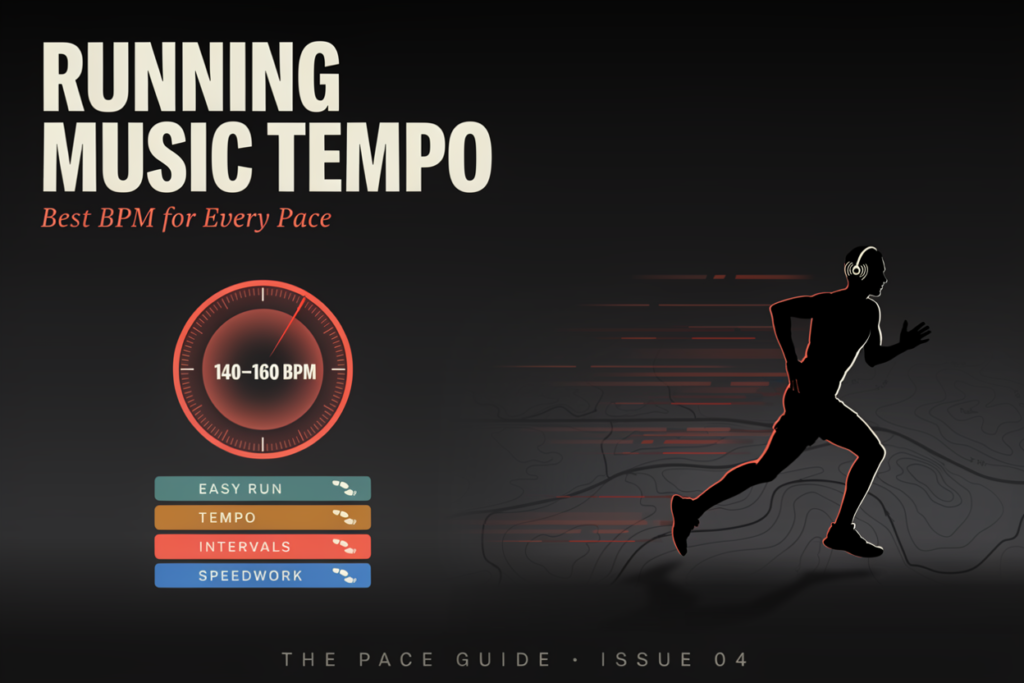
Running music tempo is the speed of a song measured in beats per minute, or BPM. The best BPM for running depends on your natural cadence, pace, workout type, and whether you want each step to match the beat.
There is no universal running tempo. Many runners use music around 120–140 BPM for easy or steady runs and 150–180 BPM for faster sessions. Others use songs at half their step cadence, such as 85 BPM music for a 170-step-per-minute rhythm.
What Is the Best Running Music Tempo?
The best running music tempo is the range that supports your pace without forcing your stride. Use the following ranges as playlist-building guides rather than fixed biomechanical rules.
| Running session | Practical music range | How to use it |
|---|---|---|
| Warm-up or easy jog | 100–125 BPM | Follow the general energy |
| Easy or steady run | 120–140 BPM | Match selected beats or use half-time |
| Moderate or tempo run | 140–165 BPM | Choose a clear, consistent pulse |
| Intervals or fast running | 160–180+ BPM | Match one step per beat only when comfortable |
| Cool-down | 90–120 BPM | Gradually lower the intensity |
Your natural rhythm matters more than reaching a particular number. A broader guide to BPM ranges used by runners can help you compare these starting points.
How Does Music BPM Relate to Running Cadence?
Music BPM counts beats per minute, while running cadence counts total steps per minute. The values can match directly, but they do not have to.
A runner moving at 160 steps per minute may use a 160 BPM song and place one step on every beat. The same runner could use an 80 BPM song and take two steps during each main beat cycle.
What Is Running Cadence?
Running cadence is the total number of steps taken in one minute, counting both feet. Cadence changes with pace, terrain, fatigue, height, experience, and personal mechanics.
Does One Step Have to Match Every Beat?
No. You can use one step per beat, two steps per main beat, one step every two beats, or listen without exact synchronization. The clearest choice depends on the song’s rhythmic structure.
How Can an 85 BPM Song Match a 170-Step Cadence?
If you take two steps for every beat of an 85 BPM song, you complete 170 steps per minute.
| Running cadence | Full-time music | Half-time music |
| 160 steps per minute | 160 BPM | 80 BPM |
| 170 steps per minute | 170 BPM | 85 BPM |
| 180 steps per minute | 180 BPM | 90 BPM |
Half-time matching gives you more playlist choices without changing the intended stepping rhythm.
Should You Run at 180 Steps per Minute?
No. A cadence of 180 steps per minute is a commonly discussed reference point, not a universal requirement.
Why Natural Cadence Varies
An efficient cadence can be lower or higher depending on running speed, body proportions, terrain, fatigue, experience, and individual mechanics. A slow jog and a fast interval should not be expected to produce the same step rate.
Can Faster Music Change Running Cadence?
Music may encourage some runners to adjust their rhythm when the beat is clear and close to their natural cadence. However, faster music does not guarantee better form, faster running, or reduced injury risk.
Use music as a cue, not a correction. Stop forcing the synchronization if your stride feels rushed or tense.
How Do You Find Your Running BPM?
Measure your current cadence at a comfortable pace, then choose songs near that number or at half of it.
Measure Your Current Cadence
- Run at your normal comfortable pace.
- Count every foot strike for 30 seconds.
- Multiply the result by two.
- Repeat several times and average the results.
If you count 84 steps in 30 seconds, your estimated cadence is 168 steps per minute.
Choose Music Near Your Cadence
A runner averaging 168 steps per minute might test tracks between approximately 164 and 172 BPM. You can analyze the tempo of a playlist track before adding it to a cadence-focused set.
Half-time options also work:
- 160-step cadence with 80 BPM music
- 170-step cadence with 85 BPM music
- 180-step cadence with 90 BPM music
Test new music during a normal training run. Do not lengthen or shorten your stride aggressively to stay on the beat.
What Music Tempo Works for Different Runs?
Different workouts benefit from different playlist structures. Exact cadence matching is optional; sometimes the music only needs to support the intended energy.
Easy and Recovery Runs
Music around 110–140 BPM can support a relaxed, steady effort. Familiar songs may be less likely to pull you into an unnecessarily fast pace. A list of songs around 120 BPM can provide suitable starting options.
Steady and Long Runs
Long-run playlists should feel consistent. Begin around 120–135 BPM, move gradually toward 140–155 BPM if needed, and lower the tempo for the cool-down. Explore tracks near 140 BPM for a moderate pulse.
Tempo Runs
A tempo run uses a controlled effort that is faster than easy running but sustainable for a planned period. Music around 145–165 BPM may work well when it has clear drums and a stable rhythm.
Intervals and Speed Sessions
Fast sessions often use music around 160–180 BPM or higher. Place faster tracks during work intervals and lower-intensity tracks during recovery. Useful options include songs around 160 BPM and music near 180 BPM.
How Do You Build a Running Playlist by BPM?
Build the playlist around the workout’s structure rather than choosing every track from one tempo range.
Arrange Songs in a Tempo Curve
A simple progression is:
- Warm-up: 110–125 BPM
- Early run: 125–140 BPM
- Main effort: 145–165 BPM
- Fast segment: 165–180 BPM
- Cool-down: below 125 BPM
The transitions do not need to be perfectly linear, but large jumps can disrupt pacing.
Verify Each Song’s Tempo
Automated tools may label a song at half or double its perceived tempo. A track shown as 85 BPM may function like 170 BPM.
You can tap along to measure the pulse or use a manual method for checking a song’s BPM.
Consider More Than BPM
Also consider beat clarity, song familiarity, energy, mood, lyrics, transitions, and personal preference. A technically matched song you dislike may be less useful than a slightly slower track that keeps you engaged.
Can Running Music Improve Performance?
Running music may improve motivation, enjoyment, rhythm, and perceived effort for some people, but responses vary.
Synchronous Versus Asynchronous Music
Synchronous music means matching movement to the beat. Asynchronous music means listening without deliberately timing each step. Both approaches can be useful.
What Music Cannot Guarantee
A particular BPM cannot guarantee faster race times, better form, correct cadence, lower impact forces, or reduced injury risk. Music can provide a cue, but it cannot replace gradual training, recovery, or individual assessment.
How Can You Run Safely With Music?
Keep the volume low enough to hear traffic, bicycles, other runners, warning signals, and changes in the environment.
Use extra caution near roads, crossings, shared paths, trails, and crowded events. Some races restrict headphones, so check the rules beforehand.
Do not chase a song’s tempo when breathing, fatigue, terrain, or form suggests slowing down. The playlist should support the run rather than control it.
Frequently Asked Questions
What BPM is best for running?
There is no single best BPM. Many runners use 120–140 BPM for easy running and 150–180 BPM for faster sessions, depending on pace and cadence.
Is 180 BPM always best for runners?
No. A cadence of 180 steps per minute is a reference point, not a universal target.
Should each foot strike match one music beat?
Not necessarily. You can match one step per beat, use two steps per main beat, or listen without exact synchronization.
Can 90 BPM music work for a 180-step cadence?
Yes. Taking two steps during each main beat cycle allows a 90 BPM song to support 180 steps per minute.
Does faster music make you run faster?
It may influence rhythm for some runners, but the effect is not guaranteed. Do not force an unnatural pace to follow a song.
How do I measure my running cadence?
Count both-foot steps for 30 seconds and multiply by two. Repeat the measurement and average the results.
Can running music reduce injury risk?
Music alone cannot guarantee injury prevention. Training load, recovery, strength, terrain, footwear, and individual mechanics also matter.

Olivia Carter is a music technology writer and rhythm analysis specialist at Tempo Finder. She focuses on tempo detection, BPM analysis, beat matching, rhythm tools, and music production workflows for DJs, producers, musicians, and beginners. Olivia creates practical, easy-to-understand content around tempo finding, beat synchronization, metronomes, DJ transitions, and audio timing to help creators improve workflow, accuracy, and musical performance.