
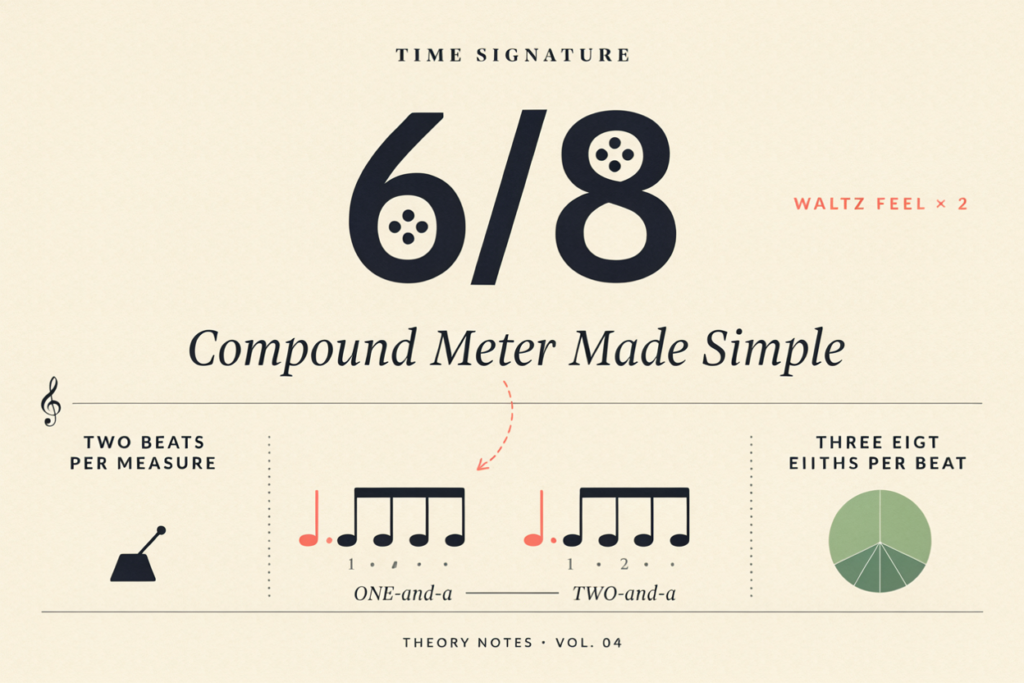
The 6/8 time signature is one of the most common compound meters in music. It creates a flowing, swinging, and rhythmic feel that appears in many styles, including classical music, folk, ballads, pop, and traditional songs.
Unlike simple time signatures such as 4/4, where beats are usually divided into groups of two, 6/8 time groups its beats into two larger pulses, with each pulse containing three eighth notes.
Understanding 6/8 time helps musicians read sheet music, count rhythms correctly, and perform songs with the intended musical feel.
What Is a 6/8 Time Signature?
A time signature appears at the beginning of a piece of sheet music and tells musicians how beats are organized in each measure.
In 6/8 time:
- The top number (6) means there are six eighth-note pulses in each measure.
- The bottom number (8) means the eighth note receives one count.
So, a measure of 6/8 contains:
Six eighth notes per measure
Written as:
1 2 3 4 5 6
However, musicians usually do not feel all six notes equally. Instead, the rhythm is grouped into two main beats:
ONE-two-three FOUR-five-six
This creates the characteristic flowing feeling of 6/8 music.
How to Count 6/8 Time
The easiest way to count 6/8 is to feel it as two groups of three eighth notes.
Instead of counting:
1 – 2 – 3 – 4 – 5 – 6
many musicians count:
ONE-two-three TWO-two-three
or:
ONE-and-a TWO-and-a
The strongest accents usually happen on:
- Beat 1
- Beat 4
Example:
ONE-two-three FOUR-five-six
The first and fourth eighth notes receive more emphasis, creating the two-beat feeling.
How Does 6/8 Time Feel?
6/8 time often feels:
- Flowing
- Circular
- Smooth
- Dance-like
- Emotional
Because each main beat is divided into three parts, the rhythm often has a gentle movement similar to a waltz-like flow.
Many emotional songs use 6/8 because the rhythm naturally creates a rolling or expressive feeling.
Understanding Compound Meter
6/8 is called a compound meter because each main beat divides naturally into three smaller parts.
In compound meters:
- Each beat divides into three equal subdivisions.
- The main pulse is often felt as a dotted note.
In 6/8:
- Two dotted-quarter-note beats occur in each measure.
- Each dotted-quarter beat contains three eighth notes.
This is different from simple meters like 4/4, where beats divide naturally into groups of two.
6/8 Time Signature vs 3/4 Time Signature
Many beginners confuse 6/8 and 3/4 because both can contain six eighth notes in a measure. However, they feel completely different.
| 6/8 Time | 3/4 Time |
|---|---|
| Compound meter | Simple meter |
| Two main beats per measure | Three main beats per measure |
| Each beat divides into three | Each beat divides into two |
| Feel: ONE-two-three FOUR-five-six | Feel: ONE-two-three ONE-two-three |
Example:
6/8:
ONE-two-three FOUR-five-six
3/4:
ONE-two-three ONE-two-three
The difference is not the number of notes but how the notes are grouped and accented.
How BPM Works in 6/8 Time
BPM (beats per minute) in 6/8 can sometimes be confusing because musicians may count either:
- Every eighth note
or - The two main beats per measure
For example:
A song written at 120 BPM in 6/8 may feel like:
- Six eighth-note movements per measure
- Two larger pulses per measure
The interpretation depends on the musical context and how the composer or performer feels the beat.
Understanding BPM helps musicians connect rhythm and speed. Learn more about what BPM means in music.
Examples of 6/8 Rhythm Pattern
A basic 6/8 rhythm pattern:
Count:
ONE-two-three FOUR-five-six
Clap:
👏 – – 👏 – –
The strong accents occur on beats:
- 1
- 4
A drummer might emphasize:
Kick – soft – soft | Snare – soft – soft
This creates the characteristic rolling feel of 6/8.
Famous Songs Using 6/8 Time
Many famous songs use 6/8 because of its emotional and flowing quality.
Examples include:
| Song | Artist | Style |
|---|---|---|
| House of the Rising Sun | The Animals | Folk/Rock |
| Nothing Else Matters | Metallica | Rock Ballad |
| Hallelujah | Leonard Cohen | Folk |
| Perfect | Ed Sheeran | Pop Ballad |
The exact tempo of songs can vary depending on the recording version. You can explore more song tempo examples in this famous songs BPM list.
How to Practice 6/8 Time Signature
Learning 6/8 becomes easier with structured practice.
1. Clap the Rhythm
Start by counting:
ONE-two-three FOUR-five-six
Clap only on:
- Beat 1
- Beat 4
This helps you feel the main pulse.
2. Use a Metronome
Set a comfortable tempo and practice counting along.
A metronome helps develop accurate timing and rhythm control. Learn more about how to use a metronome.
3. Practice Subdivisions
Try different patterns:
- Eighth notes
- Quarter notes
- Dotted-quarter rhythms
This improves flexibility and control.
How 6/8 Appears in Different Music Styles
Classical Music
Composers often use 6/8 for flowing melodies and expressive passages.
Folk Music
Many traditional songs use 6/8 because the rhythm supports dancing and storytelling.
Pop and Ballads
Modern singers often use 6/8 to create emotional and dramatic arrangements.
Film Music
Composers use 6/8 for cinematic and emotional scenes because of its natural movement.
Common Mistakes When Playing 6/8
Treating Every Eighth Note as Equal
A common mistake is counting all six notes with equal emphasis.
Instead, remember:
ONE-two-three FOUR-five-six
The first and fourth notes are stronger.
Confusing 6/8 With 3/4
Although both contain six eighth notes, the grouping is different.
Focus on the main pulse rather than the number of notes.
Playing Too Mechanically
6/8 often requires a smooth, flowing feel. Avoid making it sound stiff.
Frequently Asked Questions
How many beats are in 6/8 time?
6/8 contains six eighth notes per measure, but it is usually felt as two main beats, each divided into three parts.
Is 6/8 faster than 4/4?
Not necessarily. The time signature describes rhythm organization, not speed. Tempo determines how fast the music is played.
What is the difference between 6/8 and 3/4?
6/8 has two groups of three eighth notes, while 3/4 has three groups of two eighth notes.
How do you count 6/8 time?
Count it as “ONE-two-three FOUR-five-six” or “ONE-and-a TWO-and-a.”
What BPM is common for 6/8 songs?
There is no fixed BPM. 6/8 songs can be slow, moderate, or fast depending on the musical style.

Olivia Carter is a music technology writer and rhythm analysis specialist at Tempo Finder. She focuses on tempo detection, BPM analysis, beat matching, rhythm tools, and music production workflows for DJs, producers, musicians, and beginners. Olivia creates practical, easy-to-understand content around tempo finding, beat synchronization, metronomes, DJ transitions, and audio timing to help creators improve workflow, accuracy, and musical performance.