
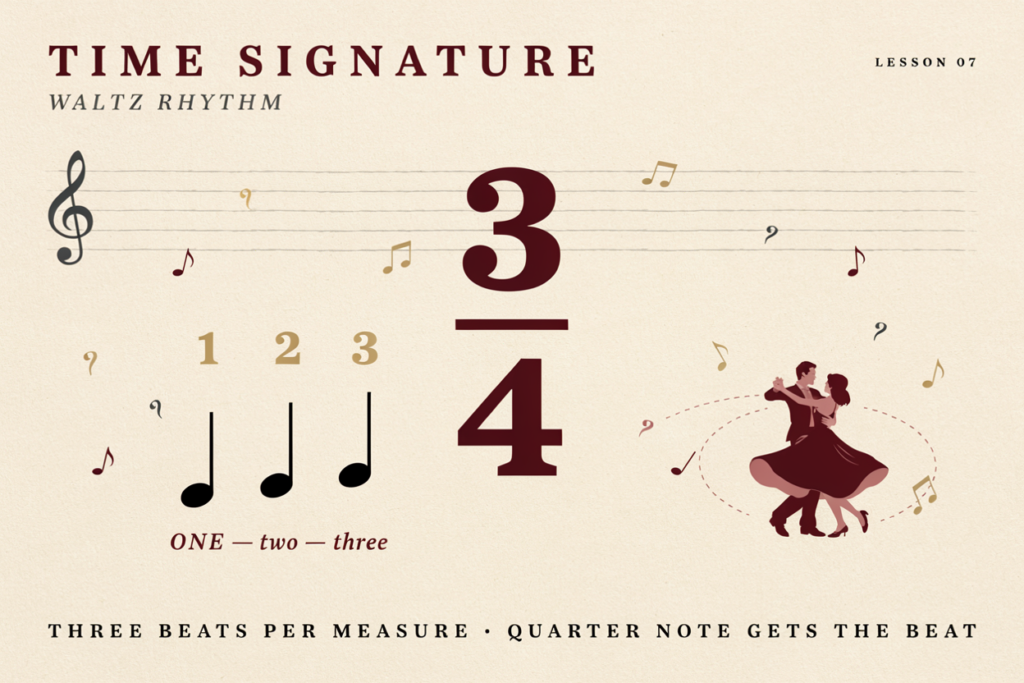
The 3/4 time signature is one of the most recognizable rhythms in music. It is often called waltz time because many traditional waltzes use this pattern. However, 3/4 time is not limited to waltzes; it appears in classical music, folk songs, ballads, and modern compositions.
A 3/4 time signature creates a flowing, circular feeling because each measure contains three beats, with the first beat usually receiving the strongest emphasis.
Understanding 3/4 time helps musicians read sheet music, count rhythms correctly, and perform songs with the intended musical character.
What Is a 3/4 Time Signature?
A time signature tells musicians how beats are organized inside each measure.
In 3/4 time:
- The top number (3) means there are three beats in each measure.
- The bottom number (4) means the quarter note receives one beat.
Therefore, one measure of 3/4 contains:
Three quarter-note beats
It can be counted as:
1 – 2 – 3
or:
ONE – two – three
The first beat is usually stronger, creating the familiar three-beat pattern.
To understand how rhythm speed connects with musical timing, you can also learn more about how tempo affects musical speed.
How to Count 3/4 Time
The simplest way to count 3/4 time is:
ONE – two – three
The emphasis is usually:
STRONG – weak – weak
Example:
ONE two three
ONE two three
The first beat acts as the foundation, while beats two and three provide movement and flow.
Musicians often feel this pattern as a gentle circular motion.
How Does 3/4 Time Feel?
3/4 time often creates a feeling that is:
- Flowing
- Graceful
- Rotating
- Dance-like
- Emotional
This happens because the three-beat cycle naturally creates a rise-and-fall movement.
Common uses include:
- Waltzes
- Romantic melodies
- Classical compositions
- Folk music
- Emotional ballads
The feeling of a rhythm is influenced by both time signature and tempo. You can learn more about the relationship between speed and rhythm in this guide about what BPM means in music.
Why Is 3/4 Called Waltz Time?
The term waltz time comes from the famous dance style called the waltz, which traditionally uses a three-beat pattern.
A typical waltz rhythm feels like:
ONE-two-three
with dancers moving in a repeating three-step pattern.
However, not every song in 3/4 is a waltz. The time signature only describes the organization of beats, not the entire musical style.
3/4 Time Signature vs 4/4 Time Signature
3/4 and 4/4 are two of the most common time signatures, but they create different rhythmic feelings.
| 3/4 Time | 4/4 Time |
|---|---|
| Three beats per measure | Four beats per measure |
| Count: ONE-two-three | Count: ONE-two-three-four |
| Strong emphasis on beat 1 | Strong emphasis usually on beat 1 |
| Common in waltzes and flowing music | Common in pop, rock, and many modern songs |
A song in 3/4 often feels like a repeating circle, while 4/4 often feels more straight and balanced.
3/4 Time Signature vs 6/8 Time Signature
Many beginners confuse 3/4 and 6/8 because both can contain similar numbers of eighth notes.
However, the grouping is different.
| 3/4 Time | 6/8 Time |
|---|---|
| Simple meter | Compound meter |
| Three main beats | Two main beats |
| Beats divide into two parts | Beats divide into three parts |
| ONE-two-three | ONE-two-three FOUR-five-six |
In 3/4:
ONE-and TWO-and THREE-and
In 6/8:
ONE-two-three FOUR-five-six
You can learn more about this comparison in the guide to 6/8 time signature.
How BPM Works in 3/4 Time
BPM (beats per minute) describes the speed of the beats in a song.
For example:
- 60 BPM means each beat occurs once per second.
- 120 BPM means two beats occur every second.
In 3/4 time, BPM usually refers to the three main beats in each measure.
A slow 3/4 song may feel:
- Gentle
- Emotional
- Relaxed
A faster 3/4 song may feel:
- Energetic
- Dance-like
- Lively
The same time signature can sound completely different depending on tempo.
Famous Songs Using 3/4 Time
Many well-known songs use 3/4 time because of its unique emotional quality.
Examples include:
| Song | Artist | Style |
|---|---|---|
| Perfect | Ed Sheeran | Pop Ballad |
| Nothing Else Matters | Metallica | Rock Ballad |
| Kiss from a Rose | Seal | Pop |
| Manic Depression | Jimi Hendrix | Rock |
Song tempos can vary between recordings, so BPM values are approximate. You can explore more examples in this famous songs BPM list.
How to Practice 3/4 Rhythm
Learning 3/4 becomes easier with regular rhythm practice.
1. Clap the Beat
Start by clapping:
ONE-two-three
Repeat while keeping the first beat stronger.
2. Count Out Loud
Say:
ONE-two-three
while tapping your foot.
This helps your body understand the three-beat cycle.
3. Practice With a Metronome
A metronome provides a consistent pulse and helps musicians develop accurate timing.
Set the metronome to a comfortable speed and practice:
- Counting
- Clapping
- Playing simple patterns
Learn more about effective practice in this guide on how to use a metronome.
Common Mistakes When Playing 3/4 Time
Treating All Three Beats Equally
A common mistake is giving every beat the same emphasis.
Remember:
ONE-two-three
Beat one is usually the strongest.
Confusing 3/4 With 6/8
Although they may contain similar notes, their rhythmic grouping is different.
Focus on how the music feels rather than only counting numbers.
Losing the Pulse
Some musicians focus too much on notes and forget the underlying beat.
Using a metronome can help maintain a steady rhythm.
You can also use a BPM Finder tool to check the tempo of songs you practice.
Frequently Asked Questions
How many beats are in 3/4 time?
There are three beats in each measure of 3/4 time, with the quarter note receiving one beat.
Why is 3/4 called waltz time?
It is called waltz time because many traditional waltzes use a three-beat rhythm pattern.
Is 3/4 the same as 6/8?
No. 3/4 has three main beats, while 6/8 usually has two main beats divided into groups of three.
What BPM is common for 3/4 songs?
There is no fixed BPM. 3/4 songs can be slow, moderate, or fast depending on the style.
How do you count 3/4 rhythm?
Count it as ONE-two-three, with the first beat receiving the strongest accent.

Olivia Carter is a music technology writer and rhythm analysis specialist at Tempo Finder. She focuses on tempo detection, BPM analysis, beat matching, rhythm tools, and music production workflows for DJs, producers, musicians, and beginners. Olivia creates practical, easy-to-understand content around tempo finding, beat synchronization, metronomes, DJ transitions, and audio timing to help creators improve workflow, accuracy, and musical performance.