
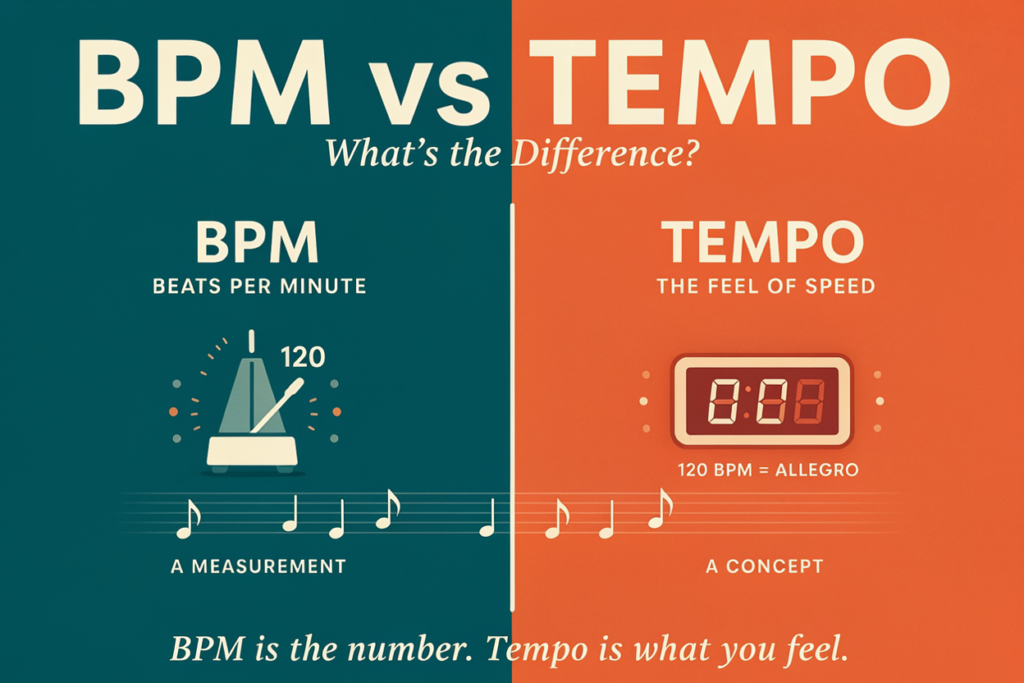
BPM and tempo are closely related music concepts, but they are not exactly the same. BPM (beats per minute) is a numerical measurement that tells you how many beats occur in one minute, while tempo describes the overall speed, movement, and feel of a piece of music. In simple terms, BPM measures tempo, but tempo includes more than just a number.
Understanding the difference between BPM and tempo helps musicians, producers, DJs, and listeners better understand how music speed works.
What Is BPM in Music?
BPM stands for beats per minute. It is a measurement used to describe the speed of a musical beat.
For example:
- 60 BPM means one beat occurs every second.
- 120 BPM means 120 beats occur in one minute.
BPM gives musicians and producers a precise numerical reference. Modern music production software, DJ equipment, and metronomes commonly use BPM because it allows creators to synchronize instruments, samples, and tracks accurately.
You can learn more about the basics of BPM in our guide to understanding BPM in music.
What Is Tempo in Music?
Tempo is the overall speed at which a piece of music is performed. It describes how fast or slow the music moves and can also include the musical character or feeling behind that movement.
A tempo is influenced by:
- The speed of the beat
- Rhythm patterns
- Musical style
- Performance interpretation
- Emotional expression
For example, two songs may have the same BPM but feel different because their rhythms, instruments, and arrangements create different experiences.
Learn more about how tempo works in music.
BPM vs Tempo: Key Differences
| BPM | Tempo |
|---|---|
| A numerical measurement | A broader musical concept |
| Counts beats per minute | Describes speed and musical movement |
| Has a specific value (such as 120 BPM) | Can include interpretation and expression |
| Common in music production and DJ software | Common in musical performance and theory |
| Measured with tools like BPM counters | Communicated through words, markings, and performance |
The easiest way to remember the difference:
BPM tells you the number. Tempo tells you how that speed functions in music.
How BPM and Tempo Work Together
BPM provides the measurement that helps define tempo.
For example, a composer or producer may choose:
- 70 BPM for a relaxed, slow groove
- 120 BPM for an energetic dance track
- 180 BPM for a fast electronic style
However, the BPM alone does not determine the complete musical experience.
A song at 100 BPM could feel slow, energetic, heavy, or relaxed depending on:
- Drum patterns
- Arrangement
- Instrument choices
- Vocal delivery
- Rhythm emphasis
This is why musicians think about tempo rather than only focusing on BPM.
Why the Same BPM Can Feel Different
One of the biggest reasons people confuse BPM and tempo is that the same BPM can create different feelings.
Rhythm Patterns
The arrangement of drums and instruments changes how listeners perceive speed.
A simple beat at 120 BPM may feel steady and relaxed, while a complex rhythm at the same BPM may feel much more energetic.
Half-Time Feel
Some music uses a half-time approach, where the listener feels the main pulse as slower than the actual BPM.
For example:
- A track at 140 BPM may feel like 70 BPM.
- Dubstep and trap often use this technique.
Double-Time Feel
A song can also feel faster than its BPM because of rapid subdivisions.
For example:
- A 90 BPM hip-hop beat may feel energetic because of fast hi-hats and rhythmic details.
BPM, Tempo, and Tempo Markings
In traditional music notation, composers often use tempo markings instead of exact BPM values.
Examples include:
- Largo – very slow
- Adagio – slow and expressive
- Andante – moderate walking pace
- Allegro – fast and lively
- Presto – very fast
These terms provide musical direction but do not always represent one exact BPM value.
For more information about these traditional terms, see our guide to tempo markings.
How Musicians and Producers Use BPM
Different music professionals use BPM in different ways.
Music Producers
Producers choose BPM to create a specific mood and match the style of a track.
Examples:
- Dance music often uses faster BPM ranges.
- Ballads usually use slower tempos.
- Hip-hop frequently uses slower grooves with strong rhythmic patterns.
DJs
DJs use BPM to match tracks smoothly during mixing. Songs with similar BPM values are easier to blend because their beats can stay synchronized.
Musicians
Instrumentalists use BPM with a metronome to practice timing, improve consistency, and maintain a steady rhythm.
A metronome helps musicians practice at a controlled speed.
Recording Artists
Singers and musicians often record with a fixed BPM because it keeps different parts of a song aligned.
How to Find the BPM of a Song
If you want to know the BPM of an existing track, you can analyze the beat using a BPM detection tool.
A BPM finder can help identify the approximate tempo of a song by analyzing its rhythmic pattern.
However, remember that the BPM value does not always explain the complete musical feel. Listening context and rhythm are still important.
Frequently Asked Questions
Is BPM the same as tempo?
No. BPM is the measurement of beats per minute, while tempo describes the overall speed and feel of music. BPM helps measure tempo, but tempo includes musical interpretation.
Does higher BPM mean faster music?
Usually, a higher BPM means a faster beat, but the perceived speed can change depending on rhythm, arrangement, and musical style.
Can two songs have the same BPM but different tempos?
Two songs can have the same BPM but feel different because tempo perception depends on rhythm, instrumentation, and performance style.
What BPM is common in popular music?
Many popular songs fall between around 100–130 BPM, although different genres use a wide range of tempos.
How do musicians measure tempo?
Musicians measure tempo using BPM values, metronomes, digital audio software, and traditional tempo markings such as Allegro or Adagio.

Olivia Carter is a music technology writer and rhythm analysis specialist at Tempo Finder. She focuses on tempo detection, BPM analysis, beat matching, rhythm tools, and music production workflows for DJs, producers, musicians, and beginners. Olivia creates practical, easy-to-understand content around tempo finding, beat synchronization, metronomes, DJ transitions, and audio timing to help creators improve workflow, accuracy, and musical performance.