
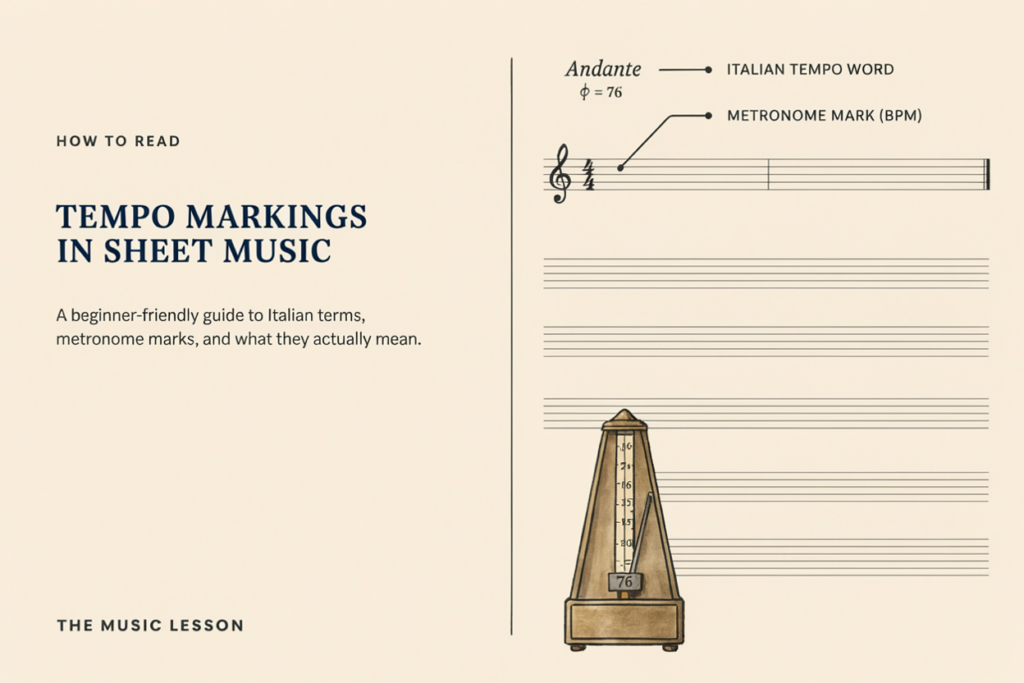
Tempo markings tell you how fast a piece should move and often suggest its character. To read one correctly, identify the descriptive word, check the note symbol and BPM number, and then apply any modifiers or later tempo-change instructions.
For example, Allegro, ♩ = 120 means the music should feel fast and lively while the quarter note moves at 120 beats per minute. The number gives a measurable speed, while the word shapes the performance.
How Do You Read a Tempo Marking?
Read a tempo marking in three parts:
- Identify the main tempo word.
- Read the note symbol and BPM number, if present.
- Apply modifiers such as
molto,con moto, orma non troppo.
A full marking may combine all three. For example, Andante con moto, ♩ = 84 suggests a walking pace with forward motion, measured at 84 quarter-note beats per minute.
A guide to tempo markings in music can help you compare the most common terms.
Example: Allegro, ♩ = 120
Allegro suggests a fast, bright, energetic character. The symbol ♩ = 120 means the quarter note receives 120 pulses per minute.
Each quarter-note beat lasts half a second, so a four-beat measure in 4/4 lasts about two seconds.
Which Part Takes Priority?
A metronome number gives the clearest measurable speed, but the verbal marking still matters because performances at the same BPM can sound different.
Allegro should not feel the same as Allegro grazioso. The second marking asks for a graceful character, even if the metronome number remains unchanged.
How Do Metronome Markings Work?
A metronome marking shows which note value receives the pulse and how many of those pulses occur each minute.
The format is:
note value = BPM
The note symbol is essential. A marking of ♩ = 60 does not mean the same thing as ♪ = 60.
What Does ♩ = 60 Mean?
♩ = 60 means 60 quarter-note beats occur each minute. That equals one quarter-note pulse every second.
You can hear this directly with an online metronome by setting the tempo to 60 BPM.
What Does the Note Symbol Tell You?
The note symbol identifies the rhythmic unit that receives each click. The number tells you how many occur per minute.
| Marking | Meaning |
|---|---|
♩ = 100 | 100 quarter-note beats per minute |
♪ = 120 | 120 eighth-note beats per minute |
𝅗𝅥 = 60 | 60 half-note beats per minute |
𝅗𝅥. = 72 | 72 dotted-quarter beats per minute |
This matters in compound meters such as 6/8, where the dotted quarter often functions as the main beat.
What Do Common Italian Tempo Markings Mean?
Italian tempo words describe approximate speed and musical character. They are not universal fixed BPM values.
| Marking | Basic Meaning | General Character |
| Largo | Broad and slow | Spacious, weighty |
| Adagio | Slow | Calm, expressive |
| Andante | At a walking pace | Flowing, moderate |
| Moderato | Moderately | Controlled, balanced |
| Allegretto | Moderately lively | Light and active |
| Allegro | Fast | Bright, energetic |
| Vivace | Lively and fast | Animated |
| Presto | Very fast | Urgent, agile |
Read these terms as interpretive directions rather than strict numbers. The guide to what tempo means explains why musical speed includes both measurement and expressive feel.
Why Do BPM Ranges Vary?
The same Italian word can suggest different speeds depending on composer, period, instrument, meter, edition, and character.
An Allegro movement in a Classical symphony may not use the same speed or articulation as an Allegro movement in a Romantic piano work. The musical context helps determine the most convincing interpretation.
How Do Modifiers Change a Tempo Marking?
Modifiers refine the main tempo word. They may make the speed stronger, softer, more restrained, or more expressive.
Molto, Poco, and Assai
Molto means very or much. Poco means a little. Assai often means very or quite.
Examples include:
Adagio molto: very slowPoco allegro: somewhat fastAllegro assai: very fast or very lively
Ma Non Troppo
Ma non troppo means “but not too much.”
Allegro ma non troppo therefore means fast, but not excessively fast. The player should preserve energy without rushing.
Con Moto, Con Brio, and Grazioso
Con moto means with motion. Con brio means with vigor or spirit. Grazioso means gracefully.
| Complete Marking | Practical Interpretation |
| Andante con moto | Walking pace with forward movement |
| Allegro moderato | Fast, but controlled |
| Adagio molto | Very slow and expressive |
| Allegro ma non troppo | Fast, but not excessively fast |
| Allegro con brio | Fast and spirited |
These words can alter articulation, weight, and phrasing without changing the BPM.
How Do You Read Tempo Changes Within a Piece?
Tempo changes may be gradual, immediate, temporary, or a return to an earlier speed.
Accelerando and Stringendo
Accelerando, often abbreviated accel., means gradually speed up.
Stringendo also suggests increasing speed, but it often adds a sense of urgency or pressing forward.
Ritardando, Rallentando, and Ritenuto
Ritardando, or rit., means gradually slow down.
Rallentando, or rall., also means gradually becoming slower, sometimes with a broader feeling.
Ritenuto, or riten., usually suggests a more immediate holding back rather than a long gradual slowing. Usage varies, so context matters.
A Tempo and Tempo Primo
A tempo means return to the previous tempo after a temporary change.
Tempo primo, or tempo I, means return to the original opening tempo. Missing these instructions can leave an entire section at the wrong speed.
Rubato
Rubato means flexible time. The performer may stretch or compress phrases expressively while preserving the larger musical flow.
Rubato should sound controlled, not random.
How Does the Time Signature Affect a Tempo Marking?
The time signature organizes beats into measures, while the tempo marking tells you how quickly those beats move.
See the guide to time signatures for the difference.
Reading Tempo in 4/4
In 4/4 time, ♩ = 80 normally means four quarter-note pulses per measure, each moving at 80 beats per minute.
A 4/4 piece can be slow, moderate, or fast.
Reading Tempo in 6/8
In 6/8, the music may be felt as six eighth notes or as two larger dotted-quarter beats.
A marking of 𝅗𝅥. = 60 means two dotted-quarter beats per measure when the music is grouped in two. The guide to reading 6/8 time explains this pulse.
Why the Note Value Matters
♩ = 60 and 𝅗𝅥. = 60 use the same number but different beat units.
At ♩ = 60, one quarter note lasts one second. At 𝅗𝅥. = 60, one dotted quarter lasts one second. Because a dotted quarter contains three eighth notes, the internal rhythmic feel is different.
How Should You Practise a Written Tempo?
Translate the entire marking into plain language before playing. Then set the metronome to the correct note value rather than focusing only on the number.
Start difficult passages below the final tempo and increase the speed gradually. The guide to using a metronome effectively gives a practical method for building speed without sacrificing accuracy.
Finally, check whether the musical character matches the words. A technically correct BPM can still sound wrong if con brio, grazioso, or maestoso is ignored.
Common Tempo-Marking Mistakes
Common mistakes include reading the BPM while ignoring the note symbol, treating Italian terms as exact fixed speeds, confusing tempo with meter, overlooking modifiers, and failing to return at a tempo.
Another mistake is playing the correct number with the wrong character.
The difference between a numerical BPM value and a broader musical direction is explored in BPM versus tempo.
Frequently Asked Questions
What does a number next to a music note mean?
It is a metronome marking. The note symbol identifies the beat unit, and the number shows how many of those beats occur per minute.
Does Allegro always have the same BPM?
No. Allegro generally means fast and lively, but the exact speed varies with style, meter, composer, and context.
What does a dotted quarter note equal 60 mean?
It means 60 dotted-quarter beats occur per minute. In many 6/8 passages, that creates two main beats per measure.
What is the difference between ritardando and rallentando?
Both usually indicate gradual slowing. Rallentando may suggest a broader relaxation, while ritardando focuses on decreasing speed, though their use often overlaps.
What does a tempo mean in sheet music?
A tempo means return to the previous established tempo after a temporary slowing, speeding, or expressive change.
Does the time signature determine the tempo?
No. The time signature organizes beats into measures, while the tempo marking determines how quickly the beat moves.

Olivia Carter is a music technology writer and rhythm analysis specialist at Tempo Finder. She focuses on tempo detection, BPM analysis, beat matching, rhythm tools, and music production workflows for DJs, producers, musicians, and beginners. Olivia creates practical, easy-to-understand content around tempo finding, beat synchronization, metronomes, DJ transitions, and audio timing to help creators improve workflow, accuracy, and musical performance.