
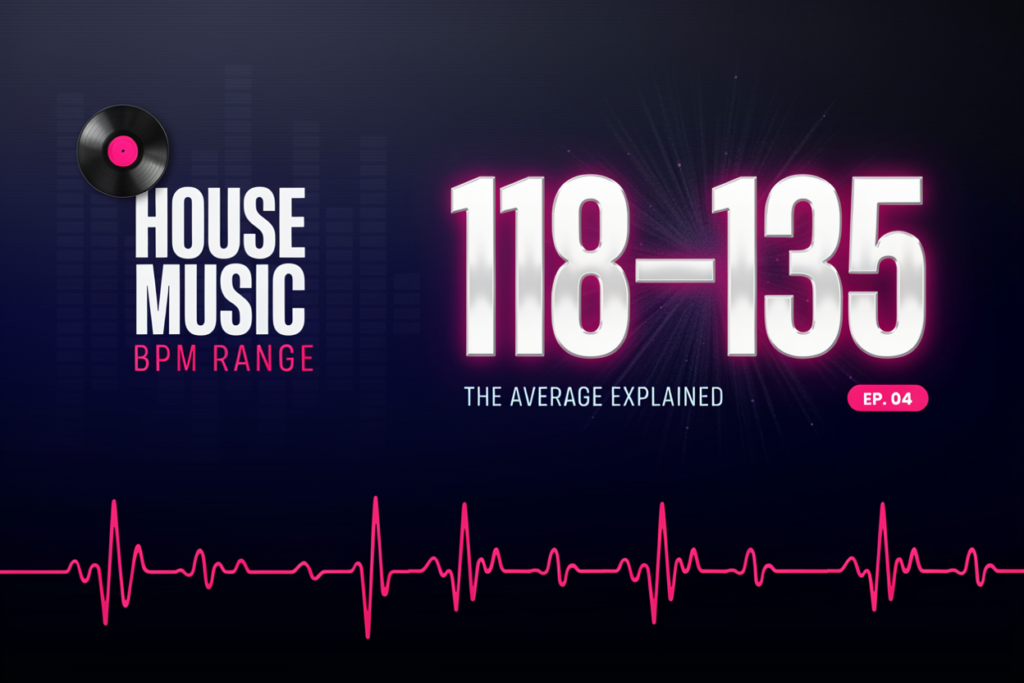
House music is usually played between 120 and 130 BPM (beats per minute), with many classic and modern house tracks commonly sitting around 124–128 BPM. This tempo range creates the steady, dance-focused energy that defines house music, allowing listeners to follow the famous four-on-the-floor rhythm while giving DJs enough flexibility for smooth mixing.
However, house music does not have one fixed tempo. Different subgenres, from deep house to tech house and progressive house, use different BPM ranges to create different moods and dance experiences.
Understanding house music tempo helps listeners identify styles, DJs mix tracks more effectively, and producers choose the right speed for their music.
To understand how BPM works in all types of music, you can explore this guide about what BPM means in music.
What Is the Typical Tempo of House Music?
The most common house music tempo range is:
120–130 BPM
Within this range:
- 120–124 BPM often feels relaxed and groovy.
- 124–128 BPM is the most common range for clubs and dance floors.
- 128–130 BPM creates a more energetic and driving feel.
A tempo around 128 BPM has become especially popular in electronic dance music because it provides enough energy for dancing while still allowing DJs to blend tracks smoothly.
Tempo is measured in BPM, which tells you how many beats occur in one minute. You can learn more about musical speed in this guide to tempo in music.
House Music BPM Range by Subgenre
Different house styles use different tempo ranges. The BPM often influences the mood and intensity of the track.
| House Style | Typical BPM Range | Musical Feel |
|---|---|---|
| Classic House | 118–125 BPM | Groovy, soulful, dance-focused |
| Deep House | 110–125 BPM | Smooth, atmospheric, relaxed |
| Tech House | 124–130 BPM | Driving, rhythmic, club-focused |
| Progressive House | 126–132 BPM | Expansive, emotional, energetic |
| Electro House | 125–130 BPM | Powerful, aggressive, high-energy |
These ranges are general guidelines rather than strict rules. Producers may speed up or slow down tracks depending on the desired feeling.
For a broader look at how different genres use tempo, see this guide on BPM by genre.
Why Is House Music Usually Around 120–130 BPM?
The popularity of this tempo range comes from the way house music is designed for movement.
Four-on-the-Floor Rhythm
House music commonly uses a four-on-the-floor beat, where the kick drum hits on every quarter note:
- Beat 1: kick
- Beat 2: kick
- Beat 3: kick
- Beat 4: kick
This creates a consistent pulse that works naturally for dancing.
Balance Between Energy and Control
A tempo around 120–130 BPM is fast enough to feel energetic but slow enough for:
- Long DJ mixes
- Smooth transitions
- Extended dance sessions
- Repetitive grooves
Very high tempos can feel more intense, while slower tempos create a more relaxed atmosphere.
Dance Floor Compatibility
Club environments often favor tempos where people can move comfortably for long periods. This is one reason house music developed around this BPM range.
How BPM Affects the Feel of House Music
The same house rhythm can feel completely different depending on tempo.
Slower House Tempo (110–120 BPM)
A slower BPM often creates:
- Deeper grooves
- More relaxed movement
- Atmospheric moods
Deep house frequently uses this approach.
Medium House Tempo (122–126 BPM)
This range provides:
- Classic dance energy
- Smooth movement
- Comfortable club pacing
Many traditional house tracks use this tempo.
Faster House Tempo (128–132 BPM)
Higher tempos create:
- More intensity
- Stronger dance-floor energy
- Faster perceived movement
Tech house and progressive house often explore this range.
The relationship between tempo and rhythmic feel is important because BPM alone does not determine the complete character of a track. Learn more about this relationship in rhythm vs tempo.
Choosing the Right House Music Tempo for DJs and Producers
For DJs
DJs consider BPM when:
- Matching tracks during mixing
- Creating smooth transitions
- Building energy throughout a set
A DJ may gradually increase BPM during a performance to create a feeling of rising intensity.
You can learn more about tempo management for DJs in this guide about BPM for DJs.
For Producers
Producers choose BPM based on the style and emotion they want to create.
A producer making deep house may prefer a slower tempo, while someone creating festival-style progressive house may choose a faster BPM.
The important factor is not choosing the highest BPM, but choosing a tempo that supports the rhythm, melody, and atmosphere.
How to Find the BPM of a House Track
You can find the BPM of a house song using several methods:
- Use a BPM detection tool.
- Tap along with the beat using a tempo calculator.
- Check music software that analyzes tempo automatically.
- Use DJ software with BPM detection features.
A BPM finder tool can quickly estimate the tempo of a track, while a tap tempo tool allows you to measure BPM manually.
You can also read this guide about how to find BPM of a song for more detailed methods.
Frequently Asked Questions
What BPM is house music usually?
House music is usually between 120 and 130 BPM, with many tracks commonly around 124–128 BPM.
Is 128 BPM house music?
Yes. 128 BPM is one of the most common tempos used in house and electronic dance music.
What BPM is deep house?
Deep house is commonly around 110–125 BPM, although some tracks may fall outside this range.
Why do house DJs use 120–130 BPM?
This tempo range provides a balance between dance energy, comfortable movement, and smooth mixing between tracks.
Is all house music the same tempo?
No. Different house subgenres use different BPM ranges depending on their style, mood, and production approach.

Olivia Carter is a music technology writer and rhythm analysis specialist at Tempo Finder. She focuses on tempo detection, BPM analysis, beat matching, rhythm tools, and music production workflows for DJs, producers, musicians, and beginners. Olivia creates practical, easy-to-understand content around tempo finding, beat synchronization, metronomes, DJ transitions, and audio timing to help creators improve workflow, accuracy, and musical performance.