
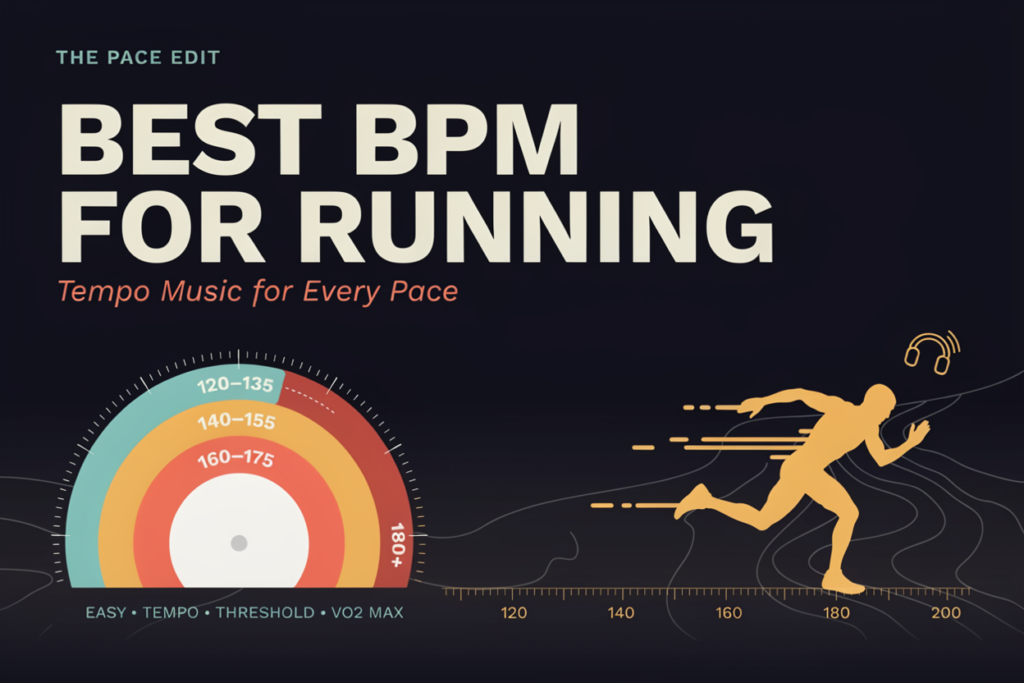
The best BPM for running is the music tempo closest to your step cadence. Many runners test songs between 150 and 180 BPM when taking one step per beat, or 75–90 BPM when taking two steps per beat. The ideal number varies with pace, terrain, body mechanics, and experience.
What Is the Best BPM for Running?
There is no single best BPM for every runner. A useful starting point is the tempo that feels natural at your current pace without forcing shorter, faster, or more awkward steps.
Music BPM measures song speed, while running cadence measures steps per minute. They can be matched, but neither directly determines pace because stride length also affects speed.
For more context, see the guide to running music tempo.
Why There Is No Universal Running BPM
Cadence changes with pace, terrain, experience, fatigue, and individual mechanics. The often-repeated 180-steps-per-minute target is a reference, not a rule.
BPM Versus Running Pace
BPM describes how quickly the musical beats occur. Cadence describes how many steps you take each minute. Pace describes how long it takes to cover a mile or kilometre.
Two runners can move at the same pace with different cadences because one may take longer strides while the other takes more frequent steps.
What BPM Should You Use for Different Runs?
The following ranges are practical playlist starting points rather than fixed biomechanical targets.
| Running Session | Suggested Music BPM | How to Use It |
|---|---|---|
| Warm-up walk or light jog | 100–125 BPM | Establish a relaxed rhythm |
| Easy run | 120–150 BPM or cadence-matched | Keep effort controlled |
| Steady run | 140–165 BPM | Support a consistent rhythm |
| Tempo run | 155–175 BPM | Match a quicker sustainable cadence |
| Intervals | 165–185 BPM | Support short, faster repetitions |
| Race effort | Cadence-matched | Use familiar tracks that suit target rhythm |
| Cooldown | 90–120 BPM | Reduce intensity gradually |
These ranges overlap because effort and cadence vary. The guide to running BPM ranges adds more context.
How Do You Match Music BPM to Running Cadence?
You can match one step to each beat or take two steps during every musical beat. Both methods can create a stable running rhythm.
One Step Per Beat
If your cadence is 164 steps per minute, a 164 BPM song gives you one musical beat for each foot strike.
Some runners find high-BPM music busy during longer sessions.
Two Steps Per Beat
A 90 BPM song can support a cadence of 180 steps per minute when you take two steps during each beat.
This half-time approach supports a fast cadence with slower music.
| Music BPM | Possible Step Cadence |
| 80 BPM | 160 steps per minute |
| 85 BPM | 170 steps per minute |
| 90 BPM | 180 steps per minute |
| 160 BPM | 160 steps per minute |
| 170 BPM | 170 steps per minute |
| 180 BPM | 180 steps per minute |
Half-Time and Double-Time Relationships
A 90 BPM track and a 180 BPM track can both support a 180-step cadence, depending on how footsteps are placed. This makes playlists more varied.
How Do You Find Your Natural Running Cadence?
Measure cadence during a comfortable run before choosing music.
- Run at an easy, steady pace for several minutes.
- Count every foot strike for 30 seconds.
- Multiply the number by two.
- Repeat the count two more times.
- Average the results.
- Choose songs near that BPM or half of it.
For example, 82 steps in 30 seconds equals 164 steps per minute. You could test music around 160–166 BPM or around 80–83 BPM.
A tap tempo counter can help estimate the rhythm of a song before adding it to your running playlist.
Should You Count One Foot or Both Feet?
If you count both feet, multiply a 30-second total by two. If you count only one foot, multiply the 30-second total by four.
Why Measure at Different Speeds?
Easy-run cadence may differ from interval or race cadence, so measure more than one workout type.
Should Every Runner Aim for 180 BPM?
No. The 180 figure is a reference point, not a universal target.
Cadence often rises with speed, but stride length also changes. Some runners naturally sit below 180, while others move above it.
When a Cadence Increase May Help
A small increase may help some runners, especially under guidance from a qualified coach or clinician. Test only a few BPM above natural cadence rather than making a large jump.
Why Sudden Changes Can Be Counterproductive
Forcing a large cadence increase may create tension, shorten the stride unnaturally, disrupt breathing, or make the workout less enjoyable.
A playlist should support efficient movement rather than make you chase a number.
Can Faster Music Make You Run Faster?
Faster music may increase motivation or encourage synchronization, but it does not guarantee faster running. Some runners change cadence; others only feel more energized.
Rhythmic Entrainment
Rhythmic entrainment is the tendency to synchronize movement with an external rhythm. It is usually easier when the song is already close to natural cadence.
Motivation Versus Mechanical Change
A song can feel more energizing without changing mechanics. Treat BPM as a pacing aid, not a guaranteed performance tool.
How Should Beginners Choose Running Music?
Start with songs near your measured cadence rather than choosing an arbitrary target.
Use a Narrow BPM Range
Test music within about 2–5 BPM of your natural step rate. If your cadence is 162, try songs between roughly 157 and 167 BPM.
You can also use half-time tracks around 79–84 BPM.
Test Short Playlist Blocks
Try three or four songs at one tempo range instead of committing an entire run to it. Notice whether your stride feels smooth, your breathing stays controlled, and your effort matches the workout.
To check unfamiliar tracks, use one of the methods for finding a song’s BPM.
Avoid Forcing Every Step
You do not need rigid synchronization. Stop following the beat if it changes your form or makes an easy run too hard.
Use Effort as the Final Guide
Breathing, comfort, form, and the talk test matter more than a playlist number.
How Do You Build a BPM-Based Running Playlist?
- Measure cadence during an easy run.
- Select songs within a narrow matching range.
- Add slower music for the warm-up.
- Place steady tracks in the main section.
- Add higher-BPM songs for faster intervals.
- Reduce BPM gradually for the cooldown.
- Test the playlist outdoors or on a treadmill.
- Replace songs that create an uncomfortable stride.
A playlist for 160 steps per minute can include both 160 BPM and 80 BPM songs. Compare typical BPM ranges by genre for more ideas.
Common Running BPM Mistakes
Confusing Music BPM With Heart Rate
Both use beats per minute, but music BPM describes tempo while heart rate measures pulse. The guide to heart rate BPM explains the distinction.
Treating 180 BPM as Mandatory
A fixed target ignores individual pace, mechanics, and terrain.
Assuming Faster Music Always Means Faster Running
A high-energy track can improve motivation without changing speed or cadence.
Ignoring Half-Time Songs
A runner at 170 steps per minute can use both 170 BPM and 85 BPM music.
Changing Cadence Too Quickly
Large changes may create tension and awkward movement. Small adjustments are easier to evaluate.
Letting Music Override the Workout
An easy run should not become a tempo session because the playlist encourages a harder effort.
Ignoring Safety and Surroundings
Music should not prevent awareness of traffic, cyclists, other runners, or environmental hazards.
Frequently Asked Questions
Is 160 BPM good for running?
Yes, 160 BPM can work well for runners whose natural cadence is close to 160 steps per minute. It may also suit steady or moderate running, depending on the individual.
Is 180 BPM the ideal running cadence?
Not for everyone. It is a commonly discussed reference, but cadence varies with pace, body mechanics, terrain, and experience.
Can I run at 180 steps per minute with a 90 BPM song?
Yes. Take two steps during each musical beat. This creates a half-time relationship between the song and your cadence.
What BPM is best for an easy jog?
Many runners use music around 120–150 BPM, but cadence-matched music is more precise. Choose a tempo that supports relaxed breathing and comfortable form.
Does music BPM determine running pace?
No. Pace depends on both cadence and stride length. Music may influence rhythm, but it does not directly set your speed.
Should running music match every footstep?
No. Exact synchronization is optional. The music should support a comfortable rhythm rather than force unnatural movement.

Olivia Carter is a music technology writer and rhythm analysis specialist at Tempo Finder. She focuses on tempo detection, BPM analysis, beat matching, rhythm tools, and music production workflows for DJs, producers, musicians, and beginners. Olivia creates practical, easy-to-understand content around tempo finding, beat synchronization, metronomes, DJ transitions, and audio timing to help creators improve workflow, accuracy, and musical performance.