
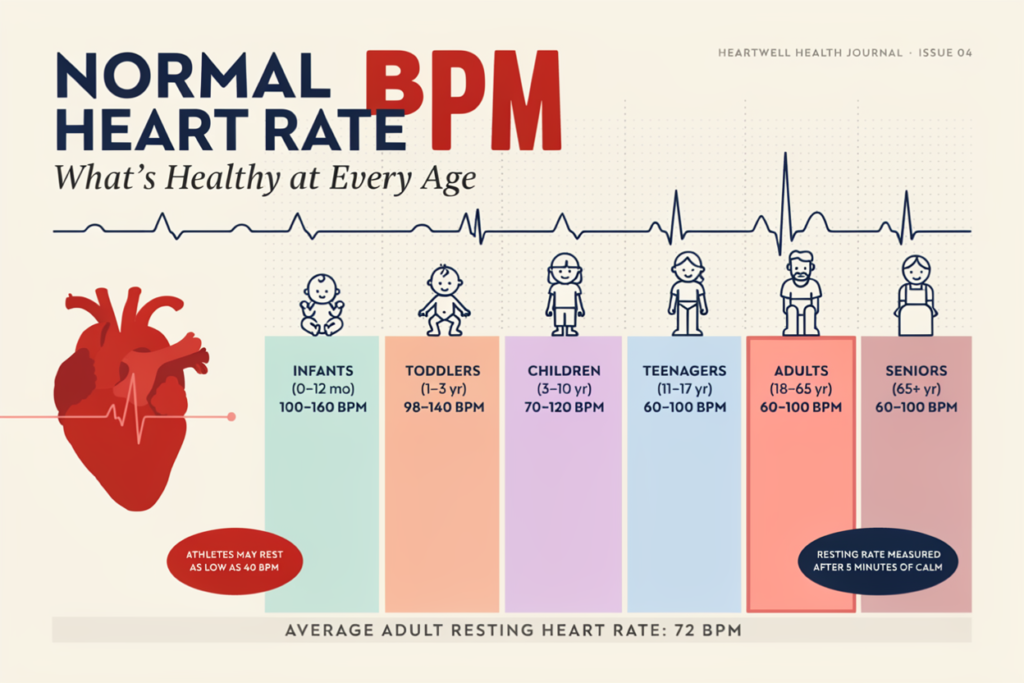
A normal resting heart rate for most adults is 60–100 beats per minute while sitting or lying down, calm, and feeling well. Children usually have faster heart rates, while well-trained athletes may have resting rates near 40–60 BPM without symptoms.
Heart rate, also called pulse rate, is the number of times the heart beats in one minute. A single reading should be interpreted alongside age, activity, fitness, medication, illness, and symptoms rather than treated as a diagnosis by itself.
What Is a Normal Heart Rate in BPM?
For most adults, the usual resting range is 60–100 BPM. A resting measurement should be taken when you are awake, physically inactive, calm, and not immediately recovering from exercise.
The guide to heart rate and BPM explains how a biological pulse differs from musical tempo even though both use beats per minute.
Is a Resting Heart Rate Below 60 BPM Normal?
A resting rate below 60 BPM is commonly called bradycardia, but the number is not automatically dangerous. Athletes and physically active adults may have lower resting rates because the heart can pump blood efficiently with fewer beats.
Heart rate can also drop during sleep or because of medicines such as beta blockers. A low rate deserves medical assessment when it is new, persistent, or accompanied by fainting, dizziness, unusual fatigue, breathing difficulty, confusion, or chest discomfort.
Is a Resting Heart Rate Above 100 BPM Normal?
A resting adult rate above 100 BPM is commonly called tachycardia. Temporary increases can occur with exercise, anxiety, pain, fever, dehydration, caffeine, nicotine, or some medicines.
A repeated resting rate above 100 BPM should be discussed with a healthcare professional, particularly when there is no clear temporary cause or when symptoms are present.
Normal Resting Heart Rate by Age
Children generally have faster pulses than adults, and the usual range gradually decreases as they grow.
| Age | Approximate Resting Heart Rate |
|---|---|
| Newborn, 0–1 month | 70–190 BPM |
| Infant, 1–11 months | 80–160 BPM |
| 1–2 years | 80–130 BPM |
| 3–4 years | 80–120 BPM |
| 5–6 years | 75–115 BPM |
| 7–9 years | 70–110 BPM |
| Age 10 and older | 60–100 BPM |
| Well-trained adult athlete | Often 40–60 BPM |
These are general reference ranges rather than personal targets. Fever, crying, movement, stress, dehydration, medication, and illness can change a child’s or adult’s pulse.
The word BPM simply means beats per minute, but a normal value depends entirely on what is being measured and under which conditions.
What Is the Difference Between Resting and Active Heart Rate?
Resting heart rate is measured while the body is calm and physically inactive. Active heart rate rises because working muscles need more oxygenated blood.
Exercise Heart Rate
Heart rate normally increases during walking, running, cycling, and other exercise. The expected number varies with age, intensity, fitness, temperature, hydration, medication, and health.
A commonly used rough estimate for maximum heart rate is:
220 − age
This formula is only a population-level estimate and can be inaccurate for an individual.
Moderate exercise is often described as approximately 50–70% of estimated maximum heart rate, while vigorous exercise is commonly placed near 70–85%. People with heart conditions or medicines that alter pulse response should use clinician guidance instead of relying solely on these percentages.
The running BPM guide discusses cadence and music tempo, but song BPM should not be confused with a medically appropriate exercise heart rate.
Recovery Heart Rate
After exercise stops, heart rate should begin moving back toward its resting level. The speed of recovery varies with exercise intensity, fitness, heat, hydration, medication, and health.
A wearable can help identify trends, but one recovery reading should not be used to diagnose a condition.
Sleeping Heart Rate
Heart rate often decreases during sleep because the body’s energy demands are lower. It can still fluctuate with sleep stage, dreams, breathing disturbances, fever, alcohol, stress, and illness.
What Factors Affect Heart Rate?
Heart rate naturally changes throughout the day. Common influences include:
- Physical activity and fitness
- Stress, anxiety, and strong emotions
- Fever, pain, dehydration, and illness
- Caffeine, nicotine, and other stimulants
- Prescription and nonprescription medicines
- Body position and environmental temperature
- Hormonal changes and heart-rhythm conditions
A reading taken immediately after climbing stairs should not be compared directly with one taken after several quiet minutes in bed.
Music can influence workout pace and perceived effort, but running music tempo is a playlist characteristic rather than a clinical target.
How Do You Measure Your Heart Rate Correctly?
Sit quietly for at least several minutes before measuring a resting pulse. Avoid checking immediately after exercise, caffeine, smoking, or emotional stress.
Find Your Pulse
Place the pads of two fingers on the thumb side of the opposite wrist. Apply gentle pressure until you feel the radial pulse.
You can also feel the carotid pulse beside the windpipe, but press gently and check only one side of the neck at a time.
Count the Beats
When the rhythm feels regular, count for 30 seconds and multiply by two.
Beats counted in 30 seconds × 2 = BPM
For example, 36 beats in 30 seconds equals 72 BPM.
Count for a full 60 seconds when the pulse seems irregular, unusually slow, or difficult to measure. Notice whether the beats feel evenly spaced as well as how many occur.
Repeat the Measurement
Repeat the reading after another quiet period. Measuring at a similar time and in a similar posture can reveal a more useful personal baseline than one isolated result.
Is Heart Rate the Same as Blood Pressure?
No. Heart rate counts how many times the heart beats each minute, while blood pressure measures the force of blood against artery walls.
One can be normal while the other is abnormal. A normal pulse does not prove that blood pressure is normal, and a high pulse does not automatically mean high blood pressure.
Comparing heart rate with the average tempo concept can explain the shared unit, but medical and musical BPM serve different purposes.
When Should You Seek Medical Help?
Seek urgent medical help for a fast, slow, pounding, or irregular heartbeat accompanied by chest pain, shortness of breath, fainting, severe dizziness, confusion, marked weakness, or signs of a stroke. Contact local emergency services rather than trying to interpret the BPM yourself.
Arrange medical advice for repeated unexplained resting readings above 100 BPM, a newly low rate, persistent irregularity, or palpitations that keep returning. The urgency depends more on symptoms and clinical context than on one number alone.
Do not stop a prescribed medicine because it changes your heart rate without speaking to the clinician who prescribed it.
How Can You Track Resting Heart Rate Over Time?
Measure under similar conditions, such as shortly after waking and before caffeine. Record the number, rhythm, symptoms, recent activity, illness, and relevant medication changes.
Look for trends rather than reacting to minor daily variation. Watches and fitness trackers can be useful for patterns, but movement, loose fit, poor skin contact, and device algorithms can affect accuracy.
A persistent change from your usual baseline is more informative than a single unusual reading and can be shared with a healthcare professional.
Frequently Asked Questions
Is 72 BPM a normal resting heart rate?
Yes. A resting rate of 72 BPM is within the usual 60–100 BPM adult range, provided the person is calm and feeling well.
Is 50 BPM too low?
It may be normal for a trained athlete, during sleep, or for someone taking a heart-rate-lowering medicine. Medical advice is appropriate when it is new or accompanied by dizziness, fainting, weakness, chest discomfort, or breathing difficulty.
Is 100 BPM normal when resting?
One hundred BPM is at the upper edge of the usual adult resting range. Repeated higher readings, especially without an obvious cause, should be discussed with a healthcare professional.
What is a normal heart rate while walking?
There is no single normal walking rate. It depends on age, pace, fitness, temperature, health, and medication.
Does resting heart rate increase with age?
The standard adult resting range remains broadly similar across adulthood. Maximum exercise heart rate generally decreases with age.
When is a fast heartbeat an emergency?
A fast or irregular heartbeat with chest pain, shortness of breath, fainting, severe dizziness, confusion, or neurological symptoms requires urgent medical help.

Olivia Carter is a music technology writer and rhythm analysis specialist at Tempo Finder. She focuses on tempo detection, BPM analysis, beat matching, rhythm tools, and music production workflows for DJs, producers, musicians, and beginners. Olivia creates practical, easy-to-understand content around tempo finding, beat synchronization, metronomes, DJ transitions, and audio timing to help creators improve workflow, accuracy, and musical performance.