
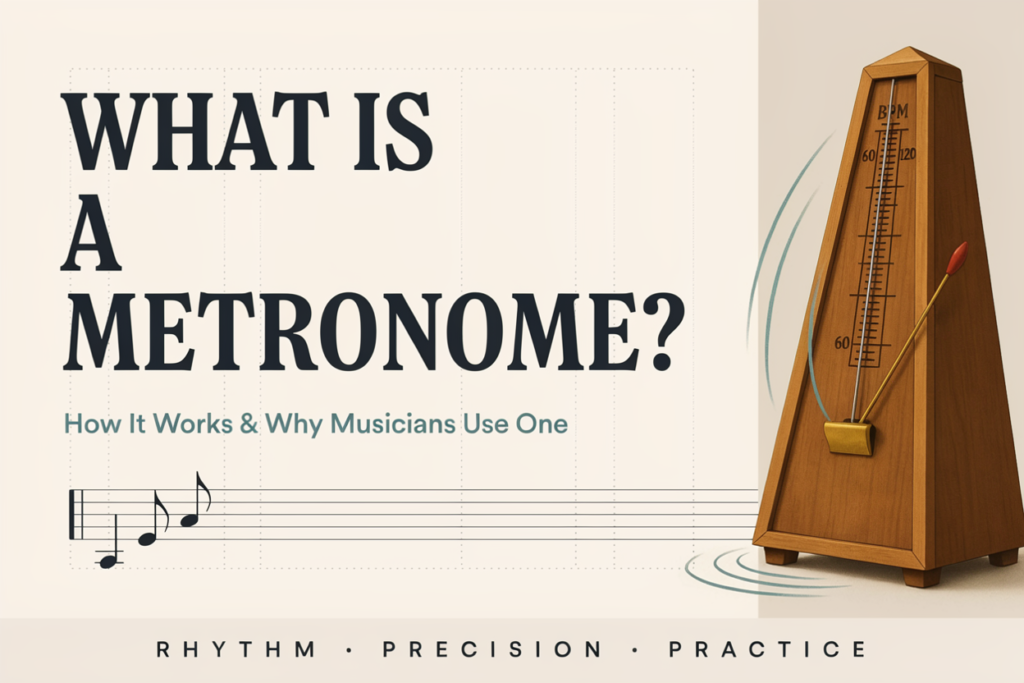
A metronome is a device or software tool that produces a steady, evenly spaced pulse to help musicians play in time. Its speed is set in beats per minute, so 60 BPM creates one click per second and 120 BPM creates two clicks per second.
Musicians use metronomes to improve timing, practise difficult passages, understand subdivisions, prepare for ensemble playing, and reproduce a specific tempo. It gives you an objective reference for checking whether your timing is stable.
What Is a Metronome?
A metronome creates regular clicks, flashes, or vibrations at a selected tempo. Each signal represents a beat or another chosen rhythmic unit.
The simplest example is a metronome set to 60 BPM. Because 60 beats occur in one minute, the device produces one click every second. At 120 BPM, it produces two clicks every second.
You can hear this directly with an online metronome by choosing a BPM value and starting the pulse.
What Does Each Click Represent?
A click usually represents the main beat, but it does not always equal a quarter note. The score, time signature, and practice goal determine which note value receives the pulse.
In a piece marked ♩ = 80, each click represents a quarter note. In a fast 6/8 passage marked 𝅗𝅥. = 60, each click represents a dotted quarter note.
How Does a Metronome Work?
Every metronome divides time into equal intervals, though the mechanism varies.
Mechanical Metronomes
A traditional mechanical metronome uses a spring-powered pendulum. A movable weight on the pendulum controls the speed.
Moving the weight upward slows the swing; moving it downward speeds it up. The mechanism produces a tick at each side of the motion, while printed numbers indicate approximate BPM settings.
Mechanical metronomes require no batteries and provide a visible pulse, but they usually offer fewer features than digital models.
Digital Metronomes
A digital metronome produces its pulse electronically. It may use a speaker, headphone output, flashing light, screen, or vibration.
Many digital models include adjustable accents, different click sounds, time-signature settings, subdivisions, memory presets, and tap tempo.
Online and App Metronomes
Online and mobile metronomes generate the click through software. They are convenient because they can run on devices musicians already own.
Common controls include tempo, start and stop, accents, time signatures, and tap tempo. A guide to using a metronome effectively can help you turn those controls into a structured practice routine.
What Does BPM Mean on a Metronome?
BPM means beats per minute. It tells you how many metronome pulses occur during 60 seconds.
| Setting | Click Rate | General Feel |
|---|---|---|
| 60 BPM | One click per second | Slow and spacious |
| 90 BPM | 1.5 clicks per second | Moderate |
| 120 BPM | Two clicks per second | Steady and energetic |
| 180 BPM | Three clicks per second | Fast |
The guide to what BPM means explains the calculation in more detail.
Does One Click Always Equal a Quarter Note?
No. One click represents whichever rhythmic value you assign to the pulse.
Quarter notes are common in 4/4, while half notes, eighth notes, and dotted quarter notes may be used in other contexts. The written metronome marking is the clearest guide when one appears in the score.
What Is a Metronome Used For?
A metronome helps musicians maintain a stable tempo, develop rhythmic accuracy, measure progress, and coordinate with other performers or recording systems.
Maintaining a Steady Tempo
Many players unintentionally speed up during easy passages and slow down during difficult ones. A steady click reveals this movement immediately.
The goal is not merely to chase the click. You should learn to place each beat confidently so the sound and click appear together.
Practising Difficult Passages
Start below the final tempo at a BPM where the passage feels controlled, then increase it in small steps.
Raise the speed only when the passage remains clean and relaxed.
Improving Subdivision
One steady pulse can support several rhythmic layers:
- Quarter notes: one note per click
- Eighth notes: two notes per click
- Triplets: three notes per click
- Sixteenth notes: four notes per click
Recording and Ensemble Playing
Recording sessions often use a click track synchronized with the project timeline so parts and edits stay aligned.
What Are the Main Types of Metronomes?
| Type | How It Produces the Pulse | Main Advantage | Main Limitation |
| Mechanical | Pendulum and clockwork | Clear visual motion | Limited features |
| Digital hardware | Electronic click and display | Portable and configurable | Requires power |
| Online or app | Software-generated pulse | Easy access | Device distractions |
| DAW click track | Project-synchronized click | Precise recording alignment | Mainly production-focused |
| Wearable | Vibration or tactile pulse | Silent practice | Less familiar feedback |
Beginners mainly need clear sound, accurate timing, simple controls, and minimal distraction. The overview of metronome app options explains what to compare when choosing software.
How Do You Use a Metronome?
First, identify the beat unit. Then choose a comfortable starting tempo, listen before playing, and align your notes with the pulse.
Set a Comfortable BPM
Choose a speed where you can perform accurately.
Count Before Playing
Listen for one or two measures and count aloud before beginning.
Play With the Click
Aim to place your note directly with the click. If you consistently hear the click before your note, you are late. If your note comes first, you are early.
Increase the Tempo Gradually
Raise the BPM after several clean repetitions; lower it again if tension or mistakes return.
How Does a Metronome Relate to Time Signatures?
A time signature organizes beats into measures, while a metronome controls how quickly the selected beat passes. They are related, but they do not mean the same thing.
See understanding time signatures for more on beat grouping.
Metronome in 4/4 and 3/4
In 4/4, a digital metronome may group four clicks and accent the first one. In 3/4, it may group three clicks, creating a strong-weak-weak pattern.
The accent marks the start of the measure without changing BPM.
Metronome in 6/8
In 6/8, musicians may count six eighth-note pulses or two larger dotted-quarter beats. The best choice depends on the tempo and character.
Six clicks can clarify subdivisions, while two dotted-quarter clicks often feel more natural at faster tempos.
Does Practising With a Metronome Make You Better?
A metronome can improve timing awareness, coordination, rhythmic precision, and tempo control when used deliberately. It cannot replace listening, phrasing, dynamics, groove, or expressive flexibility.
See beat versus tempo for the distinction between pulse and musical rhythm.
To avoid dependence, alternate between playing with and without the click, or reduce the number of audible clicks.
Who Invented the Metronome?
Dietrich Nikolaus Winkel created an influential compact mechanism in the early nineteenth century. Johann Nepomuk Maelzel adapted and commercially promoted a similar design, patenting his metronome in 1815.
Ludwig van Beethoven became one of the earliest prominent composers to publish numerical metronome markings.
Reading tempo markings helps connect numerical values with descriptive terms.
Common Metronome Mistakes
Common mistakes include starting too fast, reacting after each click, using the wrong beat unit, ignoring subdivisions, and increasing the BPM before a passage is accurate.
Mechanical precision does not replace phrasing, tone, dynamics, articulation, or stylistic judgment.
The guide to what tempo means explains why speed is both measurable and expressive.
Frequently Asked Questions
What is a metronome in simple terms?
A metronome is a tool that makes evenly spaced clicks or signals. Musicians use those signals to practise and maintain a steady tempo.
What does 60 BPM mean on a metronome?
It means the metronome produces 60 beats per minute. That equals one click every second.
Is a metronome the same as a beat?
No. A beat is the recurring pulse in music, while a metronome is a tool that produces a reference pulse at a selected speed.
Can a metronome help with rhythm?
Yes. It can improve timing, subdivision, coordination, and awareness of rushing or slowing. Rhythm still requires understanding note lengths, accents, rests, and phrasing.
Should beginners always practise with a metronome?
Beginners should use one regularly, but not during every repetition. Alternating between metronome and unaccompanied practice helps develop an independent internal pulse.
What is the difference between a metronome and a click track?
A metronome is a general tempo-reference tool. A click track is a metronome-like pulse synchronized with a recording, backing track, or digital project timeline.

Olivia Carter is a music technology writer and rhythm analysis specialist at Tempo Finder. She focuses on tempo detection, BPM analysis, beat matching, rhythm tools, and music production workflows for DJs, producers, musicians, and beginners. Olivia creates practical, easy-to-understand content around tempo finding, beat synchronization, metronomes, DJ transitions, and audio timing to help creators improve workflow, accuracy, and musical performance.