
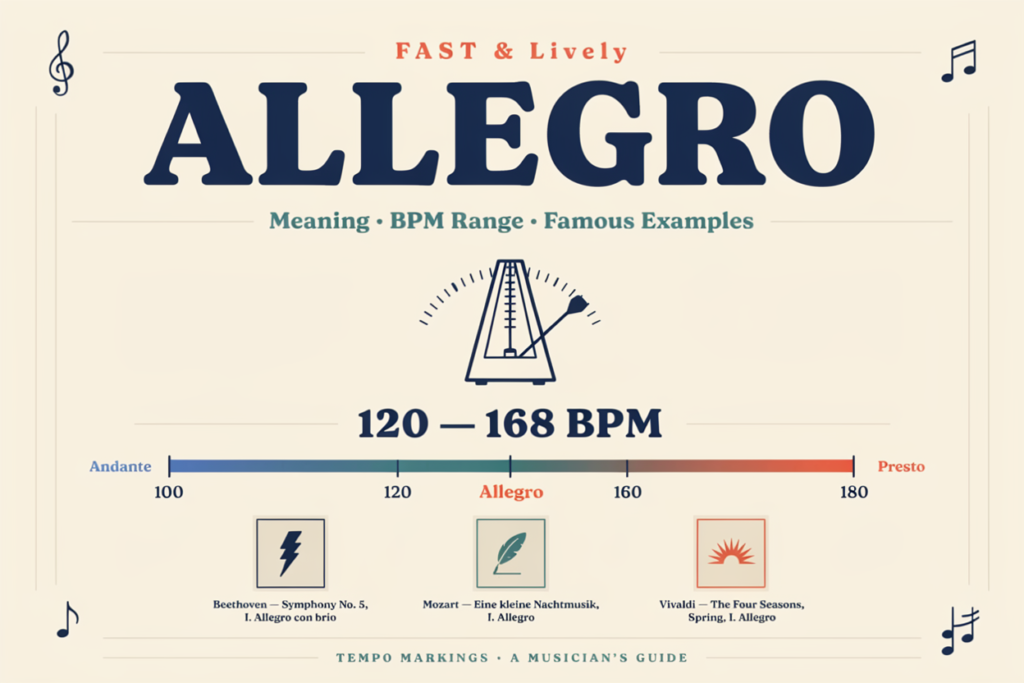
Allegro is an Italian musical direction meaning fast, quick, and usually bright in character. Modern tempo charts often place Allegro around 120–156 beats per minute, but the correct speed depends on the beat unit, meter, period, and musical context.
A good Allegro performance should feel energetic without sounding hurried. The pulse, articulation, and phrasing must remain controlled.
For a broader overview of related terms, see the guide to common tempo markings.
What Does Allegro Mean in Music?
Allegro means fast or lively in music. It usually tells the performer to use a quick tempo with a bright, active, or cheerful character.
The marking may appear at the beginning of a movement or section and can be combined with words that refine its speed or expression.
Understanding what tempo means in music helps explain why Allegro is more than a metronome number. A BPM value measures speed, while the word Allegro also suggests how that speed should feel.
What Is the Literal Meaning of Allegro?
In Italian, allegro can mean cheerful, lively, or merry. In a musical score, the word usually indicates a fast tempo with an animated character.
Not every Allegro passage sounds joyful. Harmony, dynamics, articulation, and instrumentation may make it dramatic, elegant, or forceful.
Does Allegro Describe Speed or Character?
Allegro describes both speed and character. It points toward a fast pulse, but it also suggests energy, brightness, and forward motion.
Two performances at nearly the same BPM can still feel different because of accent, phrasing, and tone.
What BPM Is Allegro?
Allegro is associated with approximately 120–156 BPM. This is a practical reference range rather than a universal rule.
Some systems use narrower ranges. A composer’s metronome marking should take priority, while historical style and performance tradition may influence the result.
Why Do Allegro BPM Ranges Differ?
Italian tempo words were used long before precise metronome markings became common. They functioned as flexible performance directions rather than exact numerical categories.
Modern publishers divide the tempo spectrum differently. One chart may begin Allegro near 120 BPM, while another may classify part of that range as Allegretto or Vivace. Musicians should therefore combine BPM charts with the score, meter, and context.
How Does the Beat Unit Affect Allegro?
The beat unit determines which note value receives the BPM number. Quarter note = 132 means 132 quarter-note beats occur each minute. Dotted quarter note = 132 creates a different note-level speed because each beat contains three eighth notes.
In 6/8 time, performers often feel two large beats per measure rather than six separate eighth notes.
Before choosing a practice tempo, identify the beat unit and learn how to read tempo markings together with the time signature.
Allegro vs Allegretto vs Vivace vs Presto
Allegro is generally faster than Allegretto but slower than Vivace and Presto. The ranges overlap because each marking also communicates character.
| Tempo marking | Common reference range | General meaning |
|---|---|---|
| Allegretto | 112–120 BPM | Moderately fast |
| Allegro | 120–156 BPM | Fast and bright |
| Vivace | 156–176 BPM | Lively and spirited |
| Presto | 168–200 BPM | Very fast |
These figures are approximate; the score and style should guide the final decision.
Is Allegro Faster Than Allegretto?
Yes. Allegretto means moderately fast or slightly less fast than Allegro.
Allegretto often feels lighter, while Allegro creates stronger forward motion.
Is Allegro Slower Than Vivace?
Allegro is generally slower than Vivace. Vivace means lively or spirited and usually suggests greater animation.
Their upper and lower ranges can meet near the mid-150s. The Vivace tempo guide explains why its lively quality matters as much as the number.
Is Allegro Slower Than Presto?
Yes. Presto means very fast and normally sits above Allegro in the traditional tempo hierarchy.
A typical Allegro should feel energetic and controlled. Presto pushes the speed further and often creates a more urgent or virtuosic effect. The guide to Presto in music compares that faster marking in more detail.
What Do Common Allegro Variations Mean?
Additional Italian words refine the basic Allegro instruction. They can restrain the speed, intensify it, or change the expressive character.
Allegro Moderato
Allegro moderato means moderately fast. It asks for an Allegro character without using the full speed of a more energetic Allegro.
The phrase sits between Moderato and ordinary Allegro. It is useful when the music needs momentum but should not feel hurried.
Allegro Ma Non Troppo
Allegro ma non troppo means fast, but not too much. The performer should maintain energy while avoiding excessive speed.
This protects detail and phrasing that might disappear at excessive speed.
Molto Allegro
Molto Allegro means very fast or very lively. It intensifies the normal Allegro direction.
The exact BPM still depends on the piece; molto does not create one fixed numerical increase.
Allegro Con Brio and Allegro Energico
Allegro con brio means fast with vigor or spirit. Allegro energico asks for an energetic and forceful character.
These modifiers shape performance character rather than assigning exact BPM ranges.
Is Allegro the Same as Sonata-Allegro Form?
No. Allegro is a tempo and character marking, while sonata-allegro form is a structural design.
Sonata form commonly includes an exposition, development, and recapitulation. It became strongly associated with fast first movements, which is why the word Allegro often appears in its name.
Why Are the Terms Often Confused?
Many Classical-period sonatas, symphonies, and concertos begin with a fast movement in sonata form. The repeated connection between structure and tempo led to the term sonata-allegro form.
However, the word Allegro in a score still indicates performance character. The form describes how themes and key areas are organized.
Can Sonata Form Be Played at Another Tempo?
Yes. A movement can use sonata form without being performed at a standard Allegro speed.
Some slow movements use sonata-like structures, while some fast movements use other forms. Tempo and form remain separate concepts.
How Should You Practice an Allegro Passage?
Practice below the final tempo, secure the rhythm and movement, then increase the speed gradually. The goal is controlled energy rather than repeated attempts at the fastest possible setting.
Establish the Rhythm Below Final Tempo
Begin where notes, rests, fingering, articulation, and phrasing remain accurate, often around 60–75% of the target tempo.
Use short sections and repeat them without tension. Fix uncertain transitions before increasing the speed.
Increase the Metronome Gradually
Raise the tempo by two to five BPM after several dependable repetitions. Small changes make it easier to notice when coordination begins to weaken.
An online metronome can help you make consistent increases instead of guessing.
Group Notes Into Beats and Phrases
Fast passages become easier when notes are organized into beat groups and phrases rather than treated separately.
Practice with a slight emphasis on the start of each group. Remove the extra accent later while preserving the internal organization.
Avoid Turning Allegro Into Rushing
Rushing happens when the pulse becomes unstable or details disappear. Common signs include clipped notes, uneven subdivisions, physical tension, and uncontrolled acceleration.
Understanding how a metronome works can help separate deliberate tempo practice from simply playing faster.
Why Can Two Allegro Performances Sound Different?
Two Allegro performances can differ because tempo markings leave room for interpretation. Historical style, instrumentation, articulation, room acoustics, phrasing, and conductor preference all affect the result.
A Baroque Allegro may use light articulation, while a Romantic Allegro may use broader phrases and heavier accents.
Historical Performance Practice
Musicians interpret tempo through period conventions. Instruments, ensemble size, dance influence, and notation habits all affect how fast a passage can be played convincingly.
Metronome Numbers vs Musical Character
A metronome number provides precision, but it cannot describe every expressive detail. Allegro tells the performer that the music should move with energy and brightness.
The best tempo is one that preserves both the intended speed and the musical shape.
Frequently Asked Questions
What BPM is Allegro?
Allegro is commonly placed around 120–156 BPM. The exact tempo depends on the beat unit, meter, style, and any metronome number supplied by the composer.
What does Allegro mean in music?
Allegro means fast, quick, and usually bright or lively in character. It communicates both speed and expressive energy.
Is Allegro fast or slow?
Allegro is fast. It normally sits above Moderato and Allegretto but below Vivace and Presto.
Is Allegro faster than Vivace?
No. Vivace is generally faster and more animated than Allegro, although their estimated BPM ranges may meet near the boundary.
What does Allegro ma non troppo mean?
Allegro ma non troppo means fast, but not excessively fast. It asks the performer to preserve energy without allowing speed to damage clarity or expression.
What is the difference between Allegro and sonata-allegro form?
Allegro is a tempo and character instruction. Sonata-allegro form is a structural pattern involving sections such as exposition, development, and recapitulation.

Olivia Carter is a music technology writer and rhythm analysis specialist at Tempo Finder. She focuses on tempo detection, BPM analysis, beat matching, rhythm tools, and music production workflows for DJs, producers, musicians, and beginners. Olivia creates practical, easy-to-understand content around tempo finding, beat synchronization, metronomes, DJ transitions, and audio timing to help creators improve workflow, accuracy, and musical performance.