
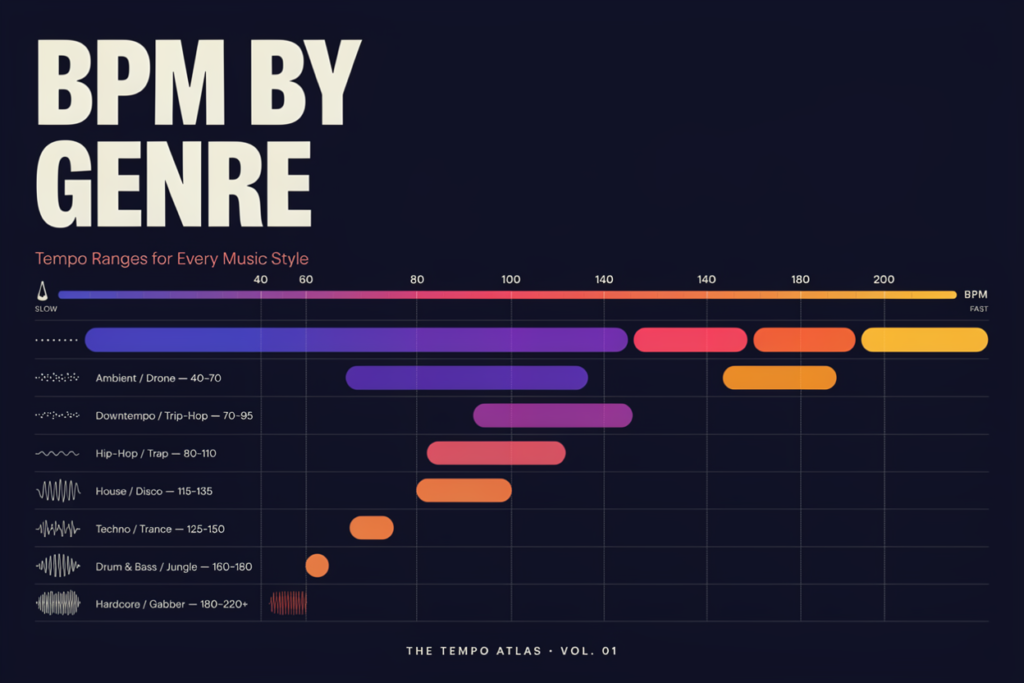
BPM by genre refers to the typical beats-per-minute ranges commonly used in different styles of music. While genres do not have fixed BPM rules, many styles tend to fall within recognizable tempo ranges that influence their energy, groove, and overall feel. For example, house music often sits around 120–130 BPM, while drum and bass commonly uses much faster tempos around 160–180 BPM.
Understanding BPM by genre helps musicians, producers, DJs, and listeners identify the rhythmic character of different music styles and choose suitable tempos when creating or mixing tracks.
What Is BPM and Why Does Genre Matter?
BPM stands for beats per minute and measures the speed of a musical beat. A song at 120 BPM contains 120 beats in one minute, while a song at 80 BPM has a slower pulse.
You can learn more about the fundamentals of BPM and how it relates to musical timing in our guide to what BPM means in music.
Genre influences BPM because different styles are built around different rhythmic traditions, instruments, and listening experiences. A slow hip-hop groove, an energetic dance track, and an aggressive electronic song may all use different tempo ranges to create their characteristic feel.
However, BPM alone does not define a genre. Rhythm patterns, production techniques, instrumentation, and arrangement are equally important.
BPM by Genre Chart
The following ranges represent common tempo areas rather than strict rules. Many songs fall outside these ranges while still belonging to the same genre.
| Music Genre | Typical BPM Range | Common Musical Feel |
|---|---|---|
| Ambient | 60–90 BPM | Slow, atmospheric, spacious |
| Lo-fi Hip-Hop | 70–100 BPM | Relaxed, mellow, laid-back |
| Hip-Hop | 80–110 BPM | Groove-focused, rhythmic |
| R&B | 60–110 BPM | Smooth, vocal-focused |
| Reggae | 70–100 BPM | Relaxed, offbeat groove |
| Pop | 100–130 BPM | Catchy, energetic, accessible |
| Rock | 110–140 BPM | Driving, live-performance energy |
| House | 120–130 BPM | Steady dance groove |
| Trance | 125–150 BPM | Uplifting, repetitive energy |
| Techno | 125–150 BPM | Mechanical, driving pulse |
| Dubstep | 135–145 BPM | Heavy half-time feel |
| Drum and Bass | 160–180 BPM | Fast breakbeat movement |
| Hardcore | 160–200+ BPM | Extremely fast and intense |
Electronic Music BPM Ranges
Electronic music contains some of the most recognizable BPM patterns because DJs often mix tracks based on tempo compatibility.
House Music
House music commonly uses 120–130 BPM. The steady four-on-the-floor beat makes this range ideal for clubs, dancing, and DJ transitions.
Different subgenres may vary:
- Deep house: around 110–125 BPM
- Classic house: around 120–130 BPM
- Progressive house: around 125–135 BPM
For more details, see our guide on house music tempo.
Techno
Techno often falls between 125–150 BPM. Faster techno styles create a more intense and driving experience, while slower versions may focus more on atmosphere and groove.
Dubstep
Dubstep is commonly associated with 135–145 BPM, but it is often felt at half-time. A track at 140 BPM may feel like a slower 70 BPM groove because the drums emphasize fewer major beats.
Drum and Bass
Drum and bass usually ranges from 160–180 BPM. The fast breakbeats and energetic drum patterns create its distinctive high-speed character.
Learn more about this style in our guide to drum and bass tempo.
Hip-Hop and Urban Music BPM Ranges
Hip-hop frequently uses slower BPM values compared with many dance genres, commonly between 80–110 BPM.
However, producers often use a half-time or double-time approach. For example:
- A beat at 90 BPM can feel relaxed and spacious.
- A trap track produced at 140 BPM may feel like 70 BPM because of the drum arrangement.
Common ranges:
- Traditional hip-hop: 80–100 BPM
- Trap: 120–160 BPM (often perceived in half-time)
- Lo-fi hip-hop: 70–90 BPM
- Modern R&B: 60–110 BPM
The emotional feel of a track often depends more on rhythm placement and sound design than BPM alone.
Why the Same BPM Can Feel Different in Different Genres
Two songs can have the same BPM but feel completely different.
For example, a 120 BPM pop song and a 120 BPM house track share the same basic tempo, but their rhythms create different experiences.
Several factors affect perceived speed:
Half-Time and Double-Time Feel
A producer may count the same BPM in different ways:
- Half-time feel: A fast BPM feels slower because the main accents are spaced farther apart.
- Double-time feel: A slower BPM feels faster because rhythms are subdivided more actively.
Drum Patterns
The placement of kicks, snares, and hi-hats changes how listeners perceive movement.
A dense drum pattern can make a moderate BPM feel energetic, while a simple arrangement can make the same BPM feel relaxed.
Musical Arrangement
Vocals, melodies, basslines, and chord changes also influence the feeling of speed.
This is why BPM should be considered a guide rather than the complete identity of a genre.
How to Choose the Right BPM When Producing Music
When selecting a BPM for a new track, consider:
1. Start With Genre Expectations
Use common BPM ranges as a starting point. A dance track may naturally fit a faster tempo, while a ballad may require something slower.
2. Match the Emotional Goal
Ask what feeling you want:
- Calm and reflective → slower BPM
- Energetic and exciting → faster BPM
- Dance-focused → steady rhythmic BPM
3. Consider Vocals and Instruments
A tempo that works for drums may not always suit a singer. Leave enough space for vocal phrasing and musical expression.
4. Test the Groove
Small BPM changes can significantly affect the character of a song. Try several tempos before deciding.
If you need to measure the tempo of an existing track, you can use a BPM finder tool to identify its speed.
Frequently Asked Questions
What BPM is most common in popular music?
There is no single universal BPM for popular music, but many pop songs fall around 100–130 BPM because this range supports both energetic and comfortable listening experiences.
What BPM is house music?
House music commonly uses around 120–130 BPM, although specific subgenres may use slightly slower or faster tempos.
What BPM is hip-hop?
Hip-hop commonly falls between 80–110 BPM, but modern styles such as trap may use higher BPM values with a half-time feel.
Is BPM the same as tempo?
BPM is a measurement of tempo. Tempo describes the speed of music, while BPM provides the numerical measurement of that speed.
For a deeper explanation, see our guide on BPM vs tempo.
Can a song break the usual BPM rules of its genre?
Yes. Genres are defined by many factors, including rhythm, sound, instruments, and production style. A song can use an unusual BPM and still fit its genre.

Olivia Carter is a music technology writer and rhythm analysis specialist at Tempo Finder. She focuses on tempo detection, BPM analysis, beat matching, rhythm tools, and music production workflows for DJs, producers, musicians, and beginners. Olivia creates practical, easy-to-understand content around tempo finding, beat synchronization, metronomes, DJ transitions, and audio timing to help creators improve workflow, accuracy, and musical performance.