
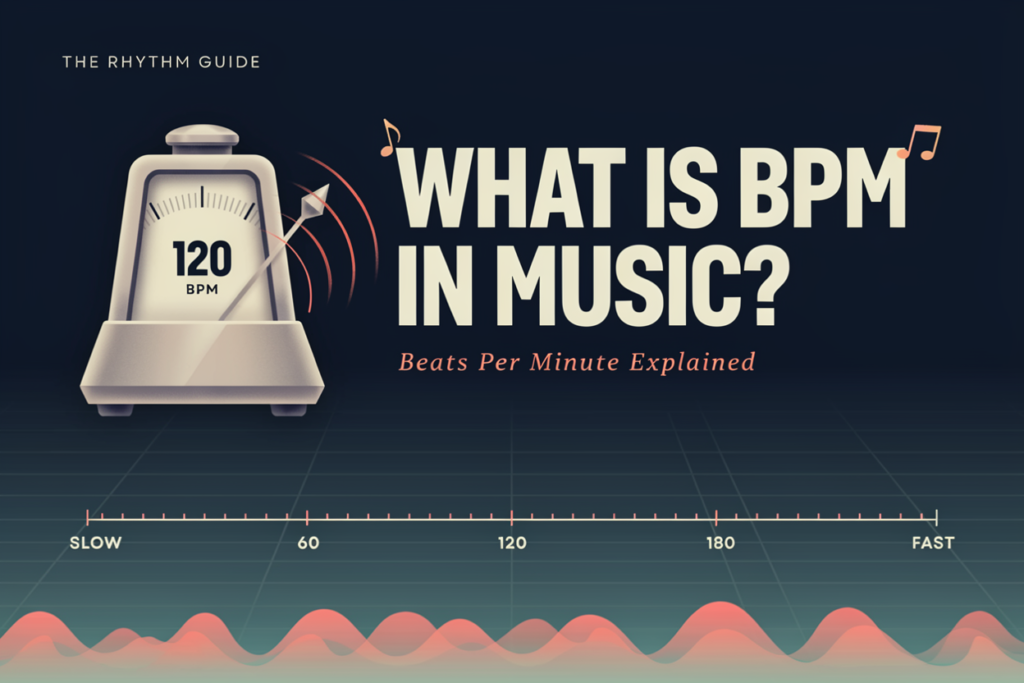
BPM stands for beats per minute. In music, it measures tempo by counting how many beats occur in one minute. A song at 60 BPM has one beat every second, while a song at 120 BPM has two beats every second.
BPM gives musicians, producers, DJs, and listeners a numerical way to compare musical speed.
For a broader explanation of musical speed, see the guide to what tempo means in music.
What Does BPM Mean in Music?
BPM means beats per minute. It tells you how many steady musical pulses occur during one minute.
If a track is set to 100 BPM, the main beat repeats 100 times in 60 seconds. Higher values usually indicate faster tempos, while lower values indicate slower ones.
How Does BPM Measure Musical Speed?
BPM measures the frequency of the main pulse.
Common examples include:
- 60 BPM: one beat per second
- 90 BPM: one and a half beats per second
- 120 BPM: two beats per second
- 180 BPM: three beats per second
What Counts as One Beat?
The beat is the repeating pulse you naturally tap along with. In written music, the score also indicates which note value receives it.
A quarter note may represent one beat in 4/4 time, while a dotted quarter note often represents one beat in 6/8 time. That is why BPM should be understood together with meter and the beat unit.
What Is the Difference Between BPM, Beat, Rhythm, and Tempo?
BPM is the numerical measurement of tempo. The beat is the repeating pulse, rhythm is the pattern of notes and rests, and tempo is the overall speed of the music.
| Term | Meaning |
|---|---|
| Beat | The repeating musical pulse |
| BPM | The number of beats per minute |
| Tempo | The overall speed of the music |
| Rhythm | The pattern of notes, rests, and accents |
BPM vs Tempo
Tempo describes how fast or slow the music moves. BPM expresses that speed with a number.
For example, a composer might write Allegro to indicate a fast, lively tempo. A producer might communicate the same general speed more precisely by setting the project to 132 BPM.
The guide to BPM versus tempo explains why the terms are related but not identical.
Beat vs Rhythm
The beat is the steady pulse underneath the music. Rhythm is the way sounds and silences are arranged around that pulse.
A drummer may keep the beat steady while playing different rhythmic patterns. The BPM can remain unchanged as the rhythm becomes denser.
For a deeper comparison, see beat versus tempo and rhythm versus tempo.
How Do BPM Numbers Work?
BPM numbers describe how often the main beat occurs. Lower values usually create more space between beats, while higher values place the beats closer together.
A practical tempo guide looks like this:
| Tempo feel | Approximate BPM |
| Very slow | 40–60 BPM |
| Slow | 60–80 BPM |
| Medium | 80–120 BPM |
| Fast | 120–160 BPM |
| Very fast | 160 BPM and above |
These are general references. Arrangement and half-time feel can change how fast the music seems.
Common BPM Examples
At 60 BPM, each beat lasts one second. At 120 BPM, each beat lasts half a second; at 180 BPM, one-third of a second.
How Does the Beat Unit Affect BPM?
The BPM number only becomes complete when you know which note value receives the beat.
Quarter note = 120 means 120 quarter-note beats per minute. Dotted quarter note = 120 means 120 dotted-quarter beats, each commonly divided into three eighth notes.
Quarter Note vs Dotted-Quarter Beat
In 4/4 time, the quarter note usually carries the main beat. In 6/8 time, musicians often feel two dotted-quarter beats per measure rather than six separate eighth-note beats.
Both pieces might show 120 BPM, but their rhythmic motion can feel very different because the beat is organized differently.
How Time Signatures Affect Counting
In 4/4 time, musicians usually count four quarter-note beats per measure. In 3/4, they usually count three. In 6/8, they often feel two larger beats, each divided into three eighth notes.
The time signature does not automatically determine the BPM, but it affects how performers hear and count the pulse.
What Is a Typical BPM by Music Genre?
Genres tend to occupy broad tempo ranges rather than one exact BPM. Production style, regional influence, dance patterns, and subgenre all affect the final speed.
| Genre | Common tempo range |
| Ballads | 60–80 BPM |
| Hip-hop | 60–100 BPM |
| Reggaeton | 85–105 BPM |
| Pop | 85–125 BPM |
| House | 115–130 BPM |
| Techno | 120–145 BPM |
| Dubstep | 135–145 BPM |
| Drum and bass | 160–180 BPM |
These ranges are flexible, and double-time counting can place some tracks much higher.
The BPM ranges by genre guide provides a wider comparison.
Why Do Genre Ranges Overlap?
Genres overlap because drum patterns, sound design, harmony, instrumentation, and vocal delivery also shape style.
Two tracks at 128 BPM may feel completely different if one uses a four-on-the-floor house beat and the other uses syncopated percussion or a half-time groove.
Why Can the Same Song Have Two BPM Values?
The same song may be labeled with two BPM values because one source counts the main pulse while another counts half or twice as many beats.
A track listed at 75 BPM may also be listed at 150 BPM without changing playback speed.
Half-Time and Double-Time
At 75 BPM, the listener may focus on the slower main groove. At 150 BPM, the listener may count a faster subdivision between those beats.
Both values can describe the same recording:
- 75 BPM emphasizes the slower pulse.
- 150 BPM emphasizes the double-time pulse.
- The song itself does not become faster.
Why BPM Detectors Make Mistakes
Automatic BPM detectors can struggle with syncopation, quiet percussion, unusual meters, tempo changes, or an unclear downbeat.
A detector may return exactly half or double the expected tempo. When that happens, compare the result with manual counting or tapping.
How Can You Find a Song’s BPM?
You can find BPM by counting beats manually, using tap tempo, or analyzing the audio automatically.
Count Beats Manually
Use this simple method:
- Play the song and identify the main pulse.
- Count the beats for 15 seconds.
- Multiply the number by four.
If you count 30 beats in 15 seconds, the estimated tempo is 120 BPM.
The guide to finding the BPM of a song includes additional methods and troubleshooting tips.
Use Tap Tempo
A tap tempo tool calculates BPM from the timing of your clicks or key presses. Tap steadily with the main beat for several seconds.
You can estimate a track directly with the tap tempo tool.
Use Automatic Audio Detection
Audio analysis is useful for scanning tracks quickly, but complex rhythms and unusually high or low results should be checked manually.
Why Is BPM Useful?
BPM supports practice, production, DJ transitions, dance, and exercise. Musicians use it to increase speed gradually, while producers use it for grids, loops, and synchronized effects.
A metronome is one of the simplest ways to practice at a specific BPM. The online metronome provides a steady reference pulse.
Why Can Songs at the Same BPM Feel Different?
Songs at the same BPM can feel different because rhythm, subdivision, dynamics, articulation, and arrangement affect perceived speed.
A 90 BPM song with rapid hi-hats may feel energetic, while one with sustained chords and soft vocals may feel calm. BPM measures pulse frequency, not the full musical experience.
Frequently Asked Questions
What does BPM stand for in music?
BPM stands for beats per minute. It measures how many beats occur during one minute of music.
Is BPM the same as tempo?
Not exactly. Tempo is the overall speed of the music, while BPM is the numerical measurement used to describe that speed.
Is a higher BPM always faster?
A higher BPM usually means the counted pulse is faster. However, half-time grooves, subdivisions, and arrangement can make the perceived speed feel different.
What BPM is considered fast music?
Music above roughly 120 BPM is often considered fast. Genre expectations matter, and some styles regularly exceed 160 BPM.
Why can one song be both 70 and 140 BPM?
One value counts the slower main pulse, while the other counts the double-time pulse. Both can describe the same audio.
Does the time signature change the BPM?
The time signature does not automatically change the BPM. It changes how beats are grouped and often helps determine which note value functions as the main pulse.

Olivia Carter is a music technology writer and rhythm analysis specialist at Tempo Finder. She focuses on tempo detection, BPM analysis, beat matching, rhythm tools, and music production workflows for DJs, producers, musicians, and beginners. Olivia creates practical, easy-to-understand content around tempo finding, beat synchronization, metronomes, DJ transitions, and audio timing to help creators improve workflow, accuracy, and musical performance.