
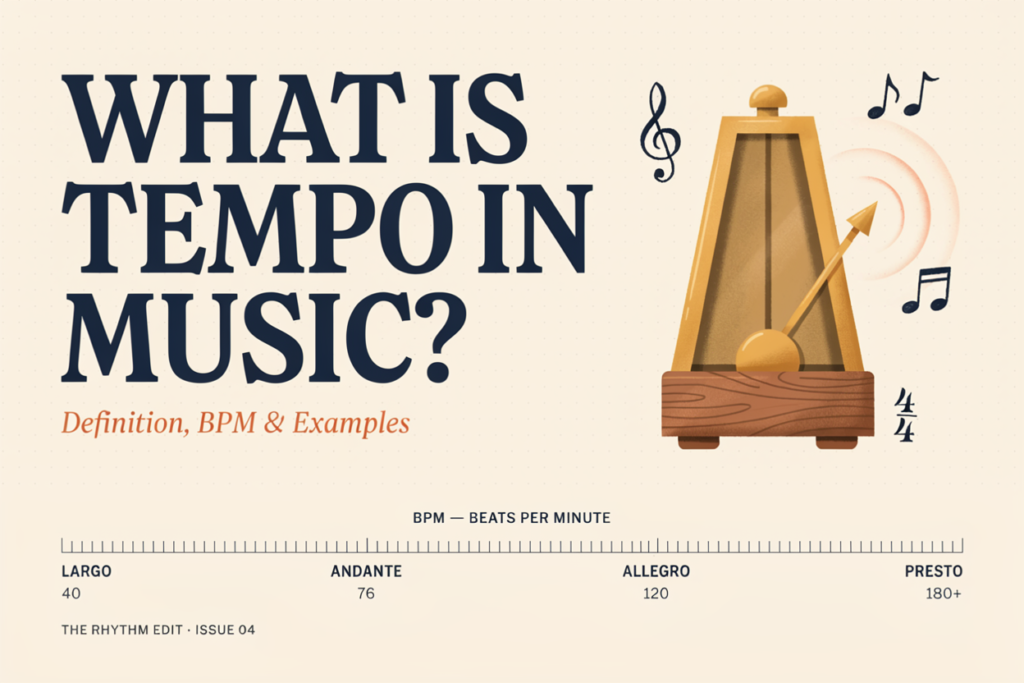
Tempo in music is the speed or pace at which the beats of a piece are performed. It is commonly measured in beats per minute, or BPM, and may also be described with markings such as Adagio, Moderato, Allegro, or Presto.
What Is Tempo in Music?
Tempo describes how quickly or slowly the underlying beats of music move. A faster tempo makes the pulse pass more quickly, while a slower tempo creates more space between beats.
Tempo affects energy, mood, phrasing, and technical difficulty.
For a concise definition, see the guide to what tempo means.
Why Tempo Matters
Tempo shapes the character of a performance.
Fast tempos can create excitement or tension, while slow tempos can create calmness or weight.
Is Tempo Always Constant?
No. Music may stay steady, change gradually, shift suddenly, or use expressive flexibility through rubato.
How Is Tempo Measured?
Tempo is usually measured in beats per minute.
BPM tells you how many selected beats occur during one minute.
What Does BPM Mean?
Simple examples include:
- 60 BPM = one beat per second
- 90 BPM = one and a half beats per second
- 120 BPM = two beats per second
The guide to what BPM means explains the numerical side of tempo in more detail.
Why the Beat Unit Matters
A BPM number must be connected to a note value.
These examples all contain 80 measured pulses per minute:
- Quarter note = 80 BPM
- Half note = 80 BPM
- Dotted quarter = 80 BPM
They create different musical motion because each pulse represents a different duration.
BPM Versus Descriptive Tempo Words
A BPM value gives an exact pulse rate. A word such as Allegro or Adagio gives an approximate speed and often an expressive character.
As the guide to BPM and tempo explains, BPM is numerical while tempo can include character.
What Is the Difference Between Tempo, Beat, and Rhythm?
Tempo is speed, beat is the recurring pulse, and rhythm is the pattern of note durations and accents.
| Musical Element | What It Describes | Example |
|---|---|---|
| Tempo | Speed of the pulse | 120 BPM |
| Beat | Recurring pulse | Steady quarter-note taps |
| Rhythm | Pattern of durations and accents | Quarter notes followed by eighth notes |
| Meter | Grouping of beats | Four beats per measure |
| Time signature | Written meter symbol | 4/4 or 6/8 |
Tempo Versus Beat
The beat is the pulse you tap along with. Tempo tells you how quickly that pulse moves.
Changing tempo makes the beats pass faster or slower.
Tempo Versus Rhythm
Rhythm organizes notes and rests into patterns.
The same rhythm can be played at several tempos. See rhythm and tempo for more detail.
Tempo Versus Time Signature
Tempo controls speed. The time signature organizes beats into measures.
A piece in 4/4 can be slow or fast, and a piece in 6/8 can also be slow or fast. Meter and tempo work together but describe different things.
What Are the Main Tempo Markings?
Traditional tempo markings use Italian words to describe approximate speed and character.
| Marking | General Meaning | Approximate BPM |
| Largo | Slow and broad | About 40–66 |
| Adagio | Slow and expressive | About 44–66 |
| Andante | At a walking pace | About 56–108 |
| Moderato | Moderate | About 108–120 |
| Allegro | Fast and lively | About 120–156 |
| Vivace | Lively and fast | About 156–176 |
| Presto | Very fast | About 168–200 |
These ranges overlap and are only reference points.
The complete guide to tempo markings explains more terms and modifiers.
Slow Tempo Markings
Largo suggests breadth, while Adagio often implies expressive slowness.
Moderate Tempo Markings
Andante suggests a walking pace. Moderato indicates a balanced middle speed that is neither clearly slow nor clearly fast.
Fast Tempo Markings
Allegro suggests speed and liveliness. Vivace is lively and fast, while Presto indicates a very fast pace.
How Is Tempo Written in Sheet Music?
Tempo instructions usually appear above the staff at the beginning of a piece or where the speed changes.
Verbal Tempo Directions
A score may use Italian terms such as Andante, Moderato, or Allegro.
It may also use plain-language directions such as slowly, freely, with movement, or with energy.
Metronome Marks
An exact marking may appear as:
Quarter note = 100
The note value identifies the beat, and the number gives the BPM.
Combined Instructions
A score may combine both: Allegro, quarter note = 132. The word gives character, while the number gives pulse rate.
How Do Musicians Find the Tempo of a Song?
Musicians can find tempo by identifying the main pulse and measuring how often it occurs.
- Listen for the strongest repeating beat.
- Tap along steadily.
- Count beats for a fixed period or use a tap-tempo tool.
- Check whether the result is half-time or double-time.
- Verify the tempo across several sections.
- Watch for intentional tempo changes.
For more methods, see the guide to finding tempo.
Counting BPM Manually
Count the beats for 15 seconds and multiply the result by four.
If you count 30 beats in 15 seconds:
30 × 4 = 120 BPM
Longer counts can improve accuracy.
Using Tap Tempo
Tap along with the song using a tap tempo tool.
The tool estimates BPM from the intervals between taps.
Checking Half-Time and Double-Time
A song may be described as 70 BPM or 140 BPM depending on which pulse level is counted.
Choose the value that best matches the genre, beat grid, and feel.
Why Can Songs at the Same BPM Feel Different?
Songs at the same BPM can feel different because of subdivision, meter, accents, groove, and instrumentation.
Subdivision and Note Density
Sparse quarter notes at 120 BPM may feel relaxed, while continuous sixteenth notes feel busier.
Meter and Beat Grouping
A quarter-note pulse at 120 BPM in 4/4 does not feel the same as a dotted-quarter pulse at 120 BPM in 6/8.
The pulse rate matches, but the grouping differs.
Groove and Accent Placement
Straight, swung, syncopated, and backbeat rhythms feel different.
Tempo supplies the speed, while groove determines how the rhythm sits within that speed.
How Does Tempo Change During Music?
Tempo may change gradually, immediately, or expressively.
Accelerando
Accelerando means gradually becoming faster.
Ritardando and Rallentando
Both indicate gradual slowing, though their nuance may differ.
A Tempo
A tempo means return to the previously established speed.
Rubato
Rubato is controlled expressive flexibility around the underlying pulse.
It allows time to flex without losing the broader pulse.
Sudden Tempo Changes
A composer may place a new BPM or tempo word at the beginning of a contrasting section.
The new instruction replaces the previous tempo unless a transition is marked.
How Do You Practise Tempo With a Metronome?
Use an online metronome to establish a steady pulse and test different speeds.
Choose a Comfortable Starting BPM
Begin slowly enough to maintain accuracy and relaxed technique.
Match the Beat Before Playing
Listen to one or two measures, count aloud, and tap the pulse before beginning.
Practise Subdivisions
Place eighth notes, sixteenth notes, or triplets evenly between clicks.
Increase Tempo Gradually
Raise the metronome by 2–5 BPM after several controlled repetitions.
Use Fewer Clicks
Reduce the click frequency to test whether your internal pulse remains stable between metronome beats.
Common Tempo Mistakes
Common mistakes include confusing tempo with rhythm, assuming BPM equals notes per minute, ignoring the beat unit, starting too fast, rushing difficult passages, and treating Italian BPM ranges as exact.
Frequently Asked Questions
What is the simplest definition of tempo in music?
Tempo is the speed or pace of the musical beat.
Is tempo the same as BPM?
Not exactly. BPM measures tempo numerically, while tempo can also include descriptive and expressive information.
What is the difference between tempo and rhythm?
Tempo controls speed. Rhythm controls the pattern and duration of notes and rests.
Can a song change tempo?
Yes. A song can speed up, slow down, use rubato, or introduce a completely new tempo.
What does 120 BPM mean?
It means the selected beat occurs 120 times per minute, or twice per second.
How can I find the tempo of a song?
Tap the main pulse, count beats over a fixed period, or use a tap-tempo tool. Check for half-time, double-time, and tempo changes.

Olivia Carter is a music technology writer and rhythm analysis specialist at Tempo Finder. She focuses on tempo detection, BPM analysis, beat matching, rhythm tools, and music production workflows for DJs, producers, musicians, and beginners. Olivia creates practical, easy-to-understand content around tempo finding, beat synchronization, metronomes, DJ transitions, and audio timing to help creators improve workflow, accuracy, and musical performance.