
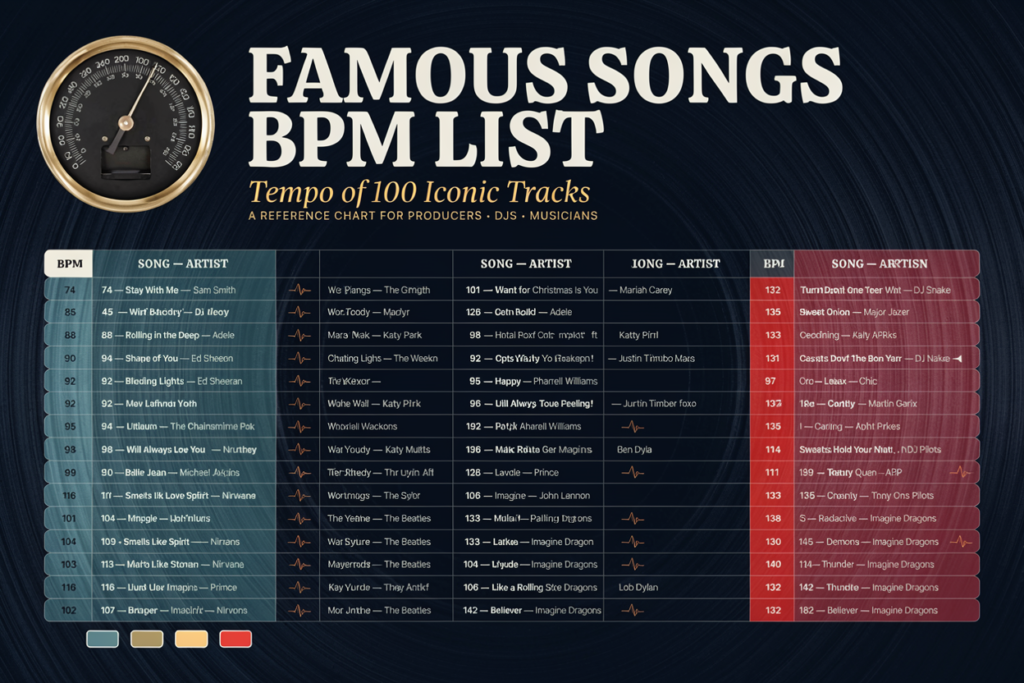
Famous songs range from slow ballads near 60 BPM to energetic tracks above 170 BPM. Most mainstream pop songs sit somewhere between about 90 and 130 BPM, but the way a song feels also depends on rhythm, instrumentation, accents, and whether the beat is heard in half-time or double-time.
BPM means beats per minute. It measures how many steady beats pass in 60 seconds.
Famous Songs BPM Chart
The following chart lists approximate BPM values for well-known recordings. Values can vary because of rounding, alternate releases, tempo drift, or half-time and double-time interpretation.
| Song | Artist | Approx. BPM | General Style |
|---|---|---|---|
| Perfect | Ed Sheeran | 63 | Pop ballad |
| Bohemian Rhapsody | Queen | 72 | Rock |
| Stayin’ Alive | Bee Gees | 104 | Disco |
| We Will Rock You | Queen | 81 | Rock |
| Come Together | The Beatles | 83 | Rock |
| Yellow | Coldplay | 86 | Alternative rock |
| Wonderwall | Oasis | 87 | Britpop |
| Bad Guy | Billie Eilish | 135 or 68 | Pop, half-time feel |
| Back in Black | AC/DC | 92 | Hard rock |
| Creep | Radiohead | 92 | Alternative rock |
| Californication | Red Hot Chili Peppers | 96 | Alternative rock |
| Dancing Queen | ABBA | 101 | Disco-pop |
| Riptide | Vance Joy | 102 | Indie pop |
| Country Girl (Shake It for Me) | Luke Bryan | 108 | Country-pop |
| Toxicity | System of a Down | 112 | Alternative metal |
| Billie Jean | Michael Jackson | 116 | Pop and funk |
| Smells Like Teen Spirit | Nirvana | 117 | Grunge |
| It’s My Life | Bon Jovi | 120 | Rock |
| Sweet Child o’ Mine | Guns N’ Roses | 123 | Hard rock |
| Enter Sandman | Metallica | 123 | Heavy metal |
| Thunderstruck | AC/DC | 136 | Hard rock |
| Seek & Destroy | Metallica | 140 | Heavy metal |
| Everlong | Foo Fighters | 156 | Alternative rock |
| The Trooper | Iron Maiden | 161 | Heavy metal |
| Blinding Lights | The Weeknd | 172 | Synth-pop |
Use the table as a reference. A live performance, remix, remaster, sped-up upload, or edited version may not have the same tempo as the original recording.
To check your own audio instead of relying on a database, use an automatic BPM finder with the exact version you plan to play or mix.
Famous Songs Around 100 BPM
Songs near 100 BPM often feel steady and moderately energetic. “Californication” sits near 96 BPM, “Dancing Queen” is around 101 BPM, and “Riptide” is close to 102 BPM.
This range suits walking, warm-ups, and relaxed dance playlists. Production can still change the perceived energy: a percussion-heavy 100 BPM song may feel more active than a sparse song at 105 BPM.
Famous Songs Around 120 BPM
The area around 120 BPM is especially common in upbeat pop, rock, and dance-oriented music. “Billie Jean” sits near 116 BPM, “Smells Like Teen Spirit” is around 117 BPM, and “It’s My Life” is approximately 120 BPM.
At 120 BPM, two beats occur each second. The guide to what BPM means explains how beat rate translates into musical timing.
Fast Famous Songs Above 150 BPM
Tracks above 150 BPM often feel urgent, driving, or highly energetic. “Everlong,” “The Trooper,” and “Blinding Lights” all sit within this faster range.
A high BPM does not always sound frantic. A track at 170 BPM may use a half-time drum feel that makes the main groove feel closer to 85 BPM.
Why Do BPM Values Differ Between Websites?
BPM values differ because tempo is not always represented by one fixed number.
Half-Time and Double-Time
A song can often be counted at two related speeds. A detector may label the same recording as 68 BPM or 136 BPM depending on which rhythmic layer it treats as the main beat.
Both numbers can describe the same pulse relationship. The best choice depends on how the beat is felt, how phrases are grouped, and how the track will be used.
Rounding and Decimal Values
A song measured at 119.6 BPM may be displayed as 120 BPM. Another database may round it differently or report the decimal value.
A one-BPM difference is usually minor but can matter in long mixes or synchronized production.
Different Recordings
Studio recordings, live versions, radio edits, remixes, covers, and remastered releases can have different tempos.
The guide to finding the BPM of a song explains how to verify a tempo using more than one method.
How Can You Find the BPM of Any Song?
The fastest options are automatic analysis and tap tempo.
Upload the exact audio recording to a BPM analyzer, then verify the result by tapping along with the main pulse. You can use a tap tempo counter while the song plays.
You can also calculate BPM manually:
BPM = beats counted × 60 ÷ seconds counted
If you count 30 beats in 15 seconds:
30 × 60 ÷ 15 = 120 BPM
Measure a clear, steady section; quiet intros, tempo changes, and unusual meters may confuse automatic tools.
Why Do DJs Care About Song BPM?
DJs use BPM to compare track speeds, prepare transitions, organize libraries, and plan changes in energy.
Songs with similar tempos are usually easier to beatmatch. Matching BPM alone does not guarantee a smooth transition. Phrase length, musical key, drum pattern, genre, and energy also matter.
The guide to BPM for DJs covers beatmatching and tempo relationships in more detail.
Half-time and double-time can also connect tracks that appear far apart. An 85 BPM hip-hop track may align rhythmically with a 170 BPM drum-and-bass track when their phrases and subdivisions are handled carefully.
What Is the Average BPM by Genre?
Genres do not have strict speed limits, but they often develop recognizable tempo ranges.
| Genre | Common Approximate Range |
| Pop | 90–130 BPM |
| Hip-hop | 60–100 BPM |
| R&B | 70–110 BPM |
| House | 115–130 BPM |
| Techno and trance | 120–140 BPM |
| Dubstep | Around 135–145 BPM |
| Rock | 90–150 BPM |
| Drum and bass | 160–180 BPM |
These ranges overlap, and many songs sit outside them. Tempo is only one part of genre identity.
See the BPM-by-genre guide for a wider comparison and the pop music tempo guide for a closer look at mainstream song speeds.
How Do You Build a Playlist by BPM?
Choose a starting tempo that fits the activity, then group songs within a narrow range. Tracks within about three to five BPM often create a consistent pace.
For rising energy, increase BPM gradually; for a cooldown, reverse the order.
Do not arrange tracks by numbers alone. A loud rock song may feel more intense than a smoother dance song at the same BPM. Also consider mood, key, rhythm density, and vocal energy.
The broader guide to music tempo explains why songs with identical BPM values can still feel very different.
Frequently Asked Questions
What is the BPM of most famous songs?
Many famous pop and rock songs fall between approximately 90 and 130 BPM. Ballads may be slower, while energetic rock and electronic tracks can exceed 150 BPM.
What famous songs are around 120 BPM?
“Billie Jean,” “Smells Like Teen Spirit,” and “It’s My Life” are all close to the 120 BPM area. Exact values may differ slightly by source and recording version.
Why do BPM websites show different values?
Websites may use different detection methods, rounding rules, recordings, or half-time and double-time interpretations.
Can one song have two BPM values?
Yes. A song measured at 70 BPM may also be counted at 140 BPM. The two values represent half-time and double-time views of the same rhythmic relationship.
Do DJs only mix songs with the same BPM?
No. DJs can adjust tempo, transition gradually, or mix tracks with half-time and double-time relationships. BPM is important, but phrasing, key, and energy are also essential.
How can I find the BPM of any song?
Analyze the exact audio file, tap along with the main beat, or count beats over a timed interval. Confirming the result with two methods improves reliability.

Olivia Carter is a music technology writer and rhythm analysis specialist at Tempo Finder. She focuses on tempo detection, BPM analysis, beat matching, rhythm tools, and music production workflows for DJs, producers, musicians, and beginners. Olivia creates practical, easy-to-understand content around tempo finding, beat synchronization, metronomes, DJ transitions, and audio timing to help creators improve workflow, accuracy, and musical performance.