
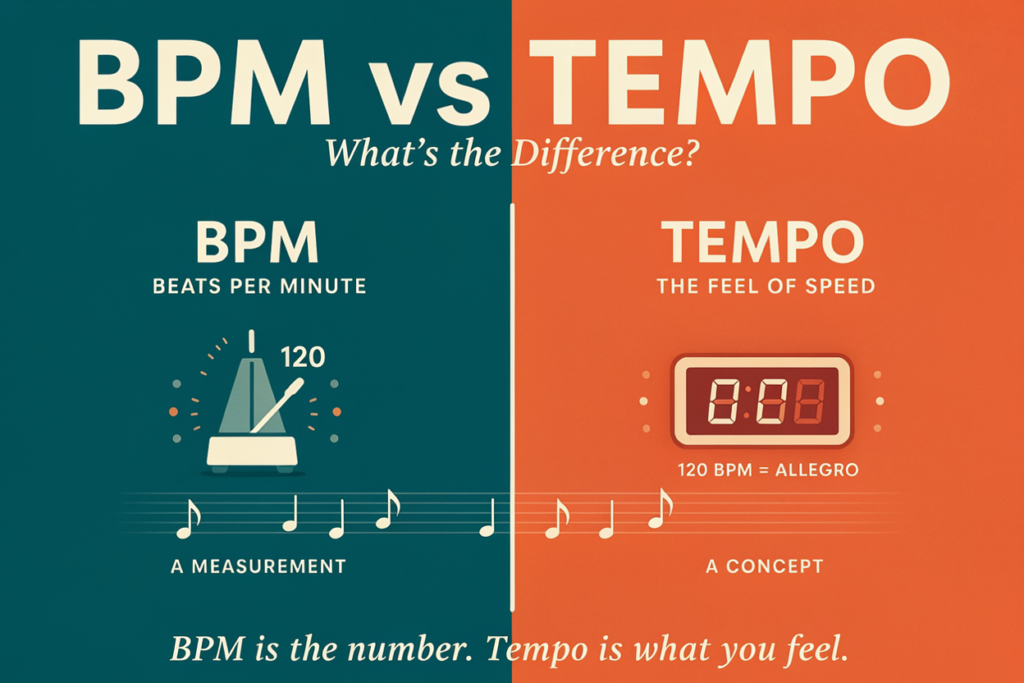
BPM and tempo are closely related, but they are not exactly the same thing.
BPM means beats per minute. It is a number that tells you how many beats happen in one minute of music. Tempo means the overall speed or pace of the music. Tempo can be described with a BPM number, but it can also be described with words like slow, fast, Adagio, Andante, Allegro, or Presto.
A simple way to remember it is this: BPM is the measurement; tempo is the musical idea being measured.
If you are trying to measure a song, use a BPM value. If you are talking about the feel, pace, or performance speed of a piece of music, use tempo.
BPM vs Tempo: Quick Comparison
| Term | Meaning | Example | Best Used For |
|---|---|---|---|
| BPM | A numeric measurement of beats per minute | 120 BPM | Metronomes, DJ mixing, DAW projects, delay timing |
| Tempo | The overall speed or pace of music | Fast, slow, Allegro, Andante | Musical feel, performance direction, general description |
In everyday music talk, people often use “BPM” and “tempo” as if they mean the same thing. That is understandable because BPM is one of the most common ways to describe tempo. But technically, BPM is more specific.
If you need a number, use BPM. If you need to describe the speed or feel of the music more broadly, use tempo.
What BPM Means in Music
BPM stands for beats per minute. It tells you how many beat pulses occur in one minute.
For example:
| BPM | Meaning |
|---|---|
| 60 BPM | 60 beats in one minute |
| 90 BPM | 90 beats in one minute |
| 120 BPM | 120 beats in one minute |
| 160 BPM | 160 beats in one minute |
A song at 120 BPM has 120 counted beats per minute. If you tap your foot evenly with the main beat, you would tap about 120 times in one minute.
BPM is especially useful when you need accuracy. Musicians use it for metronome practice. Producers use it to set DAW sessions. DJs use it for beatmatching. Runners may use BPM to choose music that matches their pace.
If you want a deeper beginner explanation, read what BPM means in music before using a tool to measure a track. When you are ready to check a real song, you can find a song’s BPM by tapping along with the beat.
What Tempo Means in Music
Tempo is the speed or pace of a piece of music.
A tempo can be described in different ways:
- Slow
- Medium
- Fast
- Relaxed
- Energetic
- Adagio
- Andante
- Moderato
- Allegro
- Presto
- 120 BPM
That last example is important. A BPM number can describe tempo, but tempo is broader than BPM. Tempo can include musical character, performance direction, and feel.
For example, two songs may both be 100 BPM, but one may feel relaxed and spacious while the other feels busy and energetic. The BPM number is the same, but the musical experience can feel different because of rhythm, groove, drum density, instrumentation, and performance style.
For a wider explanation of musical pace, the guide to what tempo means in music explains how tempo works beyond just numbers.
The Main Difference: BPM Is a Number, Tempo Is the Speed
The easiest difference is:
BPM = exact number
Tempo = musical speed or pace
Here are a few examples:
| Description | BPM or Tempo? | Why |
|---|---|---|
| 128 BPM | BPM | It gives an exact beats-per-minute value |
| Fast | Tempo | It describes speed generally |
| Allegro | Tempo | It is a musical tempo marking |
| 75 BPM | BPM | It gives a measured beat rate |
| Slow and relaxed | Tempo | It describes the musical feel |
| Presto | Tempo | It indicates a very fast pace |
So, if someone asks, “What is the BPM of this song?” they want a number. If someone asks, “What is the tempo of this song?” they may want either a general speed description or a BPM value, depending on the context.
In modern music production, DJing, and online tools, “tempo” often means the BPM number. In music theory and performance, tempo can also refer to expressive markings and musical feel.
When BPM and Tempo Mean Almost the Same Thing
In many practical situations, BPM and tempo are used almost interchangeably.
For example, a producer might say:
“The tempo of this project is 120 BPM.”
A DJ might say:
“This track’s tempo is 128 BPM.”
A drummer might say:
“Set the metronome tempo to 90 BPM.”
In these examples, tempo and BPM are closely connected because the speaker is using BPM to define the tempo. This is common and usually correct in practical music settings.
The difference matters more when you are comparing a precise measurement with a broader musical description. “120 BPM” is exact. “Moderately fast” is descriptive. Both can refer to tempo, but only one is a BPM value.
Tempo Words vs BPM Numbers
Traditional music often uses tempo markings to describe speed and feel. These words do not always point to one fixed BPM, but they give musicians a general performance direction.
| Tempo Word | General Feel | What It Tells You |
|---|---|---|
| Largo | Very slow and broad | The music should feel spacious |
| Adagio | Slow | The music should move gently |
| Andante | Walking pace | The music should feel steady and moderate |
| Moderato | Moderate speed | The music should not feel too slow or too fast |
| Allegro | Fast and lively | The music should feel energetic |
| Vivace | Lively and quick | The music should feel bright and active |
| Presto | Very fast | The music should move quickly |
These markings are useful because music is not only about numbers. A performer may need to understand the mood and character of the piece, not just the speed.
If you are learning written music, the guide to tempo markings can help you understand common Italian tempo words. You can also learn more about reading tempo markings if you work with sheet music.
BPM, Beat, Rhythm, and Time Signature Are Not the Same
Many people confuse BPM with beat, rhythm, and time signature. They are related, but each one answers a different question.
| Term | What It Means | Simple Example |
|---|---|---|
| BPM | How fast the beat moves | 120 beats per minute |
| Beat | The steady pulse you count | 1, 2, 3, 4 |
| Rhythm | The pattern of notes and rests | Kick, snare, hi-hat pattern |
| Time signature | How beats are grouped | 4/4, 3/4, 6/8 |
| Tempo | The overall speed or pace | Slow, fast, 90 BPM, Allegro |
BPM measures the speed of the beat, but it does not describe every rhythmic pattern in the music. A song can have a steady 100 BPM pulse while the drums, melody, and vocals create many different rhythms over that beat.
That is why beat and tempo are different. The beat is the pulse you count, while tempo is how fast that pulse moves. Rhythm is different again because it deals with patterns inside time; the guide to rhythm and tempo explains that distinction in more detail.
Time signature is separate too. A song in 4/4 and a song in 3/4 can both be 120 BPM, but the beats are grouped differently. If meter is confusing, review time signatures to see how beat grouping works.
Why the Same BPM Can Feel Different
BPM gives you a number, but it does not tell the whole story of musical energy.
Two songs can both be 120 BPM and feel completely different. One might feel calm and steady. Another might feel intense and driving. The difference can come from arrangement, rhythm, groove, drum density, note length, swing, or how the performer plays.
Here are a few reasons the same BPM can feel different:
- A busy drum pattern can make a tempo feel faster.
- Sparse instrumentation can make the same BPM feel slower.
- Heavy accents can make the beat feel stronger.
- Syncopation can make the rhythm feel more complex.
- A half-time groove can make a fast BPM feel slower.
- A double-time feel can make a moderate BPM feel faster.
This is one reason genre context matters. A 128 BPM house track may feel danceable and steady, while a 128 BPM rock song may feel more aggressive. The same number does not always create the same musical effect.
If you want to compare common ranges, the guide to BPM ranges by genre can help you understand why different styles often sit in different tempo zones.
Half-Time and Double-Time: Why BPM Can Be Confusing
Sometimes one person says a song is 70 BPM while another says it is 140 BPM. Both may be hearing the same track correctly, but they are counting the pulse differently.
| Slower Count | Faster Count | Common Situation |
|---|---|---|
| 60 BPM | 120 BPM | Slow pulse vs full beat feel |
| 70 BPM | 140 BPM | Half-time vs double-time interpretation |
| 85 BPM | 170 BPM | Common in energetic genres |
| 100 BPM | 200 BPM | Main beat vs subdivision count |
This happens because music can be felt at different beat levels. A hip-hop track might feel like 75 BPM if you count the main groove, but 150 BPM if you count a faster subdivision. Drum and bass often creates a similar issue because the drums may feel extremely active even when the larger pulse is slower.
For DJs and producers, the “right” BPM is usually the number that works best for beatmatching, grid alignment, or editing. For musicians, the better choice may be the one that matches the conductor’s count or metronome practice goal.
How Musicians, Producers, DJs, and Runners Use BPM vs Tempo
Different users care about BPM and tempo in different ways.
| User | Uses BPM For | Uses Tempo For |
|---|---|---|
| Musician | Practicing with a metronome | Interpreting speed and feel |
| Producer | DAW grid, loops, delay timing | Track energy and arrangement |
| DJ | Beatmatching and set planning | Dance floor flow and mood |
| Runner | Matching cadence or workout pace | Energy level and movement feel |
| Dancer | Counting beats and phrases | Movement quality and style |
| Songwriter | Demo tempo and arrangement | Emotional pace of the song |
A musician may use the online metronome to practice at a set BPM, but still think about tempo as musical feel. A producer may set a DAW session to 100 BPM, then use the BPM to milliseconds converter to calculate delay times or note-based timing. A DJ may care about both BPM and energy because two tracks with similar BPM can still feel very different in a set.
This is why BPM is practical, but tempo is musical. BPM helps you measure. Tempo helps you interpret.
How to Find or Check BPM
If you need an exact BPM number, do not guess from words like “fast” or “slow.” Measure it.
The simplest way is to play the song and tap the beat to estimate BPM. Tap along with the main pulse, not every drum hit or vocal rhythm. After several steady taps, you should get a usable BPM estimate.
For better accuracy, compare the result with a metronome. If the metronome click slowly drifts away from the song, adjust the BPM until it stays locked with the beat.
You can also use a tempo tool when you need conversions. A tempo converter is useful when you need to translate or compare tempo values for practice, production, or timing workflows.
Common Mistakes About BPM and Tempo
One common mistake is saying BPM and tempo are always the same. BPM is a way to measure tempo, but tempo can also describe musical feel and performance direction.
Another mistake is confusing tempo with rhythm. Tempo tells you how fast the beat moves. Rhythm tells you how sounds are arranged over time. A song can have a simple rhythm or a complex rhythm at the same BPM.
A third mistake is thinking time signature tells you speed. It does not. Time signature tells you how beats are grouped. A song in 3/4 can be slow or fast. A song in 4/4 can also be slow or fast.
People also make mistakes when reading tempo words. Allegro usually means fast and lively, but it is not always one exact BPM in every context. The performer, style, period, arrangement, and musical direction all matter.
Finally, do not trust one BPM result without listening. A tool may detect half-time or double-time. A database may list a different version. Your own tapping may be slightly uneven. The best check is always the same: does the beat stay locked when you play the song with a metronome?
Simple Rule: When Should You Use BPM or Tempo?
Use BPM when you need precision.
Use BPM for:
- Setting a metronome
- Matching songs for DJing
- Starting a DAW project
- Editing loops
- Syncing delay effects
- Choosing running music
- Comparing song speeds numerically
Use tempo when you are describing musical speed more generally.
Use tempo for:
- Talking about the feel of a song
- Reading sheet music
- Describing performance character
- Comparing slow, medium, and fast pieces
- Discussing musical expression
- Explaining pace to a student or performer
A good final rule is: all BPM values describe tempo, but not every tempo description is a BPM value.
FAQ
Is BPM the same as tempo?
Not exactly. BPM is a numeric measurement of tempo. Tempo is the broader musical idea of speed or pace. A tempo can be described with BPM, but it can also be described with words like slow, fast, Allegro, or Andante.
What is the difference between BPM and tempo?
BPM tells you how many beats happen in one minute. Tempo tells you how fast or slow the music feels overall. BPM is specific; tempo is broader.
What does 120 BPM mean?
120 BPM means there are 120 beats per minute. If you count the main beat evenly for one minute, you would count 120 beats.
Can tempo exist without BPM?
Yes. A musician can describe tempo with words like Adagio, Moderato, or Presto without giving an exact BPM number. However, BPM is helpful when exact timing is needed.
Is Allegro a BPM or a tempo?
Allegro is a tempo marking. It usually means fast and lively, but it is not one fixed BPM in every musical situation.
Does time signature change BPM?
No. Time signature does not directly change BPM. Time signature tells you how beats are grouped, while BPM tells you how fast the beat moves.
What is the difference between tempo and rhythm?
Tempo is the speed of the beat. Rhythm is the pattern of sounds and silences that happen over the beat.
Why can one song be listed as 70 BPM and 140 BPM?
That usually happens because of half-time and double-time interpretation. One number counts a slower pulse, while the other counts a faster subdivision.
Should DJs use BPM or tempo?
DJs usually use BPM for beatmatching and set planning, but they also think about tempo feel, energy, groove, and how one track moves into the next.
How do I find the BPM of a song?
Use a BPM finder or tap tempo tool, then verify the result with a metronome. If the result feels too slow or too fast, test half or double the BPM.