
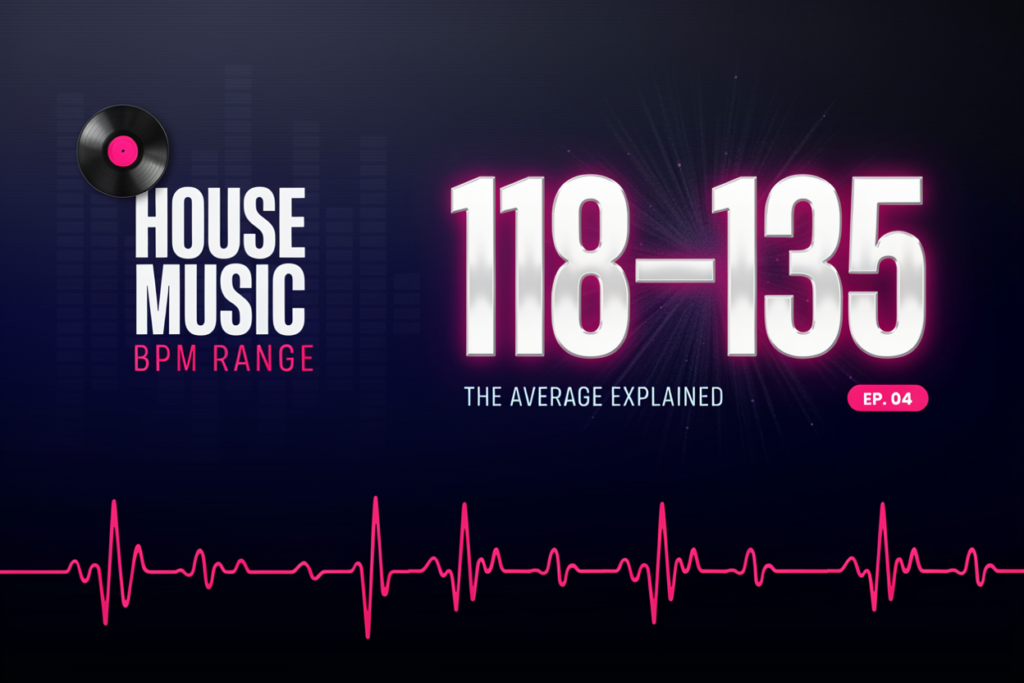
House music is typically produced between 115 and 130 BPM (beats per minute), with 120–128 BPM being the most common range for modern tracks. While 128 BPM has become a popular standard for festival and club-oriented house, the ideal tempo depends on the subgenre, groove, and the feeling you want to create—not just a number.
If you’re producing, DJing, or simply curious about electronic music, understanding house music tempo helps you build better grooves, mix tracks smoothly, and choose the right energy for your audience.
If you’re unsure how BPM differs from tempo, our guide on beat versus tempo explains the difference in more detail.
What Is the Typical House Music Tempo?
Most house tracks fall between 115 and 130 BPM, although some styles occasionally move slightly outside this range.
Here’s a quick overview:
| House Style | Typical BPM |
|---|---|
| Deep House | 115–122 |
| Soulful House | 118–123 |
| Tropical House | 100–115 |
| Classic House | 120–125 |
| Chicago House | 120–125 |
| Funky House | 122–126 |
| Tech House | 122–128 |
| Progressive House | 124–128 |
| Electro House | 126–130 |
| Bass House | 125–130 |
| Hard House | 135–150 |
These are typical production ranges rather than strict rules. Great music occasionally breaks them.
Why 128 BPM Became So Popular
Many producers choose 128 BPM because it provides an excellent balance between energy and groove.
At this speed:
- Kick drums feel punchy without sounding rushed.
- Basslines have enough room to breathe.
- Dance floors maintain consistent momentum.
- Transitions and buildups feel natural.
- DJs can easily mix with many mainstream electronic tracks.
For this reason, countless festival, progressive, and electro house records have adopted 128 BPM over the years.
Can House Music Be Slower?
Absolutely.
Slower house styles often create a warmer, more relaxed atmosphere.
Examples include:
- Deep House
- Organic House
- Tropical House
- Soulful House
These genres often prioritize groove, texture, and musicality over maximum dance-floor intensity.
House Music BPM by Subgenre
Although people often refer to “house music” as one genre, its subgenres have distinct tempo preferences.
Deep House
Typical BPM: 115–122
Deep house emphasizes atmosphere, soulful chords, smooth basslines, and subtle percussion. Lower tempos allow these musical elements more space.
Classic & Chicago House
Typical BPM: 120–125
Classic house evolved from disco influences and features steady four-on-the-floor rhythms, piano chords, vocal samples, and uplifting grooves.
Understanding the standard 4/4 time signature also helps explain why house music feels so consistent on the dance floor.
Tech House
Typical BPM: 122–128
Tech house combines the groove of house with minimalist techno influences. Slightly faster tempos help create rolling percussion and driving basslines.
Progressive House
Typical BPM: 124–128
Progressive house often builds gradually through evolving melodies, layered synths, and long transitions. Mid-to-upper tempo ranges support this gradual energy increase.
Electro & Bass House
Typical BPM: 126–130
These heavier styles use aggressive synths, punchier drums, and energetic drops that benefit from slightly faster tempos.
Hard House
Typical BPM: 135–150
Hard house pushes beyond traditional house tempos, producing a faster and more intense dance-floor experience.
Why Tempo Changes the Feel of House Music
Tempo influences much more than speed—it shapes how listeners experience rhythm, groove, and movement.
Slower House Feels Deeper
Lower BPMs provide:
- More spacious grooves
- Longer bass notes
- Relaxed vocal phrasing
- Atmospheric arrangements
- Greater emphasis on swing
Many deep house tracks feel hypnotic even without increasing tempo.
Faster House Feels More Energetic
Higher BPMs create:
- Stronger forward momentum
- More driving percussion
- Faster rhythmic movement
- Higher dance-floor intensity
- Greater excitement during drops
However, faster isn’t always better.
A well-produced 122 BPM track can often feel more energetic than a poorly arranged 128 BPM track.
Groove Matters More Than BPM
Two songs at exactly 124 BPM can feel completely different because of:
- Swing settings
- Syncopated percussion
- Bassline rhythm
- Drum programming
- Arrangement
- Instrument choice
Tempo is only one ingredient in creating musical energy.
For a broader comparison of styles, see our guide to BPM by music genre.
How Producers Choose the Right House Tempo
Rather than copying another song’s BPM, producers usually start with the musical idea.
Start With the Style
A useful starting point is:
| Style | Suggested Starting BPM |
| Deep House | 118 |
| Soulful House | 120 |
| Classic House | 122 |
| Tech House | 124 |
| Progressive House | 126 |
| Electro House | 128 |
| Bass House | 128 |
| Hard House | 140 |
These aren’t rules—they’re simply practical starting points.
Build the Groove First
Before locking the BPM:
- Program the kick.
- Add the bassline.
- Introduce percussion.
- Test vocals or melodies.
- Increase or decrease BPM until everything feels natural.
Even changing the tempo by 2–3 BPM can noticeably affect the groove.
Our guide to BPM in music production explores this workflow in more detail.
Watch for Half-Time BPM Detection
Automatic BPM detectors occasionally identify:
- 124 BPM as 62 BPM
- 126 BPM as 63 BPM
- 128 BPM as 64 BPM
This happens because software sometimes interprets every second beat instead of every beat.
If you’re unsure, use a reliable Tap Tempo tool to verify the actual tempo manually.
House Music Tempo for DJs
Most house DJs don’t play every track at exactly the same BPM.
Instead, they create an energy curve throughout the set.
A typical progression might look like this:
| Stage | Common BPM |
| Warm-up | 118–121 |
| Early Dance Floor | 122–124 |
| Peak Time | 125–128 |
| Closing | 120–123 |
Small tempo adjustments of 1–3 BPM usually sound natural during beatmatching.
If you’re learning to mix electronically, our article about BPM for DJs covers additional techniques.
House Music Tempo Compared With Other Genres
| Genre | Typical BPM |
| Tropical House | 100–115 |
| House | 115–130 |
| Techno | 125–145 |
| Trance | 130–145 |
| Dubstep | 140 |
| Drum and Bass | 160–180 |
Although some genres overlap in BPM, they remain distinct because of differences in rhythm, sound design, arrangement, and production style.
How to Find the BPM of a House Song
If you want to identify a track’s tempo, you can:
- Use BPM detection software.
- Tap along with the beat.
- Analyze the kick drum pattern.
- Use a metronome.
- Compare the track with known BPM references.
Our guide on finding a song’s BPM explains each method in detail.
Frequently Asked Questions
Is all house music 128 BPM?
No. While 128 BPM is popular—especially in festival-oriented house—many excellent house tracks are produced anywhere from about 115 to 130 BPM, depending on the subgenre and desired groove.
What BPM is best for deep house?
Deep house is commonly produced between 115 and 122 BPM. This slower tempo helps create smooth basslines, spacious grooves, and relaxed rhythms.
Is 120 BPM considered house music?
Yes. 120 BPM sits comfortably within the traditional house music range and is especially common in classic, soulful, and Chicago-inspired house.
Can house music be 140 BPM?
Yes, although 140 BPM is generally associated with hard house or other faster electronic genres rather than mainstream house music.
Why do two house songs at the same BPM feel different?
Because groove depends on more than tempo. Swing, syncopation, percussion patterns, bassline rhythm, note length, and arrangement all influence how fast or energetic a track feels.
What’s the easiest way to measure house music tempo?
The simplest method is to tap along with the beat using a tap tempo tool or use BPM detection software. If the detected value looks unusually low or high, check whether the software has interpreted the track at half-time or double-time.

Olivia Carter is a music technology writer and rhythm analysis specialist at Tempo Finder. She focuses on tempo detection, BPM analysis, beat matching, rhythm tools, and music production workflows for DJs, producers, musicians, and beginners. Olivia creates practical, easy-to-understand content around tempo finding, beat synchronization, metronomes, DJ transitions, and audio timing to help creators improve workflow, accuracy, and musical performance.