
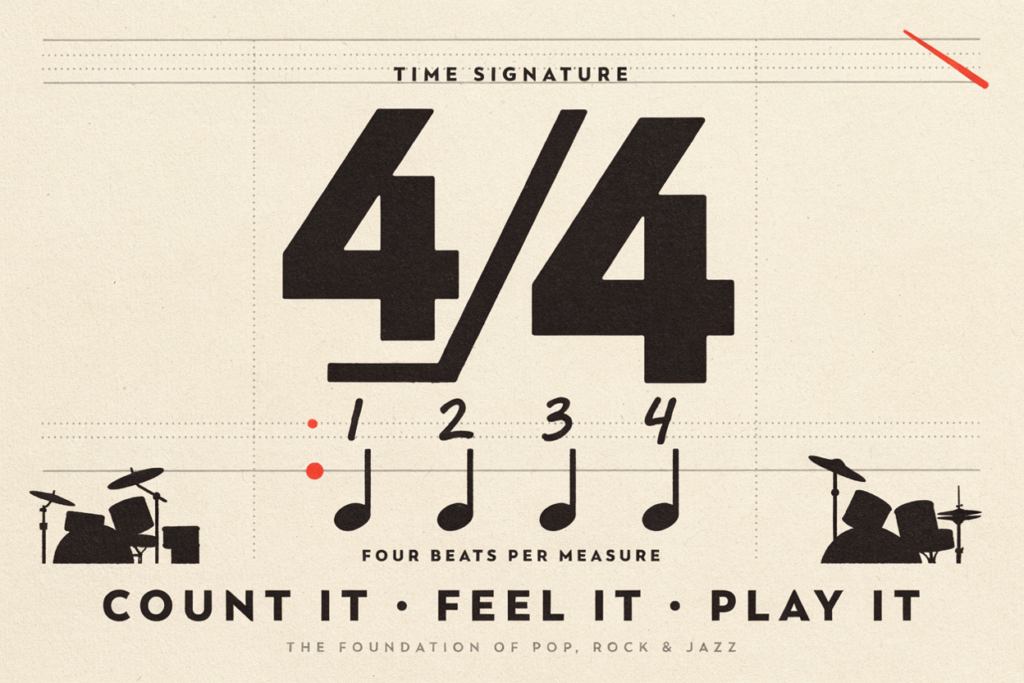
The 4/4 time signature is the most commonly used time signature in modern music. Also called common time, it appears in countless genres, including pop, rock, hip-hop, jazz, country, and classical music.
A 4/4 time signature tells musicians that each measure contains four beats, and each beat is represented by a quarter note. Its balanced and predictable structure makes it easy to follow, which is why it has become the foundation of much popular music.
Understanding 4/4 time helps musicians read sheet music, count rhythms, play with other performers, and create accurate timing.
What Is a 4/4 Time Signature?
A time signature appears at the beginning of sheet music and shows how beats are organized in each measure.
In 4/4 time:
- The top number (4) means there are four beats in every measure.
- The bottom number (4) means the quarter note receives one beat.
Therefore, one measure contains:
Four quarter-note beats
It is counted as:
1 – 2 – 3 – 4
or:
ONE – two – THREE – four
The first beat usually receives the strongest emphasis, creating a stable and predictable rhythmic pattern.
To understand how rhythm speed connects with musical movement, you can learn more about how tempo affects musical speed.
How to Count 4/4 Time
The basic counting pattern for 4/4 time is:
ONE – two – THREE – four
Each number represents one quarter-note beat.
A common accent pattern is:
- Beat 1 → strongest
- Beat 2 → weaker
- Beat 3 → secondary strong beat
- Beat 4 → weaker
Example:
ONE two THREE four
This creates the steady pulse that listeners naturally follow in many songs.
Counting Subdivisions in 4/4
Musicians often divide beats into smaller parts.
Eighth Notes
Instead of:
1 – 2 – 3 – 4
Count:
1-and-2-and-3-and-4-and
Each beat is divided into two parts.
Sixteenth Notes
Count:
1-e-and-a 2-e-and-a 3-e-and-a 4-e-and-a
This allows musicians to perform faster and more complex rhythms.
Why Is 4/4 Called Common Time?
The term common time comes from the widespread use of 4/4 throughout Western music.
The symbol for common time is:
𝄴
Many composers, songwriters, and producers use 4/4 because:
- It is easy for musicians to understand.
- It creates a natural walking pulse.
- It works well with many musical styles.
- It provides a flexible structure for melodies and rhythms.
Although 4/4 is extremely common, it is not the only time signature used in music.
Other examples include:
How Does 4/4 Time Feel?
4/4 time often feels:
- Balanced
- Stable
- Predictable
- Easy to follow
- Natural for movement
Because humans often organize patterns in groups of four, this rhythm feels familiar to many listeners.
Common examples include:
- Pop songs
- Rock songs
- Dance music
- Hip-hop beats
- Electronic music
However, the feeling of a song depends on more than the time signature. Tempo, rhythm, instruments, and arrangement all influence the final sound.
You can learn more about the relationship between speed and rhythm in this guide to what BPM means in music.
4/4 Time Signature vs 3/4 Time Signature
Although both are simple meters, they create different feelings.
| 4/4 Time | 3/4 Time |
|---|---|
| Four beats per measure | Three beats per measure |
| Called common time | Often called waltz time |
| Count: ONE-two-three-four | Count: ONE-two-three |
| Common in pop and rock | Common in waltzes and flowing music |
Example:
4/4:
ONE-two-three-four
3/4:
ONE-two-three
The main difference is the number of beats grouped inside each measure.
4/4 Time Signature vs 6/8 Time Signature
4/4 and 6/8 can sometimes sound similar, but their beat organization is different.
| 4/4 Time | 6/8 Time |
|---|---|
| Simple meter | Compound meter |
| Four main beats | Two main beats |
| Beats divide into two | Beats divide into three |
| ONE-two-three-four | ONE-two-three FOUR-five-six |
In 4/4:
ONE-and TWO-and THREE-and FOUR-and
In 6/8:
ONE-two-three FOUR-five-six
The grouping changes the overall feeling of the rhythm.
How BPM Works in 4/4 Time
BPM (beats per minute) describes how fast the beats occur.
For example:
- 60 BPM = one beat per second
- 100 BPM = moderate speed
- 120 BPM = energetic and common in many genres
In a 4/4 song at 120 BPM:
- There are four beats in each measure.
- Each minute contains 120 quarter-note beats.
Tempo determines the speed, while the time signature determines how those beats are grouped.
A metronome can help musicians practice 4/4 timing accurately. Learn more about how to use a metronome.
Famous Songs in 4/4 Time
Many popular songs use 4/4 because it works well across many genres.
Examples:
| Song | Artist | Genre |
|---|---|---|
| Billie Jean | Michael Jackson | Pop |
| We Will Rock You | Queen | Rock |
| Shape of You | Ed Sheeran | Pop |
| Smells Like Teen Spirit | Nirvana | Rock |
| Rolling in the Deep | Adele | Pop/Soul |
Most modern songs use 4/4, although artists often experiment with different meters.
You can explore more song tempo examples in this famous songs BPM list.
How to Practice 4/4 Rhythm
Learning 4/4 is easier with consistent practice.
1. Clap the Beat
Start by clapping:
ONE-two-three-four
Keep the first beat slightly stronger.
2. Count Out Loud
Say the numbers while tapping your foot:
ONE-two-three-four
This helps develop internal timing.
3. Practice With a Metronome
Set a comfortable BPM and practice:
- Clapping patterns
- Playing scales
- Singing phrases
- Performing songs
A metronome provides a consistent reference point and improves rhythmic accuracy.
4. Practice Subdivisions
Move from:
Quarter notes:
1-2-3-4
to:
Eighth notes:
1-and-2-and-3-and-4-and
to:
Sixteenth notes:
1-e-and-a…
This builds better rhythm control.
Common Mistakes When Playing 4/4 Time
Treating Every Beat the Same
Although all four beats are counted, beat 1 usually has the strongest emphasis.
Losing the Pulse
Musicians sometimes focus too much on notes and forget the underlying rhythm.
Practicing with a metronome helps maintain a steady pulse.
Confusing Tempo With Time Signature
Tempo tells you how fast the music moves.
Time signature tells you how beats are organized.
For example:
- 4/4 at 80 BPM
- 4/4 at 140 BPM
Both have the same time signature but different speeds.
You can explore more about tempo markings in this guide to reading tempo markings in sheet music.
Frequently Asked Questions
How many beats are in 4/4 time?
There are four beats in each measure, and the quarter note receives one beat.
Why is 4/4 called common time?
It is called common time because it is one of the most widely used time signatures in Western music.
Is most music written in 4/4?
A large amount of modern popular music uses 4/4, although many other time signatures are also used.
What BPM is common for 4/4 songs?
There is no fixed BPM. 4/4 songs can be slow, medium, or fast depending on the style.
What is the difference between 4/4 and 3/4?
4/4 contains four beats per measure, while 3/4 contains three beats per measure.

Olivia Carter is a music technology writer and rhythm analysis specialist at Tempo Finder. She focuses on tempo detection, BPM analysis, beat matching, rhythm tools, and music production workflows for DJs, producers, musicians, and beginners. Olivia creates practical, easy-to-understand content around tempo finding, beat synchronization, metronomes, DJ transitions, and audio timing to help creators improve workflow, accuracy, and musical performance.