
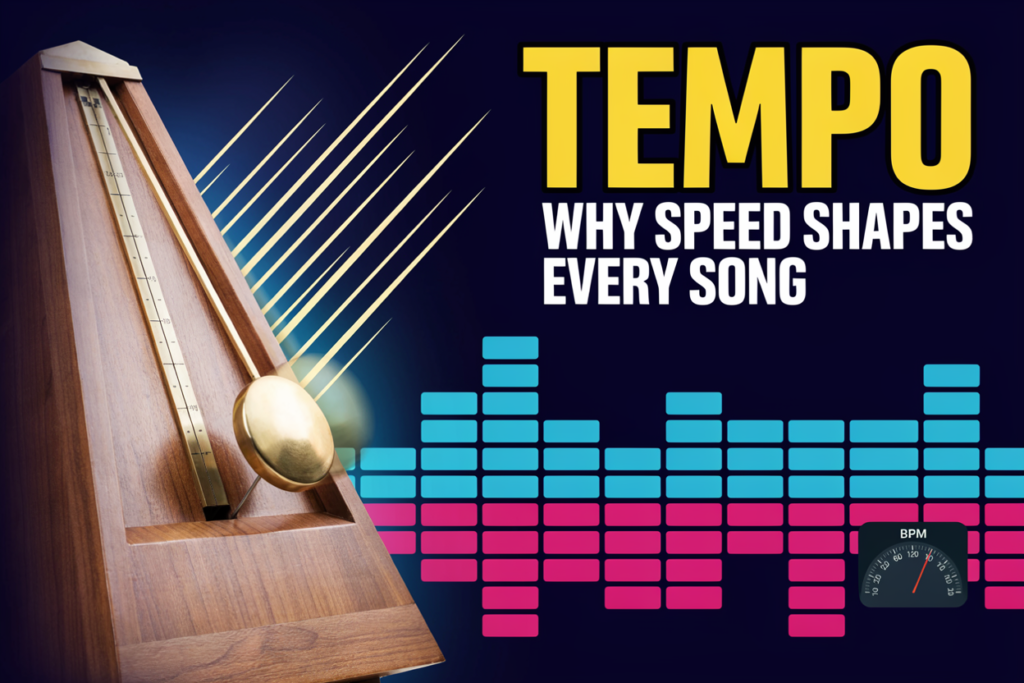
Tempo in music is the speed at which a piece of music is performed. It determines how quickly or slowly the beats move and strongly affects the energy, emotion, and overall feel of a song. Musicians usually measure tempo using beats per minute (BPM), which tells how many beats occur in one minute.
A slow tempo can make music feel calm, emotional, or dramatic, while a fast tempo can create excitement, movement, and intensity. Understanding tempo helps singers, instrumentalists, producers, DJs, and listeners better understand how music is structured.
What Is Tempo in Music?
Tempo is the rate or speed of the underlying pulse in a musical piece. It answers the question: “How fast should the beats of this song move?”
For example:
- A song at 60 BPM has one beat every second.
- A song at 120 BPM has two beats every second.
- A song at 180 BPM has three beats every second.
Tempo does not describe the pattern of sounds or notes. Instead, it controls the speed at which those musical elements happen.
A simple way to imagine tempo is like walking speed. A slow walking pace and a fast running pace can follow the same path, but they create completely different experiences. Music works similarly: the same melody can feel completely different when performed at different tempos.
How Is Tempo Measured? (BPM Explained)
Tempo is commonly measured using BPM (beats per minute). BPM represents the number of steady beats that happen within 60 seconds.
For example:
| Tempo | BPM Range | General Feeling |
|---|---|---|
| Very Slow | 40–60 BPM | Calm, emotional, spacious |
| Slow | 60–80 BPM | Relaxed, gentle |
| Medium | 80–120 BPM | Natural, balanced |
| Fast | 120–160 BPM | Energetic, exciting |
| Very Fast | 160+ BPM | Intense, driving |
BPM gives musicians a precise way to communicate tempo. Instead of saying “play this song quickly,” a composer can specify a BPM value so performers know the intended speed.
You can also use tools like a BPM Finder to identify the tempo of a song, or practice maintaining a steady pulse with an online metronome.
Tempo vs BPM vs Beat vs Rhythm
Although these terms are related, they describe different musical concepts.
| Term | Meaning |
|---|---|
| Tempo | The speed of the musical pulse |
| BPM | The numerical measurement of tempo |
| Beat | The regular pulse that listeners feel in music |
| Rhythm | The pattern of sounds and silences arranged over the beat |
| Time Signature | The organization of beats into groups |
Tempo and BPM are closely connected, but they are not exactly identical. BPM is the measurement, while tempo is the musical idea of speed. You can learn more about their relationship in this guide about BPM vs Tempo.
Similarly, tempo and rhythm are different. A song can have a fast tempo but a simple rhythm, or a slow tempo with a complex rhythm. Understanding this difference helps musicians analyze how songs create movement and emotion. Read more about Rhythm vs Tempo.
Common Tempo Markings in Music
Before BPM became common, composers often used Italian words to describe tempo. These traditional tempo markings provide a general idea of speed and character.
Slow Tempo Markings
Largo
Largo means very slow and broad. It is often used for serious, peaceful, or emotional passages.
Adagio
Adagio indicates a slow and expressive tempo. It is commonly associated with gentle and lyrical music.
Medium Tempo Markings
Andante
Andante means a walking pace. It usually represents a comfortable, moderate speed.
Moderato
Moderato means moderate or medium speed. It is often used when music should feel balanced and controlled.
Fast Tempo Markings
Allegro
Allegro means fast and lively. Many energetic classical and modern compositions use this tempo.
Presto
Presto means very fast and creates a sense of speed and excitement.
Modern musicians often combine these traditional terms with BPM values to provide clearer performance instructions. You can explore more examples in this guide to tempo markings.
Why Tempo Matters in Music
Tempo affects almost every part of musical expression.
1. It Creates Mood and Emotion
Tempo is one of the strongest tools for controlling emotion.
- Slow tempos often feel emotional, peaceful, or reflective.
- Fast tempos often feel energetic, joyful, or exciting.
A ballad performed slowly may sound emotional, while the same song performed faster may feel more energetic.
2. It Helps Musicians Perform Together
When multiple musicians play together, they need a shared tempo to stay synchronized. A drummer, guitarist, singer, and keyboard player must follow the same pulse.
A metronome helps musicians develop accurate timing and maintain a consistent tempo during practice.
3. It Shapes Music Production
Music producers use tempo when arranging songs, creating drum patterns, and designing transitions. Different genres often have typical tempo ranges:
- House music commonly uses faster dance tempos.
- Hip-hop often uses slower grooves.
- Drum and bass usually uses very fast tempos.
Tempo influences how listeners move, dance, and emotionally connect with music.
Can Tempo Change During a Song?
Yes. Although many songs maintain a consistent tempo, composers and performers can intentionally change speed.
Common tempo changes include:
Accelerando
Gradually increasing speed.
Ritardando (Rit.)
Gradually slowing down.
Rubato
A flexible approach where performers slightly speed up or slow down for emotional expression.
Tempo changes can create tension, excitement, or a more expressive musical performance.
How to Find the Tempo of Any Song
There are several ways to identify a song’s tempo:
- Use a BPM detection tool
Tools can analyze audio and estimate the BPM automatically. - Tap along with the beat
Count how many beats occur in one minute, or use a tap tempo tool. - Use a metronome comparison
Adjust a metronome until it matches the song’s pulse.
For a detailed method, see this guide on how to find the BPM of a song.
Frequently Asked Questions
What is tempo in music?
Tempo is the speed of the beat or pulse in a musical composition. It determines how fast or slow the music is performed.
Is tempo the same as BPM?
No. Tempo describes the speed of music, while BPM is the numerical measurement used to express that speed.
What is considered a fast tempo in music?
Generally, tempos above 120 BPM are considered fast, although the feeling of speed depends on genre, rhythm, and musical style.
Can two songs have the same tempo but feel different?
Yes. Two songs can have the same BPM but feel different because of differences in rhythm, instruments, arrangement, and performance style.
How do musicians keep tempo?
Musicians practice with timing exercises, conductors, drum patterns, and tools like metronomes to maintain a steady tempo.

Olivia Carter is a music technology writer and rhythm analysis specialist at Tempo Finder. She focuses on tempo detection, BPM analysis, beat matching, rhythm tools, and music production workflows for DJs, producers, musicians, and beginners. Olivia creates practical, easy-to-understand content around tempo finding, beat synchronization, metronomes, DJ transitions, and audio timing to help creators improve workflow, accuracy, and musical performance.