
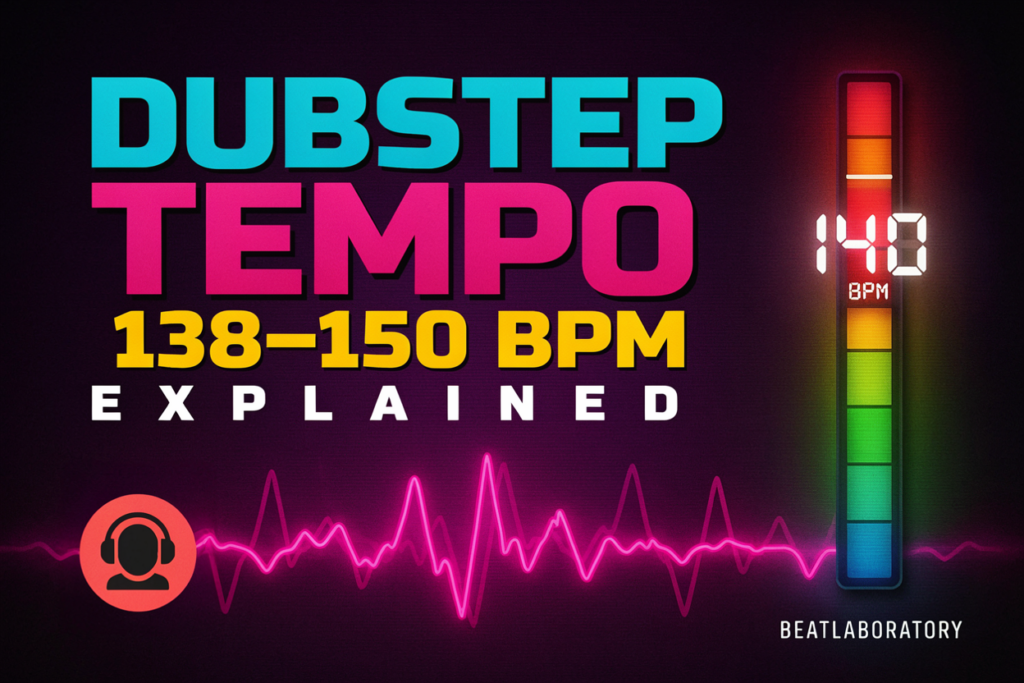
Dubstep tempo is one of the defining elements of the genre’s heavy and distinctive sound. Most dubstep tracks are commonly associated with a tempo around 140 BPM, although variations exist depending on the subgenre and production style.
What makes dubstep unique is that a track running at 140 BPM often feels much slower because of its half-time rhythm structure. The drums, bass, and spacing create a groove that listeners often perceive closer to 70 BPM, even though the actual tempo remains around 140 beats per minute.
Understanding music tempo helps explain why dubstep can feel slow, heavy, and powerful while technically using a relatively high BPM.
What Is Dubstep Tempo?
Dubstep tempo refers to the speed of the beat in dubstep music. Like other genres, it is measured using BPM (beats per minute).
BPM examples:
- 70 BPM → slow, relaxed groove
- 140 BPM → classic dubstep tempo
- 170+ BPM → very fast electronic styles such as drum and bass
Tempo controls how quickly the musical pulse moves, but it does not completely determine how fast a song feels. Rhythm patterns, drum placement, and bass movement strongly influence perception.
For a deeper explanation of BPM measurement, see our guide on what BPM means in music.
What BPM Is Dubstep Usually?
Most dubstep music is commonly produced around 135–150 BPM, with 140 BPM being the traditional and widely recognized tempo.
| Dubstep Style | Approximate BPM Range | General Feeling |
|---|---|---|
| Classic Dubstep | 135–145 BPM | Heavy, spacious, bass-focused |
| Modern Dubstep | 140–150 BPM | Aggressive, energetic |
| Melodic Dubstep | 130–145 BPM | Emotional, atmospheric |
| Brostep | Around 140 BPM | Loud, intense, high-energy |
These ranges are general guidelines. Individual producers may adjust tempo depending on the mood, arrangement, and style they want to create.
Why Is Dubstep Often 140 BPM?
The association between dubstep and 140 BPM developed because this tempo provides a strong balance between energy and space.
1. Room for Heavy Bass
Dubstep relies heavily on bass movement. A moderate-fast BPM gives producers enough space to create large bass drops and detailed sound design.
2. Strong Half-Time Groove
At 140 BPM, producers can place the main drum accents in a way that creates a slower, heavier feeling.
The result:
- Fast underlying tempo
- Slow-feeling main groove
- Powerful bass impact
3. Works Well for Drops
The famous dubstep “drop” depends on contrast. A strong rhythmic foundation allows producers to build tension and then release energy through bass and drum changes.
Why Does Dubstep Feel Slower Than Its BPM?
The main reason is half-time rhythm.
In many dubstep tracks:
- The kick and snare patterns emphasize fewer major beats.
- The snare often creates a slower backbeat.
- The bass moves around the larger rhythmic structure.
This creates a perception closer to half the actual BPM.
For example:
- Actual tempo: 140 BPM
- Perceived groove: around 70 BPM
This does not mean the song is actually 70 BPM. The BPM measurement remains 140; only the rhythmic feeling changes.
This is why tempo and rhythm should not be confused:
- Tempo = speed of the beat
- Rhythm = pattern and arrangement of sounds
Dubstep Tempo Compared With Other Genres
| Genre | Common BPM Range | General Character |
|---|---|---|
| Dubstep | 135–150 BPM | Heavy, half-time electronic groove |
| Drum and Bass | 160–180 BPM | Fast, breakbeat-driven energy |
| House | 120–130 BPM | Steady dance rhythm |
| Techno | 120–140 BPM | Repetitive and driving |
| Pop | 90–130 BPM | Melodic and accessible |
You can compare broader electronic and music styles in our guide on BPM by genre.
Dubstep Tempo vs Drum and Bass Tempo
Dubstep and drum and bass are both electronic genres, but their tempos and rhythmic approaches are different.
Dubstep
- Usually around 140 BPM
- Heavy half-time feel
- Focus on bass drops and space
Drum and Bass
- Usually around 160–180 BPM
- Faster breakbeats
- Rapid drum patterns
Although drum and bass has a higher BPM, both genres can feel energetic because of their rhythmic structures.
You can learn more about faster electronic tempos in our guide on drum and bass tempo.
How Producers Choose Dubstep Tempo
Producers consider several factors when selecting a dubstep tempo.
Energy Level
Higher tempos can increase intensity, while slower variations may create a heavier or more atmospheric feeling.
Bass Movement
The relationship between BPM and bass rhythm is important. Producers need enough space for bass sounds to feel powerful.
Subgenre
Different dubstep styles may use slightly different tempos:
- Melodic dubstep may focus more on emotional arrangements.
- Heavy dubstep may emphasize aggressive drops and sound design.
Groove
The best tempo is not only about speed. The rhythmic arrangement determines how the listener experiences the music.
How to Find the BPM of a Dubstep Song
You can identify the BPM of a dubstep track by:
- Listening for the main pulse.
- Counting beats over a period of time.
- Using a BPM analysis tool.
Knowing BPM is useful for:
- DJs mixing tracks
- Producers creating remixes
- Musicians studying arrangements
You can use a BPM finder tool to analyze the tempo of any song.
For songs around this tempo range, explore our guide on songs with 140 BPM.
Frequently Asked Questions
Is dubstep always 140 BPM?
No. While 140 BPM is strongly associated with dubstep, some tracks use different tempos depending on the style and producer.
Why does dubstep sound slow at 140 BPM?
Dubstep often uses half-time rhythms, making the main groove feel closer to 70 BPM even though the actual tempo is 140 BPM.
What BPM should I use for dubstep?
Many producers start around 140 BPM, but the ideal tempo depends on the subgenre and desired sound.
Is dubstep faster than drum and bass?
No. Drum and bass usually uses higher BPM values, often around 160–180 BPM, while dubstep commonly stays around 140 BPM.
What makes dubstep different from other electronic music?
Dubstep is known for heavy bass, half-time rhythm, dramatic drops, and detailed sound design.
Olivia Carter is a music technology writer and rhythm analysis specialist at Tempo Finder. She focuses on tempo detection, BPM analysis, beat matching, rhythm tools, and music production workflows for DJs, producers, musicians, and beginners. Olivia creates practical, easy-to-understand content around tempo finding, beat synchronization, metronomes, DJ transitions, and audio timing to help creators improve workflow, accuracy, and musical performance.