
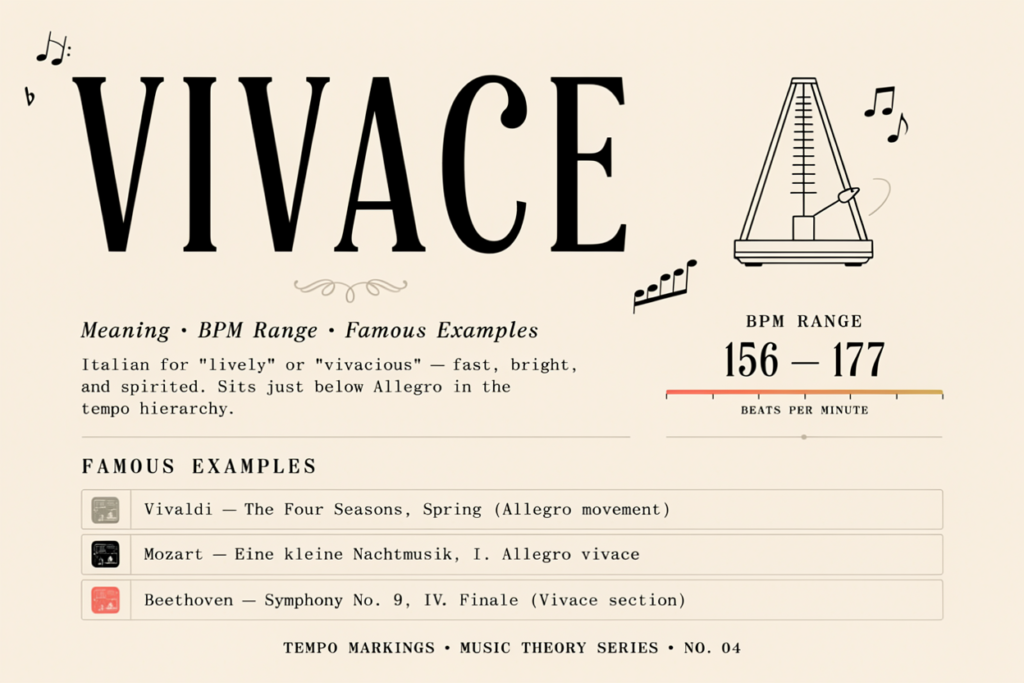
Vivace is an Italian musical direction meaning lively, spirited, or brisk. It tells a performer to play with energetic forward motion, usually at a fast tempo. Many modern tempo charts place Vivace around 156–176 BPM, but the marking is not a rigid metronome number.
The character matters as much as the speed. A technically fast performance can still miss the meaning of Vivace if it sounds heavy, tense, or mechanical. Musicians should aim for brightness, rhythmic lift, and a sense of movement while preserving clear phrasing.
To understand where the term belongs in the wider system, see the guide to common tempo markings.
What Does Vivace Mean in Music?
Vivace means lively, vivid, or spirited in Italian. In a musical score, it directs the performer to use a fast tempo with an animated character rather than simply playing as quickly as possible.
The word describes both pace and expression. A composer who writes Vivace usually expects the music to feel alert, buoyant, and energetic. That interpretation may involve crisp articulation, clear accents, flexible phrasing, and a strong sense of rhythmic direction.
This is an important distinction because tempo in music is not only a numerical speed. Traditional Italian markings often communicate the emotional and stylistic quality that should accompany the pulse.
How Do You Pronounce Vivace?
Vivace is commonly pronounced “vee-VAH-chay” in an Italian-influenced pronunciation. English-speaking musicians may vary slightly, but the middle syllable normally receives the strongest emphasis.
What Is the Literal Meaning of Vivace?
The literal meaning is lively, vivacious, or full of life. In a score, that meaning encourages a performance with energy and brightness.
Vivace does not necessarily mean loud. A soft passage can still sound lively through light articulation and active phrasing.
What BPM Is Vivace?
Vivace is commonly associated with approximately 156–176 beats per minute. This is a reference range rather than an official rule, and some charts place it somewhat lower depending on historical period, beat unit, and musical context.
At 160 BPM, for example, 160 designated beats occur in one minute. The notation still needs to show which note value receives the beat. A quarter note at 160 BPM creates a different practical result from a dotted quarter note at the same number.
Why Is There No Single Official Vivace BPM?
Italian tempo words were used before composers routinely supplied precise metronome markings. Performers interpreted them through musical style, meter, phrase structure, and accepted performance practice.
Even after the metronome became common, composers continued using expressive terms because a number alone cannot describe character. The same Vivace marking may lead to different speeds in a Baroque movement, a Classical symphony, and a Romantic chamber work.
Reference charts divide the tempo spectrum differently. The essential point is that Vivace is fast and lively, generally beyond Allegro but below Presto.
How Does Meter Affect the Tempo?
Meter determines how the pulse is grouped and which note value listeners perceive as the main beat. In 6/8 time, musicians may feel two dotted-quarter beats per measure rather than six separate eighth-note beats.
A fast-looking stream of notes does not automatically make the main tempo faster. Performers should identify the intended pulse before setting a metronome, or they may accidentally practice at half or double the appropriate speed.
Vivace vs Allegro vs Presto
Vivace is generally faster and more animated than Allegro, while Presto usually indicates a still faster tempo. The boundaries overlap because all three terms describe character as well as speed.
| Marking | Common reference range | General character |
|---|---|---|
| Allegro | 120–156 BPM | Fast, bright, cheerful |
| Vivace | 156–176 BPM | Lively, spirited, energetic |
| Presto | 168–200 BPM | Very fast, urgent, rapid |
The overlapping ranges show why musicians should not treat tempo terms as fixed boxes. A lively Allegro and a controlled Vivace may be performed at similar speeds, yet the expressive intention can differ.
Is Vivace Faster Than Allegro?
Vivace is usually faster than standard Allegro. Allegro means fast and bright, while Vivace adds a stronger sense of liveliness and animation.
The difference is not purely numerical. A performer should consider articulation, phrase direction, and musical style alongside the BPM. The detailed Allegro tempo guide explains the broader range of that marking.
Is Vivace Slower Than Presto?
Vivace is generally slower than Presto, which means very fast. However, their estimated BPM ranges can overlap near the upper end of Vivace and the lower end of Presto.
Presto often creates a stronger impression of urgency or rapid motion. Vivace should remain lively and quick, but it does not always require the extreme speed associated with Presto in music.
How Does Vivace Compare With Other Tempo Markings?
Vivace sits near the fast end of the traditional tempo spectrum. It comes well after slow markings such as Largo and Andante, and it is faster than moderate instructions such as Moderato.
A simplified progression from slower to faster is:
Largo → Adagio → Andante → Moderato → Allegro → Vivace → Presto
Scores may also use modified instructions such as Allegro vivace, molto vivace, or vivacissimo.
What Does Allegro Vivace Mean?
Allegro vivace combines the fast, bright quality of Allegro with the lively character of Vivace. It normally suggests an animated Allegro rather than a completely separate fixed BPM.
Composers add words to refine the basic direction. Molto vivace means very lively, while poco vivace asks for a somewhat lively character. These modifiers help performers understand degree and expression.
How Far Is Vivace From Moderate Tempos?
Vivace is substantially faster than Moderato, which describes a moderate pace. It is also quicker than Andante, traditionally associated with a walking character.
The contrast becomes especially clear in multi-movement works. A composer may place an Andante movement beside a Vivace finale to create a strong change in energy and momentum.
How Should You Practice a Vivace Passage?
Practice a Vivace passage below the final tempo, establish accurate rhythm and efficient movement, and then increase the metronome setting gradually. Speed should be the result of control rather than rushed repetition.
Start Below the Target Tempo
Choose a speed at which every note, rest, articulation, and fingering remains dependable. Depending on the passage, this may be 50–75% of the intended performance tempo.
Play short sections repeatedly and listen for uneven subdivisions. Once the passage feels relaxed, raise the tempo by two to five BPM. Small increases make it easier to identify the exact point where tension or inaccuracy begins.
Keep the Main Pulse Clear
Fast music becomes difficult when performers focus on every small note as a separate event. Group notes according to the beat, phrase, or harmonic direction.
Count the primary pulse aloud or emphasize the first note of each group during early practice. Later, remove the artificial accent while preserving the internal organization.
Avoid Practicing Tension
Tight shoulders, rigid wrists, excessive finger movement, and shallow breathing can limit speed. Stop when tension appears, identify the difficult motion, and rebuild it slowly.
A successful Vivace performance should sound energetic without feeling physically forced. Clean attacks and a stable pulse usually create more excitement than uncontrolled acceleration.
Why Does Character Matter More Than an Exact Number?
Vivace communicates a manner of playing, not only a BPM. Two performances can use nearly the same metronome setting while producing very different impressions through articulation, dynamics, tone, and phrasing.
A light, dance-like movement may need buoyant accents and space between gestures. A dramatic orchestral passage may require stronger momentum and broader phrasing. Both can be Vivace even when their expressive surfaces differ.
This is why Italian terminology remains useful alongside precise BPM markings. A number tells you how frequently the beat occurs; Vivace tells you that the music should feel alive.
Frequently Asked Questions
What BPM is Vivace?
Vivace is commonly placed around 156–176 BPM. Treat that range as a practical reference because the appropriate speed depends on meter, beat unit, musical period, and the character of the piece.
Is Vivace faster than Allegro?
Yes, Vivace is generally faster and livelier than standard Allegro. Their ranges can overlap, so the expressive instruction should guide the performance as well as the metronome number.
Is Vivace slower than Presto?
Vivace is usually slower than Presto. Presto indicates a very fast tempo, while Vivace emphasizes fast movement with a spirited and lively character.
What does Vivace literally mean?
Vivace literally means lively, vivid, or vivacious in Italian. In music, it asks the performer to create brightness, animation, and forward motion.
Can a modern song be described as Vivace?
Yes. Although Vivace appears most often in classical notation, the word can describe any music with an appropriately lively and fast character. Modern musicians usually communicate the speed in BPM instead of relying solely on the Italian term.

Olivia Carter is a music technology writer and rhythm analysis specialist at Tempo Finder. She focuses on tempo detection, BPM analysis, beat matching, rhythm tools, and music production workflows for DJs, producers, musicians, and beginners. Olivia creates practical, easy-to-understand content around tempo finding, beat synchronization, metronomes, DJ transitions, and audio timing to help creators improve workflow, accuracy, and musical performance.