
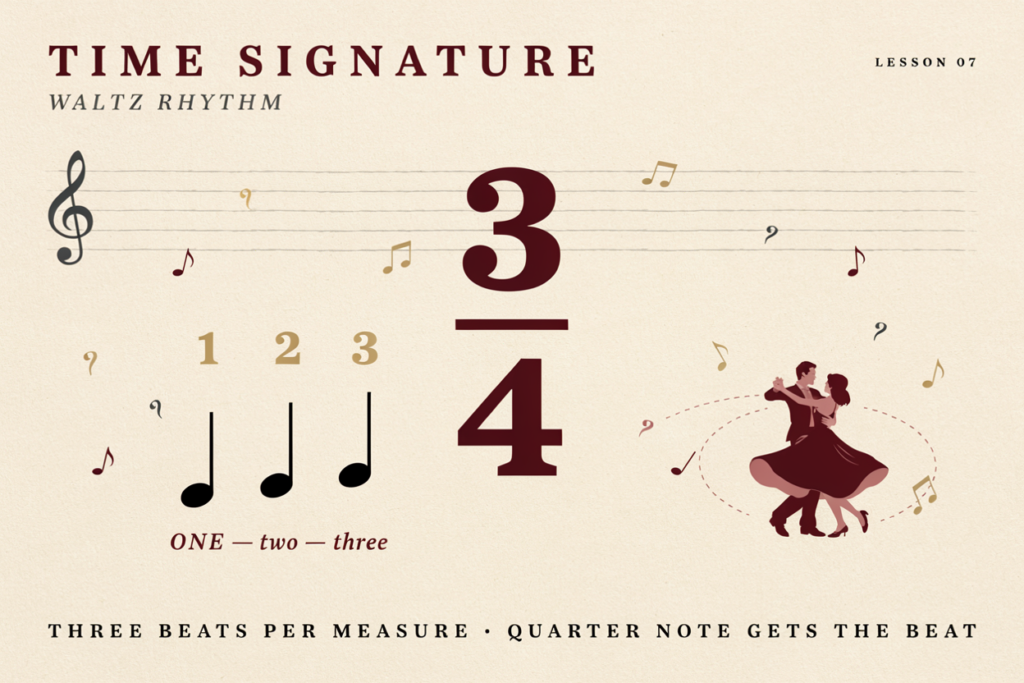
A 3/4 time signature means that each measure contains three quarter-note beats. It is counted 1, 2, 3, usually with a strong first beat followed by two weaker beats, and it is classified as simple triple meter.
The top number shows the beats per measure; the bottom number identifies the quarter note as the beat unit.
What Does the 3/4 Time Signature Mean?
The 3/4 time signature organizes music into groups of three quarter-note beats. Each measure contains the equivalent of three quarter notes before the next bar line appears.
The broader guide to understanding time signatures explains how top and bottom numbers work across other meters.
What Does the Top Number Mean?
The top number is 3, so each measure contains three main beats.
You normally count those beats:
1, 2, 3 | 1, 2, 3
The first beat, the downbeat, usually receives the strongest accent.
What Does the Bottom Number Mean?
The bottom number 4 represents the quarter note, so one quarter note equals one beat.
The bottom number does not tell you the tempo. It only identifies the beat unit.
Why Is 3/4 Called Simple Triple Meter?
The word triple means there are three beats per measure. The word simple means each beat naturally divides into two equal parts.
A quarter-note beat can divide into two eighth notes:
1-and, 2-and, 3-and
How Do You Count 3/4 Time?
Count 3/4 as 1, 2, 3, repeating the pattern at every bar line. Emphasize beat one slightly so the measure has a clear beginning.
A common spoken count is:
ONE, two, three | ONE, two, three
You can practise this with a dedicated 3/4 metronome that accents every third click.
How Do You Count Eighth Notes?
Each quarter-note beat divides into two eighth notes:
1-and, 2-and, 3-and
There are six eighth-note subdivisions, but still only three main beats.
How Do You Count Sixteenth Notes?
Each beat can divide into four sixteenth notes:
1-e-and-a, 2-e-and-a, 3-e-and-a
How Do You Count Triplets?
Triplets divide each quarter-note beat into three equal parts:
1-trip-let, 2-trip-let, 3-trip-let
Triplets do not change the time signature.
What Notes Fit Inside a 3/4 Measure?
Any combination of notes and rests can fit as long as the total duration equals three quarter-note beats.
| Rhythm | Total Duration |
|---|---|
| Three quarter notes | 3 beats |
| One half note + one quarter note | 3 beats |
| One dotted half note | 3 beats |
| Six eighth notes | 3 beats |
| Twelve sixteenth notes | 3 beats |
| Quarter rest + half note | 3 beats |
Can Notes Cross the Beat?
Yes. Notes can be tied across beats or bar lines, but clear notation usually keeps the beat structure visible.
Can a Whole Note Fit in 3/4?
A standard whole note lasts four quarter-note beats, so it is too long for one 3/4 measure. A whole-rest symbol may represent silence for the full measure.
What Does 3/4 Time Sound Like?
3/4 usually sounds like repeating groups of three with the strongest emphasis on beat one:
ONE-two-three | ONE-two-three
What Is the Waltz Pattern?
The waltz is strongly associated with 3/4. A common accompaniment pattern is:
bass-chord-chord
The bass lands on beat one, followed by chords on beats two and three.
Is Every 3/4 Song a Waltz?
No. Waltzes commonly use 3/4, but triple meter also appears in classical music, folk, country, jazz, rock, pop, hymns, and ballads.
A piece becomes a waltz through style and phrasing, not meter alone.
How Is 3/4 Different From 4/4?
3/4 contains three quarter-note beats per measure, while 4/4 contains four.
| Feature | 3/4 | 4/4 |
| Beats per measure | 3 | 4 |
| Usual beat unit | Quarter note | Quarter note |
| Meter type | Simple triple | Simple quadruple |
| Basic count | 1-2-3 | 1-2-3-4 |
| Common accent feel | Strong-weak-weak | Strong-weak-medium-weak |
The guide to 4/4 time explains why four-beat meter feels more square and balanced.
The different grouping changes accents and phrase shape.
How Is 3/4 Different From 6/8?
3/4 usually has three beats divided into twos. 6/8 usually has two beats divided into threes.
| Feature | 3/4 | 6/8 |
| Main beats | 3 | 2 |
| Typical beat unit | Quarter note | Dotted quarter note |
| Subdivision | Two eighth notes per beat | Three eighth notes per beat |
| Basic count | 1-and 2-and 3-and | 1-and-a 2-and-a |
| Meter type | Simple triple | Compound duple |
Both can contain six eighth notes; the difference is grouping and accent.
The guide to 6/8 time provides a deeper comparison of compound meter.
How Can You Hear the Difference?
In 3/4, listen for three main pulses:
ONE-two-three
In 6/8, listen for two broader pulses, each divided into three:
ONE-and-a TWO-and-a
How Do You Play 3/4 Time?
On drums, try a kick on beat one and lighter sounds on beats two and three. On piano or guitar, use bass-chord-chord.
With a standard online metronome, set the time signature to 3/4 or accent every third click. Count aloud before adding notes.
A basic conducting pattern moves down, out, then up.
The guide to using a metronome explains how to practise accurately before increasing speed.
How Can You Recognize 3/4 Time by Ear?
Listen for a strong beat that repeats every three pulses. Count continuously for several measures instead of deciding from one short phrase.
Bass and chord changes may reveal the grouping.
Do not confuse triple meter with triplets. Triplets are rhythmic subdivisions and can appear inside many time signatures.
The guide to rhythm versus tempo helps separate beat grouping from speed.
Does BPM Change the Meaning of 3/4?
No. BPM controls how quickly the beats pass, while 3/4 controls how those beats are grouped.
At ♩ = 60, each quarter-note beat lasts one second, so one 3/4 measure lasts three seconds.
At ♩ = 120, one measure lasts 1.5 seconds.
A 3/4 piece can be slow, moderate, or fast. The guide to what tempo means explains why meter and speed are separate ideas.
Common 3/4 Time Signature Mistakes
Common mistakes include counting four beats, giving every beat equal emphasis, confusing 3/4 with 6/8, and assuming every triple-meter piece is a waltz.
Other errors include ignoring rests, mistaking triplets for triple meter, and overlooking the beat unit.
Frequently Asked Questions
What does 3/4 mean in music?
It means each measure contains three quarter-note beats. The music is normally counted 1, 2, 3.
How many beats are in a 3/4 measure?
There are three main beats in each measure.
Which note receives one beat in 3/4?
The quarter note receives one beat because the bottom number is four.
Is 3/4 time always a waltz?
No. Waltzes commonly use 3/4, but many ballads, hymns, folk songs, classical pieces, and popular songs also use it.
What is the difference between 3/4 and 6/8?
3/4 has three beats divided into twos. 6/8 usually has two beats divided into threes.
Can a whole note fit in a 3/4 measure?
A standard whole note lasts four beats, so it does not fit inside one 3/4 measure. A whole-rest symbol may still represent a full measure of silence.

Olivia Carter is a music technology writer and rhythm analysis specialist at Tempo Finder. She focuses on tempo detection, BPM analysis, beat matching, rhythm tools, and music production workflows for DJs, producers, musicians, and beginners. Olivia creates practical, easy-to-understand content around tempo finding, beat synchronization, metronomes, DJ transitions, and audio timing to help creators improve workflow, accuracy, and musical performance.