
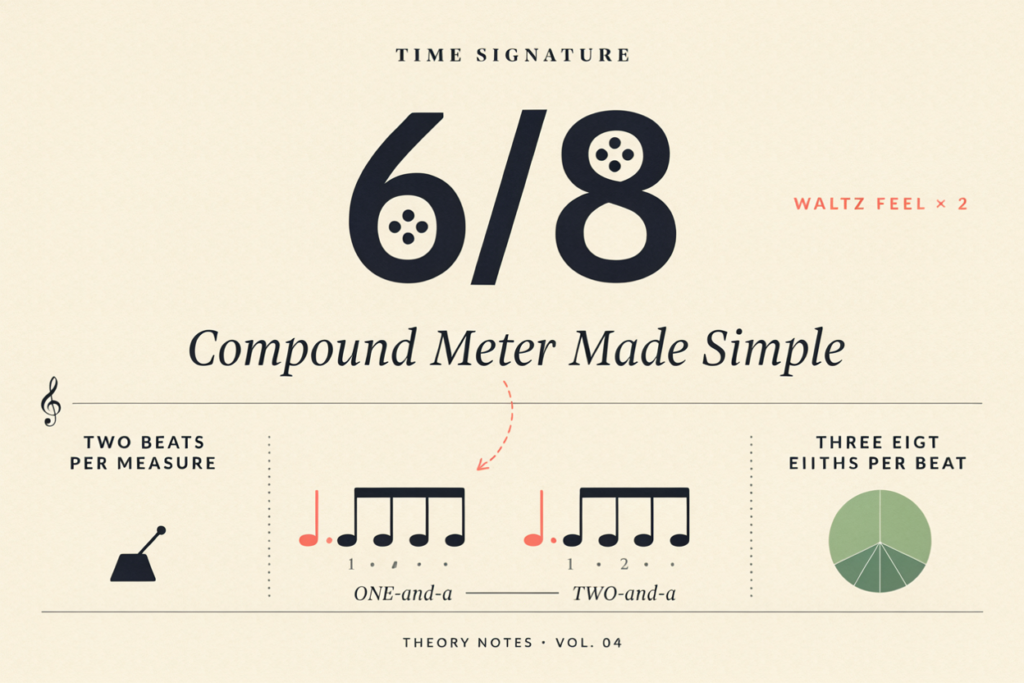
The 6/8 time signature contains six eighth-note subdivisions grouped into two main beats. Each main beat is a dotted quarter note divided into three eighth notes, so musicians commonly count it as “ONE-two-three, FOUR-five-six” or “1-and-a, 2-and-a.”
What Is the 6/8 Time Signature?
The 6/8 time signature is a compound duple meter. “Compound” means each main beat divides into three equal parts, while “duple” means there are two main beats in each measure.
A measure of 6/8 contains six eighth notes, usually felt as two larger pulses. For a broader introduction, see how time signatures work.
What Does the Top Number Mean?
The top number, 6, tells you that each measure contains six eighth-note subdivisions.
It does not mean six equally strong main beats. Standard 6/8 groups them as 3+3.
What Does the Bottom Number Mean?
The bottom number, 8, identifies the eighth note as the written subdivision unit.
In compound meter, the eighth note acts as the subdivision. Three eighth notes form one dotted-quarter beat.
How Many Main Beats Are in 6/8?
There are normally two main beats in each measure of 6/8. Each beat lasts one dotted quarter note.
That creates this structure:
ONE-two-three, FOUR-five-six
Counts one and four mark the two main pulses.
How Do You Count 6/8 Time?
You can count 6/8 by naming all six eighth-note subdivisions or by feeling two larger dotted-quarter beats.
The two most useful counting systems are:
- 1-2-3-4-5-6
- 1-and-a, 2-and-a
Counting All Six Eighth Notes
Count:
ONE-two-three, FOUR-five-six
The strongest accent falls on one. Four begins the second main beat and usually receives a secondary accent.
This helps with slow passages and precise subdivision.
Counting Two Dotted-Quarter Beats
Count:
1-and-a, 2-and-a
The numbers represent the two main beats, while “and-a” completes the three-part subdivision.
This makes the compound-duple structure easier to feel at faster tempos.
When Should You Count in Two or Six?
Count in six for slow or difficult passages and in two when six separate counts feel heavy. Both methods describe the same measure.
How Are Notes Grouped in 6/8?
A measure of 6/8 normally divides into two groups of three eighth notes. The midpoint falls between the third and fourth eighth-note subdivisions.
| Rhythmic Level | Amount per Measure | Duration |
|---|---|---|
| Main beats | 2 | One dotted quarter each |
| Eighth-note subdivisions | 6 | Three per main beat |
| Sixteenth-note subdivisions | 12 | Six per main beat |
| Complete measure | 1 | One dotted half note |
Why the Dotted Quarter Gets the Beat
A dotted quarter equals three eighth notes, so it becomes the natural compound beat.
Two dotted quarters fill one complete measure of 6/8.
How Beaming Shows the Beat Structure
Six consecutive eighth notes should normally be beamed in two groups of three:
1-2-3 | 4-5-6
This makes the two main beats visible. Three groups of two can suggest 3/4.
Common Note Combinations
A dotted quarter fills one beat, as does a quarter note followed by an eighth. Ties and rests should preserve the measure’s midpoint.
What Is the Difference Between 6/8 and 3/4?
Both 6/8 and 3/4 contain the duration of six eighth notes, but they group and accent those notes differently.
6/8 uses two groups of three. 3/4 uses three groups of two.
| Feature | 6/8 | 3/4 |
| Meter type | Compound duple | Simple triple |
| Main beats | 2 | 3 |
| Beat unit | Dotted quarter | Quarter note |
| Beat subdivision | Three eighth notes | Two eighth notes |
| Common grouping | 3+3 | 2+2+2 |
| Typical feeling | Rolling or lilting | Waltz-like or three-step |
For a closer comparison, review the guide to 3/4 time.
Why They Look Mathematically Similar
Both signatures hold the same total duration. The difference is the placement of beats and accents.
How to Hear the Difference
In 6/8, listen for two large pulses:
ONE-two-three, FOUR-five-six
In 3/4, listen for three quarter-note pulses:
ONE-and, TWO-and, THREE-and
The accent pattern often reveals the meter most clearly.
Can Music Switch Between Them?
Yes. A composer or arranger can change the accent pattern so the same six eighth notes are heard as 3+3 or 2+2+2.
This changes the perceived meter without changing the measure length.
How Do You Set a Metronome for 6/8?
A metronome can click once per dotted-quarter beat or once per eighth-note subdivision.
The best setting depends on tempo and practice goal. See how to use a metronome for the general process.
One Click per Main Beat
If the marking says dotted quarter = 70 BPM, set the metronome to 70.
Each click represents one main beat, producing two clicks per measure. Count:
1-and-a, 2-and-a
A 6/8 metronome can make the grouping easier to hear.
One Click per Eighth Note
Beginners may prefer one click per eighth note, producing six clicks per measure.
You should still accent or mentally emphasize clicks one and four.
Converting Between Settings
If dotted quarter = 60 BPM, each main beat contains three eighth notes.
Therefore:
60 × 3 = 180
An eighth-note click at 180 BPM represents the same speed as a dotted-quarter click at 60 BPM. Always check the assigned note value.
How Do You Conduct 6/8 Time?
Standard 6/8 is usually conducted in two.
Beat one moves downward and marks the strongest downbeat. Beat two moves upward or outward and leads back toward the next measure.
Conducting a Slow Passage
At a very slow tempo, a conductor may indicate all six subdivisions for precision.
The underlying grouping should still remain 3+3.
What Does 6/8 Feel Like?
6/8 often feels rolling, rocking, flowing, or lilting because each of its two main beats divides into three.
The usual accent hierarchy is:
STRONG-weak-weak, MEDIUM-weak-weak
This pattern appears in jigs, folk tunes, ballads, gospel, rock, and cinematic music.
6/8 Versus Triplets in 4/4
Both use three-part subdivisions, but their main beats differ.
6/8 has two dotted-quarter beats per measure. A triplet-based 4/4 measure has four quarter-note beats, each divided into three.
As the guide to rhythm and tempo explains, grouping defines the rhythm while BPM controls speed.
How Do You Write Music in 6/8?
Organize the measure around two groups of three eighth notes. Melodies, chords, bass, and drums should reflect that structure.
Keep Beams and Rests Clear
Beam eighth notes in groups of three and avoid hiding the midpoint of the measure. Rests should also show where the second main beat begins.
Use Accents Carefully
Syncopation is allowed, but the underlying two-beat pulse should remain understandable.
Avoid Accidental 3/4 Grouping
Repeated quarter-note accents can divide the measure into three groups of two. That makes the passage feel like 3/4 even if the written signature says 6/8.
Common 6/8 Time Signature Mistakes
A common mistake is calling all six subdivisions main beats. Standard 6/8 is normally felt in two.
Other mistakes include treating it as 3/4, accenting every eighth note equally, hiding the midpoint, and ignoring the metronome’s beat unit.
That final count creates three groups of two, which suggests 3/4 rather than standard 6/8.
Frequently Asked Questions
Does 6/8 have two beats or six beats?
It contains six eighth-note subdivisions but normally has two main beats. Each main beat is a dotted quarter note containing three eighth notes.
Why is 6/8 called compound duple time?
It is compound because each main beat divides into three parts. It is duple because there are two main beats per measure.
What note gets one beat in 6/8?
The dotted quarter note normally receives one main beat. The eighth note is the written subdivision shown by the lower number.
How should beginners count 6/8?
Beginners can count “ONE-two-three, FOUR-five-six.” Once the grouping feels natural, they can use “1-and-a, 2-and-a.”
Is 6/8 the same as 3/4?
No. Both contain six eighth notes, but 6/8 groups them 3+3 while 3/4 groups them 2+2+2.
What BPM should a metronome use for 6/8?
Use the BPM stated in the music and check the assigned note value. If dotted quarter = 60, set one main-beat click to 60 BPM or an eighth-note subdivision click to 180 BPM.

Olivia Carter is a music technology writer and rhythm analysis specialist at Tempo Finder. She focuses on tempo detection, BPM analysis, beat matching, rhythm tools, and music production workflows for DJs, producers, musicians, and beginners. Olivia creates practical, easy-to-understand content around tempo finding, beat synchronization, metronomes, DJ transitions, and audio timing to help creators improve workflow, accuracy, and musical performance.