
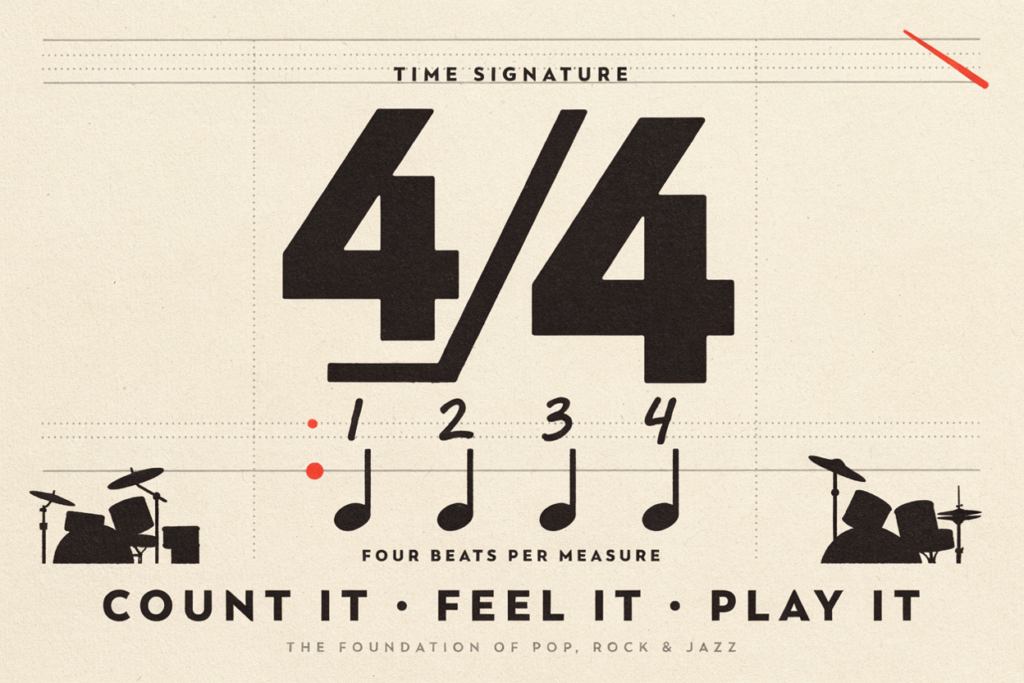
The 4/4 time signature means that each measure contains four quarter-note beats. Musicians usually count it as “1, 2, 3, 4,” with beat one acting as the downbeat before the count repeats in the next measure.
What Is the 4/4 Time Signature?
The 4/4 time signature is a meter with four quarter-note beats in every measure. It is classified as simple quadruple meter because each main beat normally divides into two equal parts, and there are four main beats per bar.
For a broader explanation of meter and beat grouping, see how time signatures work.
What Does the Top Number Mean?
The upper 4 tells you that each measure contains four main beats.
Those beats are counted:
1, 2, 3, 4
After beat four, the next measure begins again on beat one.
What Does the Bottom Number Mean?
The lower 4 identifies the quarter note as the note value receiving one beat.
A quarter note lasts for one beat, a half note lasts for two beats, and a whole note lasts for all four beats in a standard 4/4 measure.
Why Is 4/4 Called Common Time?
4/4 is often called common time because it appears frequently in Western popular, classical, folk, rock, jazz, and electronic music.
It may also be written with a C-shaped common-time symbol instead of the stacked numbers 4/4. The symbol means the same meter.
How Do You Count 4/4 Time?
Count 4/4 as:
ONE, two, three, four
Beat one is usually the strongest beat because it marks the beginning of the measure.
Finding the Downbeat
The downbeat is beat one. It gives the listener and performer a clear sense of where the bar begins.
When practising, listen for one full measure before entering. Count aloud, tap each beat, and begin on the correct number.
Feeling Strong and Weak Beats
A common accent pattern is:
STRONG-weak-medium-weak
Beat one is strongest, beat three may receive secondary emphasis, and beats two and four are often lighter. However, the exact accent pattern changes by style.
In rock, pop, funk, and many dance styles, beats two and four often receive a strong snare hit or clap. This is called the backbeat.
Which Notes Fit in a 4/4 Measure?
Any combination of notes and rests can fit in a 4/4 measure as long as the total duration equals four quarter-note beats.
| Note Value | Duration in Quarter-Note Beats | Maximum per Measure |
|---|---|---|
| Whole note | 4 beats | 1 |
| Half note | 2 beats | 2 |
| Quarter note | 1 beat | 4 |
| Eighth note | 1/2 beat | 8 |
| Sixteenth note | 1/4 beat | 16 |
Whole, Half, and Quarter Notes
Common combinations include:
- One whole note
- Two half notes
- Four quarter notes
- One half note and two quarter notes
- One dotted half note and one quarter note
Every example fills the same four-beat space.
Eighth Notes and Sixteenth Notes
Two eighth notes fit inside one quarter-note beat. Eight eighth notes fill a complete 4/4 measure.
Four sixteenth notes fit inside one quarter-note beat. Sixteen sixteenth notes fill the measure.
Notes and Rests Together
Rests take up measured time just like notes.
For example, a half note, one quarter-note rest, and one quarter note fill all four beats. Silence still counts toward the total duration of the bar.
How Do You Count Subdivisions in 4/4?
Subdivisions divide the four main beats into smaller equal parts without changing the time signature.
The distinction between rhythm and tempo is useful here: rhythm describes the pattern of notes, while tempo controls how quickly the beats pass.
Counting Eighth Notes
Count:
1-and, 2-and, 3-and, 4-and
The numbers fall on the main beats, while each “and” falls halfway between them.
Counting Sixteenth Notes
Count:
1-e-and-a, 2-e-and-a, 3-e-and-a, 4-e-and-a
Each beat divides into four equal parts.
Counting Triplets
Count:
1-trip-let, 2-trip-let, 3-trip-let, 4-trip-let
Triplets divide each quarter-note beat into three equal parts. They do not change 4/4 into 6/8 because the measure still contains four main quarter-note beats.
How Do You Use a Metronome in 4/4?
Set the metronome so each click represents one quarter-note beat. This creates four clicks per measure.
For general practice guidance, review how to use a metronome.
Set One Click per Quarter Note
If quarter note = 80 BPM, set the metronome to 80.
Count:
1, 2, 3, 4
The next click begins the next measure.
A dedicated 4/4 metronome can make the downbeat easier to hear by accenting beat one.
Practise Subdivisions Between Clicks
Play two eighth notes, four sixteenth notes, or three triplet notes between each click.
The clicks should remain steady while the notes are evenly spaced around them.
Use Fewer Clicks
For advanced timing practice, set the metronome to half the original tempo.
At 120 BPM, reducing the click to 60 BPM can make each click represent every second beat. You may hear the clicks as beats one and three or as beats two and four.
What Is the Backbeat in 4/4?
The backbeat is an accent on beats two and four.
In many styles, the kick drum emphasizes beats one and three while the snare emphasizes beats two and four. This creates a familiar groove without changing the 4/4 meter.
Why Different 4/4 Songs Feel Different
Two songs can share the same time signature and still feel completely different.
Groove depends on tempo, syncopation, swing, note length, accents, instrumentation, bass patterns, and drum placement. A slow ballad and a fast dance track can both be in 4/4 while producing very different rhythmic experiences.
How Is 4/4 Different From Other Time Signatures?
The main difference is the number and grouping of beats.
| Time Signature | Main Beats | Usual Beat Unit | Typical Grouping |
| 4/4 | 4 | Quarter note | Four steady beats |
| 2/4 | 2 | Quarter note | Two beats |
| 2/2 | 2 | Half note | Two broad beats |
| 3/4 | 3 | Quarter note | Three beats |
| 6/8 | 2 | Dotted quarter | Two groups of three |
4/4 Versus 3/4
4/4 has four quarter-note beats, while 3/4 has three. The guide to 3/4 time explains the triple-beat structure in more detail.
4/4 Versus 6/8
4/4 usually has four beats divided into two equal subdivisions. 6/8 usually has two larger beats divided into three.
See the guide to 6/8 time for a detailed comparison.
4/4 Versus 2/2
4/4 is normally felt as four quarter-note beats. 2/2, also called cut time, is felt as two half-note beats.
Both may contain the same written duration, but their pulse and conducting pattern differ.
How Is Music Written in 4/4?
Barlines divide the music into complete four-beat measures.
Beam Notes to Show the Beat
Eighth and sixteenth notes should be grouped so the quarter-note pulse remains visible.
Clear beaming helps performers identify where each beat begins.
Keep the Middle of the Measure Readable
The division between beats two and three should not be hidden unnecessarily.
Ties can sustain a note across the midpoint while keeping the beat structure visible.
Use Syncopation Without Losing the Meter
Syncopation emphasizes weak beats or subdivisions.
A note may begin on the “and” of a beat and continue across the next numbered beat. The rhythm feels displaced, but the underlying four-beat measure remains unchanged.
Common 4/4 Time Signature Mistakes
Common mistakes include assuming the two 4s mean the same thing, counting eight eighth notes as eight main beats, forgetting that rests take time, losing beat one, and treating every beat as equally accented.
Another mistake is believing every 4/4 song has the same groove. The meter only defines the beat framework. The actual rhythm, tempo, accents, and arrangement create the musical feel.
Frequently Asked Questions
What does 4/4 mean in music?
It means each measure contains four quarter-note beats. The upper 4 gives the number of beats, while the lower 4 identifies the quarter note as the beat unit.
How many beats are in a 4/4 measure?
There are four main beats in each measure. Musicians count them as 1, 2, 3, 4.
What note receives one beat in 4/4?
The quarter note receives one beat. A half note receives two beats, while a whole note receives four.
Why is 4/4 called common time?
It is called common time because it is common across many styles of Western music.
Is the C symbol the same as 4/4?
Yes. The common-time C symbol represents the same meter as 4/4.
What is the difference between 4/4 and 2/2?
4/4 is normally felt as four quarter-note beats, while 2/2 is felt as two half-note beats. They may contain the same total duration but organize the pulse differently.

Olivia Carter is a music technology writer and rhythm analysis specialist at Tempo Finder. She focuses on tempo detection, BPM analysis, beat matching, rhythm tools, and music production workflows for DJs, producers, musicians, and beginners. Olivia creates practical, easy-to-understand content around tempo finding, beat synchronization, metronomes, DJ transitions, and audio timing to help creators improve workflow, accuracy, and musical performance.